
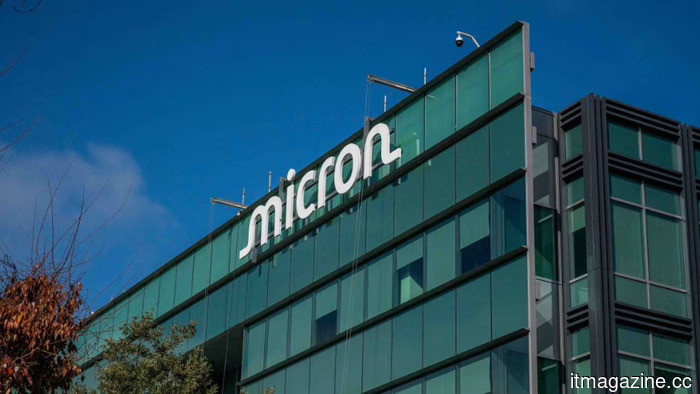
Micron nears $1 trillion as UBS identifies a route to $1.8 trillion within a year.
Timothy Arcuri raised his price target for Micron Technology from $535 to $1,625, attributing this increase to long-term HBM supply agreements that, in his view, transform the cyclical memory market into a more stable structural duopoly. As a result, Micron's shares surged nearly 19% on Tuesday, following Arcuri's more than tripling of his price target, which indicates a potential market valuation near $1.8 trillion if this forecast holds true over the coming year.
This new price target is the highest among the 46 analysts tracking the stock and marks one of the most extreme single-day re-evaluations of a well-established semiconductor firm on record. The rationale for Arcuri’s prediction delves deeper than just the number itself. UBS’s argument is not solely based on the belief that AI demand will continually drive memory prices upward, which is a typical cyclical argument. Instead, UBS contends that long-term agreements between memory manufacturers and their largest clients, especially the hyperscalers and Nvidia, now encompass a substantial portion of the market, thereby smoothing out the traditional boom-bust memory cycle into a more predictable utility-style earnings model.
UBS estimates that approximately 30% of global DDR memory volumes are already linked to pricing agreements that are set slightly below current spot prices, offering some short-term upside in exchange for longer-term visibility. If this trend continues, Micron may begin to resemble less of a cyclical commodity producer and more of a steady income generator in AI infrastructure. UBS predicts that Micron's earnings per share will surpass $100 annually through at least 2029. Given current valuations, this projection is sufficient to support a market capitalization closer to $1.8 trillion, rather than the roughly $1 trillion at which the company is currently trading; reaching a trillion-dollar valuation seemed unfathomable just a year ago.
The situation surrounding HBM is more complex than the headline indicates. SK Hynix has significantly benefited during this cycle, currently holding about 70% of HBM4 supply for Nvidia’s prominent Vera Rubin platform, with Samsung acquiring most of the remaining share. Micron was initially excluded from supplying the flagship VR200 NVL72 configuration but has since secured a role in the HBM4 supply for the Rubin CPX, a mid-range inference-focused accelerator within the Rubin portfolio, and commenced volume shipments of its 36GB 12H HBM4 stacks earlier this quarter.
UBS’s thesis essentially suggests that Micron will progressively move into the higher-end HBM4 supply tier during the next 18 months, as SK Hynix and Samsung face challenges in scaling up fast enough to meet demand. The competitive landscape deserves attention; SK Hynix reached a market capitalization of over $1 trillion on Wednesday in Seoul and currently commands about 57% of the global HBM market share. Samsung holds roughly 28%, while Micron has maintained a smaller presence. UBS’s hypothesis implies that the smaller player may benefit disproportionately as the market grows since customers are seeking a third supplier for risk diversification, even if the pricing for that third option is lower than that of the leading supplier.
While the thesis is credible, it is not guaranteed; it relies on Nvidia’s Rubin order book actually utilizing the forecasted HBM volume and assumes that SK Hynix does not capture the entire upside. The wider memory market also reacted alongside Micron on Tuesday, with SanDisk increasing by 8% and Western Digital by 10%, reflecting the notion that long-term agreements are extending into NAND and traditional storage as well. The trend UBS describes, if valid, suggests a fundamental shift rather than merely a singular stock event.
Micron is expected to release its next earnings report at the end of June. Investors should closely monitor the capacity utilization guidance and any announced expansion of its Nvidia HBM4 footprint in light of the new UBS price target.
Other articles
 Taiwan believes that NVIDIA chips were illicitly transported to China through a transshipping route in Japan.
Taiwanese prosecutors believe that at least one shipment of Nvidia AI chips, which are restricted by the US, was illegally transported to China through Japan, marking Taiwan's first publicly reported case of AI-chip diversion.
Taiwan believes that NVIDIA chips were illicitly transported to China through a transshipping route in Japan.
Taiwanese prosecutors believe that at least one shipment of Nvidia AI chips, which are restricted by the US, was illegally transported to China through Japan, marking Taiwan's first publicly reported case of AI-chip diversion.
 Airbnb spearheads a $58 million Series C funding round for WeRoad and appoints its CEO to oversee hotel operations.
The Milan-based adventure travel platform WeRoad has secured $58 million in a Series C funding round, led by Airbnb, which acquired a 10% share and appointed CEO Andrea D’Amico to manage its hotels division.
Airbnb spearheads a $58 million Series C funding round for WeRoad and appoints its CEO to oversee hotel operations.
The Milan-based adventure travel platform WeRoad has secured $58 million in a Series C funding round, led by Airbnb, which acquired a 10% share and appointed CEO Andrea D’Amico to manage its hotels division.
 China's market regulator has imposed fines on Luxshare and Wingtech for their deal termination.
China's SAMR has imposed fines on Luxshare and Wingtech due to procedural breaches in their failed asset transaction, indicating stricter enforcement of merger regulations.
China's market regulator has imposed fines on Luxshare and Wingtech for their deal termination.
China's SAMR has imposed fines on Luxshare and Wingtech due to procedural breaches in their failed asset transaction, indicating stricter enforcement of merger regulations.
 The Samsung Pay agreement marked a pivotal moment for Korean unions.
Samsung's formula for a 10.5% profit bonus resolves its labor conflict and sets a standard that other companies in the Korean chaebol system will likely use as a benchmark.
The Samsung Pay agreement marked a pivotal moment for Korean unions.
Samsung's formula for a 10.5% profit bonus resolves its labor conflict and sets a standard that other companies in the Korean chaebol system will likely use as a benchmark.
 The ASIC agreement between Qualcomm and ByteDance is structured to navigate US export restrictions intentionally.
Qualcomm has established an agreement with ByteDance, the parent company of TikTok, for the supply and manufacturing of AI chips, aimed at remaining compliant with US export-control limits.
The ASIC agreement between Qualcomm and ByteDance is structured to navigate US export restrictions intentionally.
Qualcomm has established an agreement with ByteDance, the parent company of TikTok, for the supply and manufacturing of AI chips, aimed at remaining compliant with US export-control limits.
 China's market regulator has imposed fines on Luxshare and Wingtech for their deal unwinding.
China's SAMR has imposed fines on Luxshare and Wingtech due to procedural infringements related to their failed asset deal, indicating stricter enforcement of merger regulations.
China's market regulator has imposed fines on Luxshare and Wingtech for their deal unwinding.
China's SAMR has imposed fines on Luxshare and Wingtech due to procedural infringements related to their failed asset deal, indicating stricter enforcement of merger regulations.
Micron nears $1 trillion as UBS identifies a route to $1.8 trillion within a year.
UBS analyst Timothy Arcuri increased his price target for Micron to $1,625 on Tuesday, suggesting a valuation of $1.8 trillion, based on the premise that long-term HBM agreements will shorten the memory cycle.