
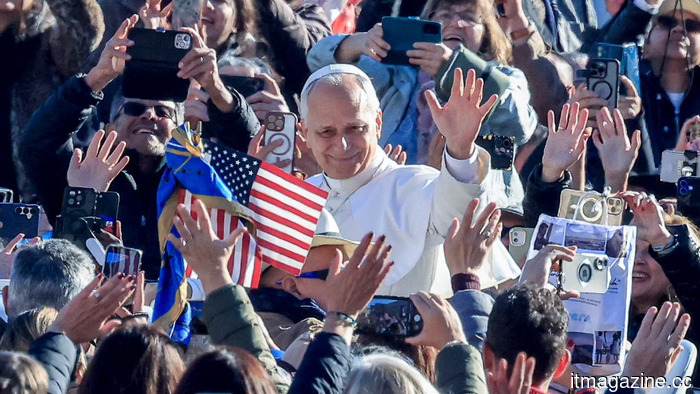
Pope Leo’s initial encyclical is viewed as addressing technology regulation as well as theological matters.
In the 24 hours following Pope Leo XIV's release of his first encyclical, Magnifica Humanitas, an unusual event has occurred: a papal document is being taken seriously by financial and policy leaders as a piece of technology regulation rather than merely a theological statement.
The text addresses directly the governments, parliaments, and executives of major AI companies, employing a tone that the Holy See seldom uses concerning a single commercial technology. The encyclical identifies artificial intelligence as the industrial revolution of the current generation, arguing that without enforceable constraints, it will exacerbate inequality, diminish human agency, and centralize power among a small number of corporations.
Pope Leo advocates for “robust legal frameworks, independent oversight, informed users, and a political system that does not relinquish its responsibilities.” He specifically urges states to “disarm AI,” meaning, as per the encyclical’s definition, to remove the technology from purely military and economic interests and place it within structures aimed at safeguarding the common good.
The Vatican's characterization of AI as a risk for power concentration has drawn significant attention in policy circles. Leo notes that the concern is not just that an individual engaging with an AI might mistake it for a human, but that over time they may lose the motivation to connect with other people entirely.
The encyclical highlights the effects of synthetic content on children and democratic discourse and points out the limited number of companies currently establishing global AI standards as a concern in itself.
The document's release on Monday was notable for a papal text because it included a public dialogue with Christopher Olah, co-founder of Anthropic, who utilized the Vatican platform to argue that AI cannot be managed solely by AI laboratories.
The selection of Olah as a discussion partner was considered intentional: Anthropic has been advocating for external oversight of advanced AI models for the past two years, and Pope Leo's choice to feature them within the Vatican's framework positioned the encyclical within a specific avenue of the ongoing AI policy debate, rather than opposing it entirely.
The encyclical builds upon a stance Leo has been developing since his election. During his initial papal visit to La Sapienza University in Rome earlier this year, he condemned AI-enabled warfare and European rearmament using notably direct language. Magnifica Humanitas solidifies this position.
It also formally replaces the earlier Vatican “Rome Call for AI Ethics,” which had faced criticism, including in our own coverage, for lacking enforceable measures.
What the encyclical actually changes is less clear. Papal documents do not possess legal authority beyond the Catholic Church, and the AI policy debate in Brussels, Washington, and Beijing was already quite vigorous prior to this one. However, Leo’s document provides a moral framework for legislators and regulators who have been searching for such guidance, and the Vatican's diplomatic influence in governments beyond the reach of the EU AI Act—including parts of Latin America, sub-Saharan Africa, and South Asia—should not be underestimated.
The European Commission expressed its support for the encyclical on Monday evening; OpenAI, Google, and Microsoft publicly acknowledged it; and Anthropic, via Olah, had already made their stance known.
The next public test will be whether the Vatican translates the encyclical into concrete positions during the UN’s General Assembly discussions on AI in September. The Pope has indicated he plans to do so.
Other articles
 Wall Street is offering $25,000 daily to AI trainers who were previously employed there.
Felipe Sinisterra and Dave Wang are charging $25,000 per day to train Wall Street banks on AI tools that they have already purchased. They are fully booked for the next two months.
Wall Street is offering $25,000 daily to AI trainers who were previously employed there.
Felipe Sinisterra and Dave Wang are charging $25,000 per day to train Wall Street banks on AI tools that they have already purchased. They are fully booked for the next two months.
 Honeywell's Quantinuum has established a $12.7 billion target for its IPO following initial expectations of $20 billion.
Quantinuum, the quantum-computing company primarily owned by Honeywell, is aiming for an IPO valuation of $12.7 billion, significantly lower than the more than $20 billion estimates circulating earlier this month.
Honeywell's Quantinuum has established a $12.7 billion target for its IPO following initial expectations of $20 billion.
Quantinuum, the quantum-computing company primarily owned by Honeywell, is aiming for an IPO valuation of $12.7 billion, significantly lower than the more than $20 billion estimates circulating earlier this month.
 Wall Street is offering $25,000 daily for AI trainers who previously worked in the industry.
Felipe Sinisterra and Dave Wang are charging $25,000 per day to educate Wall Street banks on AI tools they have already acquired. Their schedule is fully booked for two months.
Wall Street is offering $25,000 daily for AI trainers who previously worked in the industry.
Felipe Sinisterra and Dave Wang are charging $25,000 per day to educate Wall Street banks on AI tools they have already acquired. Their schedule is fully booked for two months.
 Spotify is experimenting with narrated magazine articles within its audiobook section.
Spotify is experimenting with 650 narrated long-form articles from publications like The Atlantic, WIRED, and Vogue within its audiobook section, signaling a subtle reemergence of journalism.
Spotify is experimenting with narrated magazine articles within its audiobook section.
Spotify is experimenting with 650 narrated long-form articles from publications like The Atlantic, WIRED, and Vogue within its audiobook section, signaling a subtle reemergence of journalism.
 Spotify is experimenting with narrated magazine articles within its audiobook subscription tier.
Spotify is experimenting with 650 narrated long-form articles from publications like The Atlantic, WIRED, Vogue, and others within the audiobook section, signaling a subtle revival of journalism.
Spotify is experimenting with narrated magazine articles within its audiobook subscription tier.
Spotify is experimenting with 650 narrated long-form articles from publications like The Atlantic, WIRED, Vogue, and others within the audiobook section, signaling a subtle revival of journalism.
 BNP Paribas collaborates with Mistral to provide a European solution to Anthropic's Mythos.
According to Bloomberg, BNP Paribas is assisting Mistral in developing a European sovereign alternative to Anthropic's limited Mythos cybersecurity AI.
BNP Paribas collaborates with Mistral to provide a European solution to Anthropic's Mythos.
According to Bloomberg, BNP Paribas is assisting Mistral in developing a European sovereign alternative to Anthropic's limited Mythos cybersecurity AI.
Pope Leo’s initial encyclical is viewed as addressing technology regulation as well as theological matters.
The day following the release of Magnifica Humanitas by Pope Leo XIV, his AI encyclical is being examined in policy centers as the most straightforward papal intervention in technology in many years.