
Data from CAICT indicates that shipments of foreign-brand phones to China increased by 1.8% in April.
Shipments of foreign-branded smartphones to China, primarily led by Apple, increased by 1.8% year-over-year in April, reaching 3.59 million units, according to calculations from Reuters based on data from the China Academy of Information and Communications Technology (CAICT), which tracks domestic handset shipments. This figure indicates a significant slowdown; in the first quarter, foreign-brand shipments to China experienced much higher growth, with CAICT data suggesting an approximate 52% year-over-year increase for that period. Counterpoint Research noted that iPhone shipments specifically rose to 13.1 million units in Q1, compared to 9.2 million the previous year, reflecting a rise of about 42%. Therefore, April's 1.8% increase marks the first month since late 2025 where the foreign-brand category has nearly plateaued.
The CAICT data does not provide breakdowns by individual brands. Apple remains the dominant foreign brand in the Chinese smartphone sector, and analysts often interpret the foreign-brand data as a somewhat useful, albeit imperfect, indicator of iPhone sales. Other foreign brands, including Samsung, Sony, and several niche players, make up the remainder of the foreign-brand category.
Overall, the Chinese smartphone market is no longer expanding, with total shipments declining by 3.3% in the first quarter to roughly 69 million units, according to IDC. Huawei reclaimed the top position for the first time in five years, while Apple retained the second spot. These two companies contributed to almost all of the limited growth in the premium segment during the quarter, with Huawei’s Mate 80 series and foldable Pura X performing well alongside Apple’s iPhone 17 lineup. In contrast, Xiaomi saw a significant decline in shipments, dropping by 35%.
The slowdown for foreign brands in April can be attributed to several potential factors. Analysts from Counterpoint and other trackers have cited Apple’s relative pricing advantage amid rising memory chip costs, allowing iPhones to avoid the widespread price increases that affected Xiaomi and Oppo. This pricing edge led to concentrated demand in earlier quarters as consumers made early purchases. Additionally, April marks the beginning of a seasonal downturn before the September iPhone upgrade, a period during which year-over-year comparisons tend to narrow regardless of actual demand.
In March, the total Chinese mobile handset market shipped 21.15 million units, a 7.1% year-over-year decline but a 26% increase from the previous month, with domestic brands representing 84% of shipments and foreign brands accounting for the rest. The 3.59 million foreign-brand units shipped in April indicates that this share distribution remains relatively stable.
This slowdown arrives at a challenging time for Apple. Over the past two years, the company has been working to stabilize its business in China following a steep decline in 2024, and Q1 2026 numbers from both IDC and Counterpoint suggested that the recovery was genuine. The critical question moving forward is whether April's performance is merely a weak month or the beginning of a sustained period of stagnation; the next two CAICT reports will provide clarity. The numbers for May and June, expected in late June and late July, respectively, will reveal whether the Q1 surge was a temporary pull-forward or a sign of structural recovery.
In November 2025, foreign-brand shipments had more than doubled year-over-year according to the same CAICT metrics, creating a notably strong base effect that will continue to impact year-on-year comparisons for the rest of 2026.
Other articles
 Samsung's OLED technology provides the Ferrari Luce with a dashboard that is unprecedented in any vehicle.
Samsung Display is uniquely supplying the interior of the Ferrari Luce with four OLED panels, featuring a one-of-a-kind layered display that incorporates real mechanical clock hands.
Samsung's OLED technology provides the Ferrari Luce with a dashboard that is unprecedented in any vehicle.
Samsung Display is uniquely supplying the interior of the Ferrari Luce with four OLED panels, featuring a one-of-a-kind layered display that incorporates real mechanical clock hands.
 Spain halts Polymarket and Kalshi due to lack of gambling licenses.
Spain has temporarily halted the operations of Polymarket and Kalshi for lacking a gambling license, participating in an increasing European effort to regulate US prediction markets.
Spain halts Polymarket and Kalshi due to lack of gambling licenses.
Spain has temporarily halted the operations of Polymarket and Kalshi for lacking a gambling license, participating in an increasing European effort to regulate US prediction markets.
 Apple AirPods Pro 3 review: Eight months in, still a solid choice that continues to impress.
With the AirPods Pro 3, Apple aimed to establish a new standard. The company came close to achieving that goal, while also achieving some surprising successes on the journey.
Apple AirPods Pro 3 review: Eight months in, still a solid choice that continues to impress.
With the AirPods Pro 3, Apple aimed to establish a new standard. The company came close to achieving that goal, while also achieving some surprising successes on the journey.
 Xiaomi’s 240Hz gaming monitor features a Night Vision trick for intense gaming sessions.
The Xiaomi Gaming Monitor G25i 2026 is a 24.5-inch Full HD esports screen featuring a 240Hz refresh rate, 1ms GTG response time, FreeSync Premium support, and an integrated Night Vision mode.
Xiaomi’s 240Hz gaming monitor features a Night Vision trick for intense gaming sessions.
The Xiaomi Gaming Monitor G25i 2026 is a 24.5-inch Full HD esports screen featuring a 240Hz refresh rate, 1ms GTG response time, FreeSync Premium support, and an integrated Night Vision mode.
 Ferrari's inaugural electric vehicle has arrived, and the Luce could be the brand's most divisive model to date.
Ferrari has introduced the Luce, its inaugural fully electric vehicle, boasting 1,050HP, cutting-edge design, sophisticated aerodynamics, and a look that is already splitting opinions among fans.
Ferrari's inaugural electric vehicle has arrived, and the Luce could be the brand's most divisive model to date.
Ferrari has introduced the Luce, its inaugural fully electric vehicle, boasting 1,050HP, cutting-edge design, sophisticated aerodynamics, and a look that is already splitting opinions among fans.
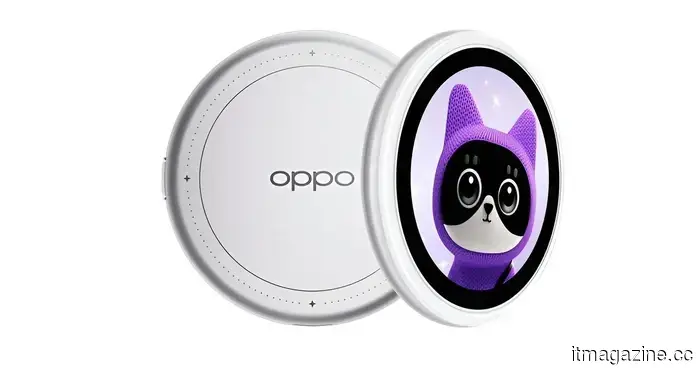 Oppo's Bubble is the entertaining MagSafe accessory that Apple continues to ignore.
Oppo Bubble is a circular magnetic display designed to attach to compatible Oppo smartphones, allowing for selfie previews, wallpapers, and remote photography.
Oppo's Bubble is the entertaining MagSafe accessory that Apple continues to ignore.
Oppo Bubble is a circular magnetic display designed to attach to compatible Oppo smartphones, allowing for selfie previews, wallpapers, and remote photography.
Data from CAICT indicates that shipments of foreign-brand phones to China increased by 1.8% in April.
Shipments of foreign-brand smartphones to China increased by 1.8% year-on-year in April, reaching 3.59 million units. This marks a significant slowdown following a first quarter where iPhone sales surged over 40%.