

According to data from CAICT, shipments of foreign-brand phones to China increased by 1.8% in April.
Shipments of foreign-branded smartphones to China, predominantly led by Apple, increased by 1.8% year-on-year in April, reaching 3.59 million units, as per calculations by Reuters based on data from the China Academy of Information and Communications Technology, the government-affiliated organization monitoring domestic handset shipments.
This figure indicates a noticeable slowdown, as foreign-brand shipments had experienced much more rapid growth in the first quarter, with one interpretation of the CAICT data suggesting year-on-year growth of about 52% for that period. Counterpoint Research also noted that iPhone shipments specifically reached 13.1 million units in Q1, a rise from 9.2 million the previous year, marking an increase of approximately 42%. Consequently, April's 1.8% growth is the first instance since late 2025 where shipments in the foreign-brand category have remained nearly flat.
The CAICT data does not provide details for individual brands. Apple is significantly the largest foreign brand within the Chinese smartphone sector, and analysts often use the foreign-brand total as an imperfect indicator for iPhone shipments. Other brands like Samsung, Sony, and a few niche players account for the remainder of this category.
The overall Chinese smartphone market is no longer experiencing growth, with total shipments declining by 3.3% in the first quarter to about 69 million units, according to IDC. In this period, Huawei regained the top position for the first time in five years, with Apple taking second place. The two companies largely contributed to the minimal premium-segment growth during this quarter, driven by Huawei's Mate 80 series and the foldable Pura X, alongside Apple's iPhone 17 line. In contrast, Xiaomi's shipments plummeted by 35% during the same timeframe.
The slowdown in April for foreign brands can be attributed to several likely factors. Trackers like Counterpoint have highlighted Apple's relative pricing advantage amid rising memory chip costs, as iPhones have avoided the broad price increases experienced by Xiaomi and Oppo. This pricing advantage has potentially shifted demand to earlier quarters as consumers made purchases sooner. Additionally, April signifies the beginning of a seasonal lull preceding the September iPhone refresh, a period typically marked by compressed year-on-year comparisons, regardless of actual demand.
In March, the total Chinese mobile handset market shipped 21.15 million units, down 7.1% year-on-year but up 26% month-on-month, with domestic brands representing 84% of shipments and foreign brands making up the remainder. The 3.59 million units of foreign-brand shipments in April indicates a generally stable share distribution.
This slowdown comes at a challenging time for Apple. The company has invested the last two years into stabilizing its business in China following a significant contraction in 2024, and Q1 2026 data from both IDC and Counterpoint had suggested real signs of recovery.
The critical question that the subsequent CAICT reports will address is whether April represents an isolated weak month or if it marks the beginning of a more prolonged stabilization trend. The figures for May and June, expected in late June and late July respectively, will reveal whether the Q1 upswing was merely a one-time occurrence or a sign of a structural rebound. In November 2025, foreign-brand shipments had more than doubled year-on-year according to the same CAICT metrics, creating an unusually strong base effect that will continue to skew year-on-year comparisons throughout the rest of 2026.
Other articles
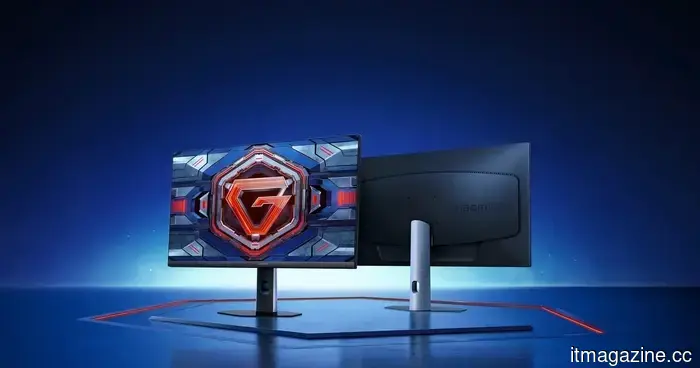 Xiaomi's 240Hz gaming monitor features a Night Vision mode for intense gaming sessions.
The Xiaomi Gaming Monitor G25i 2026 features a 24.5-inch Full HD esports screen, a 240Hz refresh rate, a 1ms GTG response time, FreeSync Premium support, and includes a Night Vision mode.
Xiaomi's 240Hz gaming monitor features a Night Vision mode for intense gaming sessions.
The Xiaomi Gaming Monitor G25i 2026 features a 24.5-inch Full HD esports screen, a 240Hz refresh rate, a 1ms GTG response time, FreeSync Premium support, and includes a Night Vision mode.
 Spotify is experimenting with narrated magazine articles within its audiobook section.
Spotify is experimenting with 650 narrated long-form articles from publications like The Atlantic, WIRED, and Vogue within its audiobook section, signaling a subtle reemergence of journalism.
Spotify is experimenting with narrated magazine articles within its audiobook section.
Spotify is experimenting with 650 narrated long-form articles from publications like The Atlantic, WIRED, and Vogue within its audiobook section, signaling a subtle reemergence of journalism.
 Ferrari's first electric vehicle has arrived, and the Luce could be the brand's most contentious model to date.
Ferrari has introduced the Luce, its inaugural fully electric vehicle, boasting 1,050 horsepower, a futuristic design, advanced aerodynamics, and a look that is already splitting opinions among fans.
Ferrari's first electric vehicle has arrived, and the Luce could be the brand's most contentious model to date.
Ferrari has introduced the Luce, its inaugural fully electric vehicle, boasting 1,050 horsepower, a futuristic design, advanced aerodynamics, and a look that is already splitting opinions among fans.
 Wall Street is offering $25,000 daily to AI trainers who were previously employed there.
Felipe Sinisterra and Dave Wang are charging $25,000 per day to train Wall Street banks on AI tools that they have already purchased. They are fully booked for the next two months.
Wall Street is offering $25,000 daily to AI trainers who were previously employed there.
Felipe Sinisterra and Dave Wang are charging $25,000 per day to train Wall Street banks on AI tools that they have already purchased. They are fully booked for the next two months.
 SPARQ has launched an $8.5 million seed funding round for its AI-native game engine, with a16z's scout fund included in the capitalization table.
SPARQ, based in the UAE, has launched an $8.5 million seed funding round for its AI-focused game engine, with early involvement from the a16z Scout Fund.
SPARQ has launched an $8.5 million seed funding round for its AI-native game engine, with a16z's scout fund included in the capitalization table.
SPARQ, based in the UAE, has launched an $8.5 million seed funding round for its AI-focused game engine, with early involvement from the a16z Scout Fund.
 SPARQ has launched an $8.5 million seed round for its AI-driven game engine, featuring a16z’s scout fund as part of its investor lineup.
UAE-based SPARQ has launched an $8.5 million seed round for its AI-driven game engine, with early participation from the a16z Scout Fund.
SPARQ has launched an $8.5 million seed round for its AI-driven game engine, featuring a16z’s scout fund as part of its investor lineup.
UAE-based SPARQ has launched an $8.5 million seed round for its AI-driven game engine, with early participation from the a16z Scout Fund.
According to data from CAICT, shipments of foreign-brand phones to China increased by 1.8% in April.
Shipments of foreign-brand smartphones to China increased by 1.8% year-on-year in April, totaling 3.59 million units, marking a significant deceleration following a first quarter where iPhone sales surged over 40%.