

Spain halts Polymarket and Kalshi due to lack of gambling licenses.
Spain's gambling authority has suspended the US-based prediction markets Polymarket and Kalshi for operating without a gambling license, marking the nation as the latest European jurisdiction to classify prediction markets as unlicensed betting. An order published in the Spanish state gazette by the Consumer Rights Ministry, which oversees gambling regulations, announced a three- to four-month suspension while an investigation is conducted.
The ministry has initiated a formal inquiry into both companies for allegedly violating Spanish regulations that require online operators offering monetary wagers on uncertain outcomes to possess administrative authorization. The suspension will likely remain in effect for three to four months during the investigation.
The order points out the lack of the necessary technical and consumer protections that licensed operators must provide, such as identity verification and access restrictions aimed at preventing minors from using the platforms.
Spain’s decision adds to an expanding list of European jurisdictions treating prediction markets as a form of gambling. France’s national gaming authority blocked Polymarket in late 2024, deeming its operations unlicensed gambling. In the same year, Belgium, Poland, and Italy also imposed bans on prediction markets.
The Dutch gambling regulator KSA warned Polymarket that it could face fines of €420,000 per week if it continued to serve Dutch users without a license, representing the largest enforcement threat from a European regulator to date.
There is currently no unified EU framework governing event contracts; each member state implements its own gambling or financial regulations. The action in Spain coincides with a coordinated global crackdown. India’s electronics and IT ministry issued a formal blocking order against Polymarket on May 21, directing internet service providers to block access at the network level, and a similar order for Kalshi is reportedly in preparation.
India recently reclassified prediction markets as “money games” under new online gaming regulations that came into effect on May 1. Additionally, Brazil and Indonesia have implemented bans in recent weeks. The Spanish suspension represents the third enforcement action at the European level in 2026, following a ramp-up in the Netherlands in February and a referral from Belgium in March.
Polymarket and Kalshi are at the heart of a rapidly growing sector. Together, the two platforms processed several billion dollars in trading volume during the 2024 US presidential election and have been expanding into areas such as sports, geopolitics, and corporate-event contracts.
Economist Robin Hanson, who has developed much of the theoretical framework for prediction markets, has recently argued that these platforms are largely functioning as intended, despite both companies moving to prohibit insider-style trading on news generated by the parties involved in the betting.
The legal landscape in Europe continues to diverge sharply from that in the US. Kalshi operates as a CFTC-regulated event-contracts venue in the US and has successfully positioned itself as a financial market rather than a gambling service. In contrast, European regulators have shown little interest in making that distinction.
The Spanish ministry's stance essentially holds that any wager on an uncertain future outcome constitutes gambling, irrespective of the underlying structure. This rationale aligns with the reasoning now echoed across cities like Paris, Brussels, Warsaw, Rome, and The Hague.
As of the time of publication, neither Polymarket nor Kalshi had publicly responded. The Spanish investigation is set to conclude by late summer.
Other articles
 Data from CAICT indicates that shipments of foreign-brand phones to China increased by 1.8% in April.
Shipments of foreign-brand smartphones to China increased by 1.8% year-on-year in April, reaching 3.59 million units. This marks a significant slowdown following a first quarter where iPhone sales surged over 40%.
Data from CAICT indicates that shipments of foreign-brand phones to China increased by 1.8% in April.
Shipments of foreign-brand smartphones to China increased by 1.8% year-on-year in April, reaching 3.59 million units. This marks a significant slowdown following a first quarter where iPhone sales surged over 40%.
 Wall Street is offering $25,000 daily for AI trainers who previously worked in the industry.
Felipe Sinisterra and Dave Wang are charging $25,000 per day to educate Wall Street banks on AI tools they have already acquired. Their schedule is fully booked for two months.
Wall Street is offering $25,000 daily for AI trainers who previously worked in the industry.
Felipe Sinisterra and Dave Wang are charging $25,000 per day to educate Wall Street banks on AI tools they have already acquired. Their schedule is fully booked for two months.
 Ferrari's inaugural electric vehicle has arrived, and the Luce could be the brand's most contentious model to date.
Ferrari has introduced the Luce, its inaugural all-electric vehicle, boasting 1,050HP, a futuristic aesthetic, cutting-edge aerodynamics, and a design that is already splitting opinions among enthusiasts.
Ferrari's inaugural electric vehicle has arrived, and the Luce could be the brand's most contentious model to date.
Ferrari has introduced the Luce, its inaugural all-electric vehicle, boasting 1,050HP, a futuristic aesthetic, cutting-edge aerodynamics, and a design that is already splitting opinions among enthusiasts.
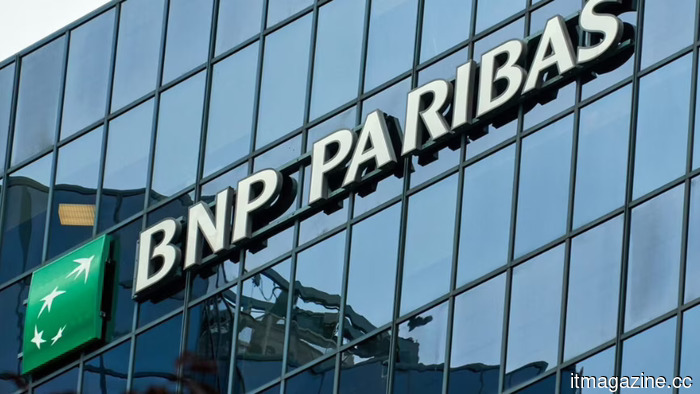 BNP Paribas collaborates with Mistral to provide a European solution to Anthropic's Mythos.
According to Bloomberg, BNP Paribas is assisting Mistral in developing a European sovereign alternative to Anthropic's limited Mythos cybersecurity AI.
BNP Paribas collaborates with Mistral to provide a European solution to Anthropic's Mythos.
According to Bloomberg, BNP Paribas is assisting Mistral in developing a European sovereign alternative to Anthropic's limited Mythos cybersecurity AI.
 Wall Street is offering $25,000 daily to AI trainers who were previously employed there.
Felipe Sinisterra and Dave Wang are charging $25,000 per day to train Wall Street banks on AI tools that they have already purchased. They are fully booked for the next two months.
Wall Street is offering $25,000 daily to AI trainers who were previously employed there.
Felipe Sinisterra and Dave Wang are charging $25,000 per day to train Wall Street banks on AI tools that they have already purchased. They are fully booked for the next two months.
 Apple AirPods Pro 3 review: Eight months in, still a solid choice that continues to impress.
With the AirPods Pro 3, Apple aimed to establish a new standard. The company came close to achieving that goal, while also achieving some surprising successes on the journey.
Apple AirPods Pro 3 review: Eight months in, still a solid choice that continues to impress.
With the AirPods Pro 3, Apple aimed to establish a new standard. The company came close to achieving that goal, while also achieving some surprising successes on the journey.
Spain halts Polymarket and Kalshi due to lack of gambling licenses.
Spain has temporarily halted the operations of Polymarket and Kalshi for lacking a gambling license, participating in an increasing European effort to regulate US prediction markets.