
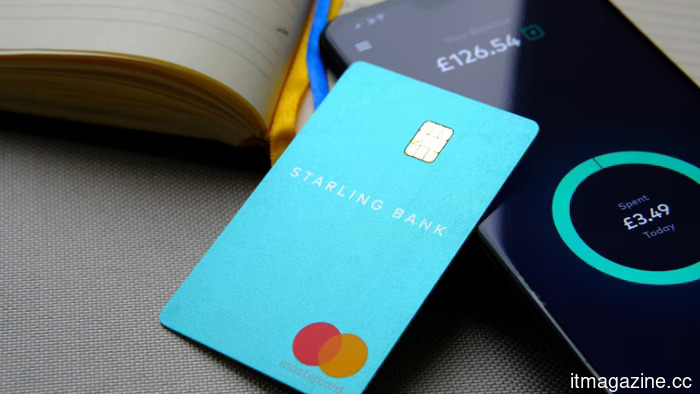
Starling's profit for FY26 falls once more as the neobank sets aside funds for increased credit losses.
The UK challenger bank backed by Goldman Sachs has reported a second consecutive annual decline, driven by additional provisions for expected credit losses, alongside the FY25 repercussions of the BBLS Covid-loan compliance issue and the FCA's £29 million anti-money-laundering fine. As Bloomberg reported on Thursday, Starling Bank’s annual profit decreased again for the year ending on 31 March 2026, as the neobank made further provisions for expected credit losses in its retail lending portfolio.
This marks a second consecutive annual downturn for the company, following the 26% decline in pre-tax profit reported in May 2025. The baseline for FY25, against which the new figures will be assessed, was a £223.4 million pre-tax profit on revenue of £714 million, down from £301 million in the previous year, mainly due to a £29 million FCA fine for anti-money-laundering and preliminary provisioning related to the bank's BBLS (Bounce Back Loan Scheme) Covid-loan risks.
Starling identified a portion of BBLS loans that may not have met a guarantee requirement because of weaknesses in past fraud checks, choosing to remove the government guarantee voluntarily, which placed the responsibility for losses on the bank. The new FY26 results reflect this provisioning. The Bloomberg report suggests that management has taken on additional expected credit loss reserves rather than working through the existing provision.
The accounting treatment follows the standard IFRS 9 forward-looking loss approach, based on management's perspective of how the impacted BBLS tranche will perform over the remaining loan duration. Starling's investor materials outline that the bank’s lending book consists of retail mortgages, legacy BBLS positions, and a growing commercial-SME portfolio, with the BBLS loans being the primary driver behind the provisioning adjustments.
Compared to the FY25 baseline, customer and deposit metrics showed improvement: 4.6 million customer accounts (+10% year-on-year), £12.1 billion in deposits, and an increase in revenue from £682 million to £714 million. The Bloomberg report on FY26 indicates ongoing growth in customer numbers, although it is the credit loss figure that has overshadowed the overall results.
Raman Bhatia, who became group CEO in March 2024 after working at OVO and leading HSBC’s UK and European digital retail bank, has been overseeing the company during the BBLS cleanup and the fallout from the FCA fine across two reporting periods. The FY26 results are the first to fully capture operational decisions made under his leadership, following the resignation of founder Anne Boden from the board in 2024.
Bhatia described the extra provisioning as a one-off legacy adjustment rather than a sign of a fundamental deterioration in the quality of the lending book. The FY26 release fits within the broader context of UK banking; recent announcements from HSBC regarding a £4 billion clean-tech lending facility in China and from Standard Chartered about job cuts driven by AI highlight how established UK banks are positioning themselves for the next cycle.
As the most successful UK neobank transitioning from a challenger to a profitable operation, Starling is navigating the same regulatory and customer landscape as larger banks, but with a significantly smaller balance sheet and a legacy loan problem that the larger banks have already addressed in the post-Covid environment.
Starling did not disclose the headline FY26 pre-tax profit figure, the amount of additional credit-loss provision compared to last year’s reported £800,000 BBLS reserve, the customer and deposit growth figures for the year, or specific insights about whether BBLS-related provisioning will continue into FY27 in the Bloomberg report. The full FY26 annual report, expected to be available shortly on the Starling investor page, will provide segment-level details. Historically, Sacra's database has captured the headline metrics shortly after release.
The next point of interest will be how the FY26 report differentiates the credit-loss provisions between BBLS legacy loans and any new flow coming from the current retail mortgage portfolio, which has been under scrutiny due to rate and affordability pressures affecting UK banks over the past year.
Other articles
 Manus is targeting a $1 billion fundraising effort to facilitate its buyout from the Meta acquisition following a blockage from China.
Manus AI, the Singapore-based agentic-AI start-up at the heart of China's regulatory obstruction regarding Meta's over $2 billion acquisition in December, is considering a new funding round of up to $1 billion to support the unwinding process.
Manus is targeting a $1 billion fundraising effort to facilitate its buyout from the Meta acquisition following a blockage from China.
Manus AI, the Singapore-based agentic-AI start-up at the heart of China's regulatory obstruction regarding Meta's over $2 billion acquisition in December, is considering a new funding round of up to $1 billion to support the unwinding process.
 ICEYE obtains a €300 million revolving credit line from a syndicate of seven banks.
The satellite-intelligence firm ICEYE, based in Helsinki, has secured a €300 million revolving credit facility for three years, led by Citi and Danske Bank.
ICEYE obtains a €300 million revolving credit line from a syndicate of seven banks.
The satellite-intelligence firm ICEYE, based in Helsinki, has secured a €300 million revolving credit facility for three years, led by Citi and Danske Bank.
 Samsung chip employees were presented with an average bonus of $340,000 while the union aims for a $1 million bonus and is considering an 18-day strike.
Samsung Electronics will provide its chip employees with an average bonus of approximately $340,000 for the year, while the union advocates for compensation nearer to $1 million per worker and gets ready for an 18-day strike.
Samsung chip employees were presented with an average bonus of $340,000 while the union aims for a $1 million bonus and is considering an 18-day strike.
Samsung Electronics will provide its chip employees with an average bonus of approximately $340,000 for the year, while the union advocates for compensation nearer to $1 million per worker and gets ready for an 18-day strike.
 ICEYE obtains a €300M revolving credit line from a syndicate of seven banks.
The satellite-intelligence firm ICEYE, based in Helsinki, has secured a €300 million revolving credit facility for three years, led by Citi and Danske Bank.
ICEYE obtains a €300M revolving credit line from a syndicate of seven banks.
The satellite-intelligence firm ICEYE, based in Helsinki, has secured a €300 million revolving credit facility for three years, led by Citi and Danske Bank.
 Google's latest tool will eliminate the lengthy delay for iOS apps to be available on your Android device.
Google's Android Studio Migration Assistant can transfer iOS projects to native Android by converting features, assets, and interfaces via an automated workflow.
Google's latest tool will eliminate the lengthy delay for iOS apps to be available on your Android device.
Google's Android Studio Migration Assistant can transfer iOS projects to native Android by converting features, assets, and interfaces via an automated workflow.
 Illuminate an entire fence for just $20: this 16-pack of solar lights is available at a 56% discount.
This article is presented in collaboration with AUDERWIN. The AUDERWIN solar fence lights are now priced at $20.99, a savings of $27: they are IP65 waterproof, offer three color temperature options, and require no wiring. The AUDERWIN solar fence lights have become a popular choice in the affordable outdoor lighting segment for a good reason, and the 16-pack is currently discounted to […]
Illuminate an entire fence for just $20: this 16-pack of solar lights is available at a 56% discount.
This article is presented in collaboration with AUDERWIN. The AUDERWIN solar fence lights are now priced at $20.99, a savings of $27: they are IP65 waterproof, offer three color temperature options, and require no wiring. The AUDERWIN solar fence lights have become a popular choice in the affordable outdoor lighting segment for a good reason, and the 16-pack is currently discounted to […]
Starling's profit for FY26 falls once more as the neobank sets aside funds for increased credit losses.
According to Bloomberg, Starling Bank's yearly profit declined once more for the year ending 31 March 2026, as the Goldman-supported UK neobank adjusted its provisions for expected credit losses on its retail lending portfolio.