
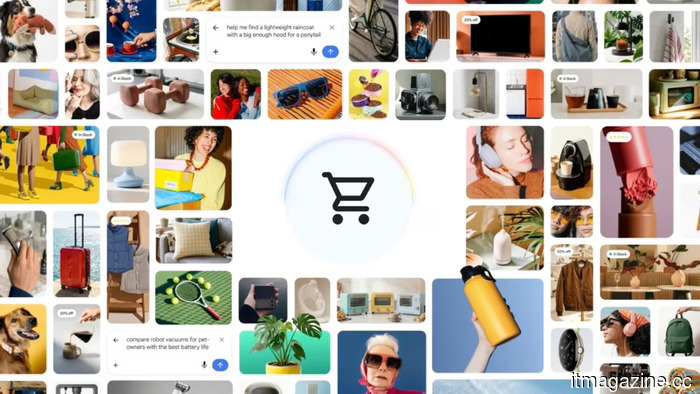
Google introduces Universal Cart and enhances AP2 at I/O 2026.
Google recently introduced Universal Cart at I/O 2026, an AI-driven shopping platform that enables users to compile products from its various services, including Search, Gemini, YouTube, and Gmail, into a single, ongoing cart. This feature, launching in the US today, marks Google's most ambitious effort to establish itself as a key player in online commerce.
Universal Cart offers more than just product storage. Utilizing Gemini's capabilities, it keeps track of price drops, shows price history, issues re-stock notifications, and performs AI compatibility checks. A demonstration illustrated how users building custom PCs could add parts from different retailers and receive alerts about any incompatibilities between selected components, along with alternative recommendations.
The functionality is based on the existing infrastructure of Google Wallet for managing rewards and loyalty points and integrates with the Universal Commerce Protocol (UCP), a standard introduced by Google in January 2026. UCP facilitates a standardized language for AI-enabled commerce, allowing for direct checkouts through Google or smooth transitions to a retailer's site. An update in March 2026 enhanced features like cart management, real-time catalog searches, and identity linking to help shoppers maintain loyalty benefits when purchasing through Google's platforms. Launch partners include brands like Nike, Sephora, Target, Ulta Beauty, Walmart, Wayfair, and Shopify merchants like Fenty and Steve Madden.
The timing is crucial as major Chinese tech companies have already implemented large-scale AI shopping agents, with Alibaba’s Qwen assistant reaching 300 million monthly active users on Taobao. Amazon has integrated Alexa within its search functionality, combining the Rufus chatbot and Alexa+ assistant for a cohesive shopping experience. Google appears to be racing to keep up in the agentic commerce realm, which McKinsey anticipates could be a $5 trillion market by 2030. The implications are significant, as controlling the primary AI shopping interface allows for substantial influence over consumer spending.
Along with Universal Cart, Google enhanced its Agent Payments Protocol (AP2), initially unveiled in September 2025 and supported by over 60 partners, including PayPal, Mastercard, and American Express. AP2 enables AI agents to conduct transactions within specified limits using digitally signed contracts known as “Mandates,” which ensure an unalterable audit trail for each transaction. The most recent release, version 0.2.0, rolled out in April 2026, introduced features allowing agents to autonomously purchase items like limited-release tickets as soon as they become available. Google has contributed AP2 to the FIDO Alliance, aiming to establish it as a standard across the industry rather than a proprietary system.
This broader push into agentic commerce is not limited to the US. UCP-based checkout solutions are also being expanded to Canada and Australia, with plans for the UK to follow. Google aims to extend this protocol to further sectors, including hotel reservations, local food deliveries, and YouTube in the US.
Universal Cart is set to be available on the Gemini app this summer, with integrations for YouTube and Gmail arriving afterward. For consumers, the allure lies in convenience: a single cart with continuous deal tracking and AI assistance for proactive shopping. For Google, the strategy is more calculated; by serving as the intermediary among consumers, merchants, and payment services, it can gather data and exert influence at every stage of the purchasing process.
Retailers' views on this development may hinge on the amount of traffic Google directs to them and the associated costs. Some have reported traffic drops of up to 30% as users pivot from traditional search methods to AI-driven queries. Google's Universal Cart could either accelerate this shift or, if its open protocols gain traction, assist merchants in reaching customers across various platforms.
Other articles
 Google showcases Android audio glasses created in collaboration with Gentle Monster and Warby Parker.
Google has provided us with an initial glimpse of the Android XR audio glasses, which are driven by Gemini and set to be released later this year.
Google showcases Android audio glasses created in collaboration with Gentle Monster and Warby Parker.
Google has provided us with an initial glimpse of the Android XR audio glasses, which are driven by Gemini and set to be released later this year.
 Google introduced the Gemini Spark agentic AI assistant during I/O 2026.
At I/O 2026, Google introduced Gemini Spark, a persistent AI agent that handles tasks through Gmail, navigates Chrome, and operates continuously on cloud VMs for AI Ultra subscribers.
Google introduced the Gemini Spark agentic AI assistant during I/O 2026.
At I/O 2026, Google introduced Gemini Spark, a persistent AI agent that handles tasks through Gmail, navigates Chrome, and operates continuously on cloud VMs for AI Ultra subscribers.
 Google introduces Android CLI 1.0 for AI programming assistants.
Google's stable Android CLI 1.0 allows AI agents such as Claude Code, Codex, and Antigravity to access Android Studio's toolchain directly from the command line.
Google introduces Android CLI 1.0 for AI programming assistants.
Google's stable Android CLI 1.0 allows AI agents such as Claude Code, Codex, and Antigravity to access Android Studio's toolchain directly from the command line.
 Chuwi's UniBook is a $449 laptop vying for the title held by the MacBook Neo, offering substantial features.
Chuwi's UniBook features Intel's latest Wildcat Lake Core 3 processor, along with a 14-inch display that covers 100% of the sRGB spectrum, ample ports, and an estimated price of $449.
Chuwi's UniBook is a $449 laptop vying for the title held by the MacBook Neo, offering substantial features.
Chuwi's UniBook features Intel's latest Wildcat Lake Core 3 processor, along with a 14-inch display that covers 100% of the sRGB spectrum, ample ports, and an estimated price of $449.
 Android Halo might be the crucial connection between Android and AI agents.
Google's latest Android Halo feature suggests a future where AI subtly supports you rather than requiring your constant focus. The most intriguing aspect is how minimally it interferes with your activities.
Android Halo might be the crucial connection between Android and AI agents.
Google's latest Android Halo feature suggests a future where AI subtly supports you rather than requiring your constant focus. The most intriguing aspect is how minimally it interferes with your activities.
 The Design Trade-Offs Influencing Contemporary UV Printing Systems
UV printing depends on precisely regulated chemical reactions, with even minor changes in ink behavior impacting the output, maintenance, and long-term reliability. As this technology is adopted by smaller studios and home environments, the discussion surrounding open versus closed ink systems increasingly revolves around finding a balance between flexibility, stability, and user-friendliness.
The Design Trade-Offs Influencing Contemporary UV Printing Systems
UV printing depends on precisely regulated chemical reactions, with even minor changes in ink behavior impacting the output, maintenance, and long-term reliability. As this technology is adopted by smaller studios and home environments, the discussion surrounding open versus closed ink systems increasingly revolves around finding a balance between flexibility, stability, and user-friendliness.
Google introduces Universal Cart and enhances AP2 at I/O 2026.
Google introduced Universal Cart, an AI shopping center that integrates Search, Gemini, YouTube, and Gmail, while also updating its Agent Payments Protocol for automated purchases.