

OpenAI has launched a new website that allows you to determine whether an image is genuine or artificially generated.
OpenAI and Google are collaborating to label every AI-generated image.
Rachit Agarwal / Digital Trends
Identifying AI-generated images is becoming increasingly challenging. OpenAI aims to address this issue with Google as its partner to tackle this monumental task.
OpenAI has unveiled a crucial update regarding content provenance, which refers to the ability to identify the source of an image and ascertain if it was created by AI.
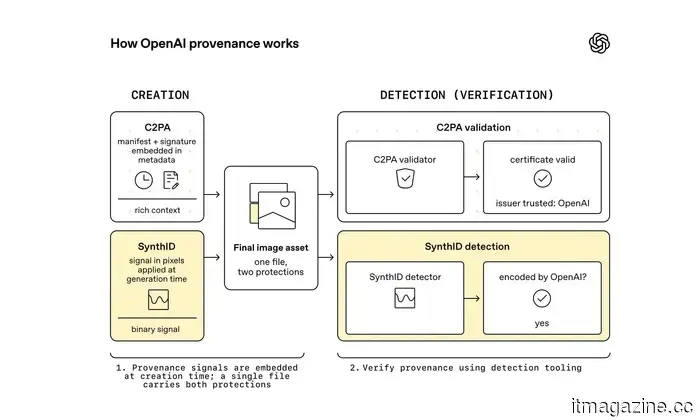
This update includes three main components: adherence to C2PA standards, a new watermarking partnership with Google, and a public tool for image verification.
So, what are the changes?
Since 2024, OpenAI has been embedding metadata, known as Content Credentials, into images produced by its tools. This metadata, present in all generated images, provides details on how the image was created. The company has now achieved the status of a C2PA Conforming Generator, enabling other platforms to reliably access and interpret the information associated with OpenAI-generated content.
The more significant development is the collaboration with Google. OpenAI is now integrating Google DeepMind's SynthID watermarking into images created via ChatGPT and the OpenAI API. Unlike metadata, which can be removed through screenshotting or re-uploading an image, SynthID incorporates an invisible watermark directly into the image, designed to endure modifications that could typically erase metadata detection.
Industry-wide collaboration on content transparency technology is essential for a trustworthy internet. 🤝 We’re building on the momentum initiated with @NVIDIA and partnering with @OpenAI, Kakao, and @ElevenLabs to implement SynthID in their generative content—providing better context for users… pic.twitter.com/rs3tobexNX— Google (@Google) May 19, 2026
Both systems function in tandem. The metadata contains comprehensive information regarding the image's origin, while the watermark serves as an alternative when the metadata is absent.
How can you determine if an image is AI-generated?
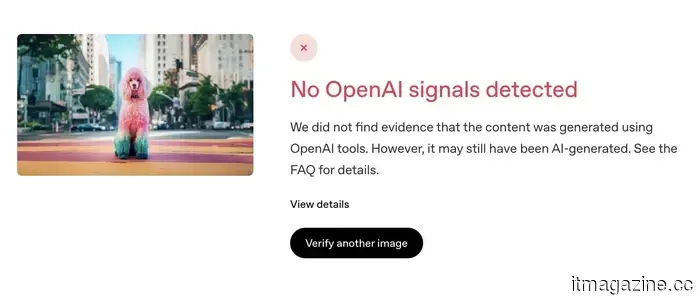
OpenAI is showcasing a public verification tool at openai.com/verify. You can upload an image, and the tool will search for both Content Credentials and SynthID watermarks to ascertain if it was generated with OpenAI’s technologies.
An important note: if the tool detects neither watermark nor metadata, it cannot conclusively claim that the image is not AI-generated since both elements can be faked.
Additionally, not all generative AI companies have teamed up with Google to incorporate SynthID into their images. Until SynthID or a similar standard is adopted universally across all generative AI models, no verification tool can guarantee with 100% certainty that an image is not AI-generated.
Nonetheless, this is a positive advancement. The proliferation of AI-generated images has become chaotic and is frequently exploited for malicious purposes. A system to identify them is crucial, and it's encouraging that Google and OpenAI are leading the charge in this area.
Rachit is an experienced tech journalist with over seven years of experience reporting on consumer technology.
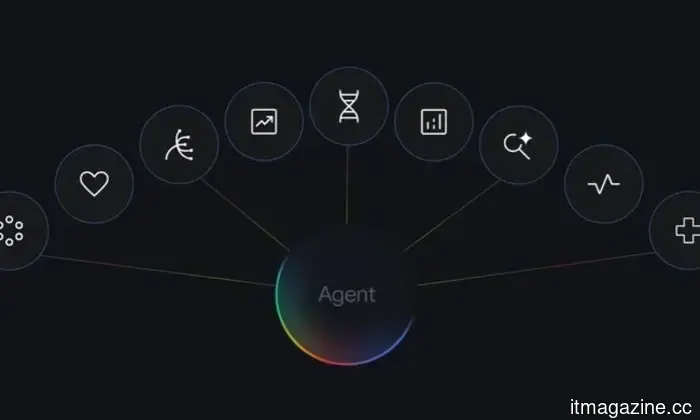
Google is aiming to use Gemini to facilitate the next major scientific advancement.
Gemini for Science integrates agentic AI more deeply into actual research processes.
At Google I/O 2026, the company rolled out Gemini for Science, an experimental suite centered around agentic AI in science. This initiative addresses the manual tasks involved in discovery, such as hypothesis generation, computational testing, and literature review.
Read more
Discord calls finally receive end-to-end encryption, though DMs were left out.
Discord has spent three years developing one of the most comprehensive cross-platform encryption systems but it doesn't apply to the app's primary communication feature.
Discord recently finalized enhancements it initiated in 2023. While the outcome is genuinely commendable, a significant limitation remains. As of early March 2026, all standard voice and video calls on Discord are end-to-end encrypted (E2EE), with the feature enabled by default, requiring no user action. The encryption relies on DAVE, Discord’s proprietary open-source protocol.
Read more
Google has introduced a 24/7 AI agent for Workspace that can send emails and schedule meetings while you rest.
Google's announcement of five new Workspace features at once either signals boldness or disorder, but the arrival of Gemini Spark, which acts on your behalf even while you sleep, truly transforms the functionality of a productivity suite.
During I/O 2026, Google unveiled several AI-driven enhancements for its Workspace applications. The standout feature is Gemini Spark, a personal AI agent that operates continuously, handling tasks such as sending emails, adding calendar appointments, and completing activities within Workspace apps. It seeks confirmation before undertaking significant tasks, and users can decide whether to enable its functions. It will soon be available for preview to Workspace business users in the Gemini app.
Read more




Other articles
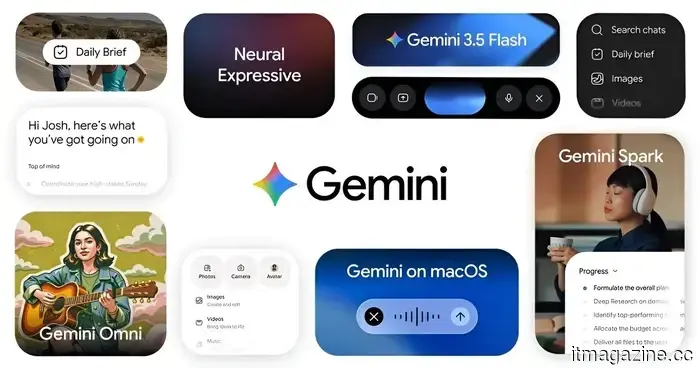 Gemini is now capable of creating videos, summarizing your morning, and handling digital tasks while you rest.
Google's Gemini app is receiving a significant update that includes cinematic video creation, morning summaries, more detailed responses, and a round-the-clock agent to assist with tasks.
Gemini is now capable of creating videos, summarizing your morning, and handling digital tasks while you rest.
Google's Gemini app is receiving a significant update that includes cinematic video creation, morning summaries, more detailed responses, and a round-the-clock agent to assist with tasks.
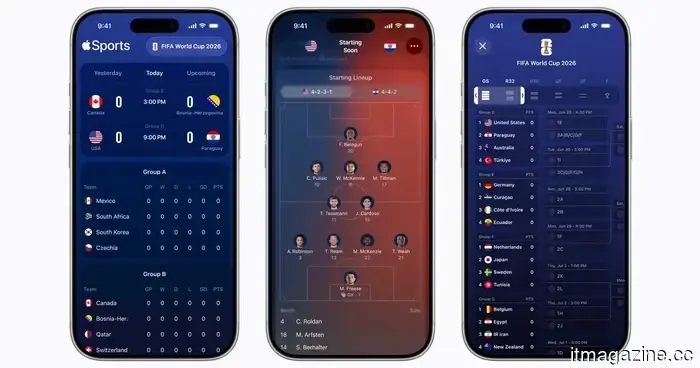 Apple Sports is prepared to monitor every moment of heartbreak during the World Cup in real time.
Apple Sports is growing its global presence by introducing World Cup tools such as bracket views, visual formations, widgets, Live Activities, and easy one-tap access to Apple TV.
Apple Sports is prepared to monitor every moment of heartbreak during the World Cup in real time.
Apple Sports is growing its global presence by introducing World Cup tools such as bracket views, visual formations, widgets, Live Activities, and easy one-tap access to Apple TV.
 French firms have submitted a $10 billion proposal for one of the five AI gigafactory locations planned by the EU.
A French consortium led by Scaleway has submitted a bid of approximately $10 billion to construct one of the AI gigafactories proposed by the European Union.
Lambda secures a cloud contract with Hudson River Trading to provide access to NVIDIA chips.
Lambda has entered into a cloud infrastructure agreement with Hudson River Trading to provide HRT with access to NVIDIA chips.
French firms have submitted a $10 billion proposal for one of the five AI gigafactory locations planned by the EU.
A French consortium led by Scaleway has submitted a bid of approximately $10 billion to construct one of the AI gigafactories proposed by the European Union.
Lambda secures a cloud contract with Hudson River Trading to provide access to NVIDIA chips.
Lambda has entered into a cloud infrastructure agreement with Hudson River Trading to provide HRT with access to NVIDIA chips.
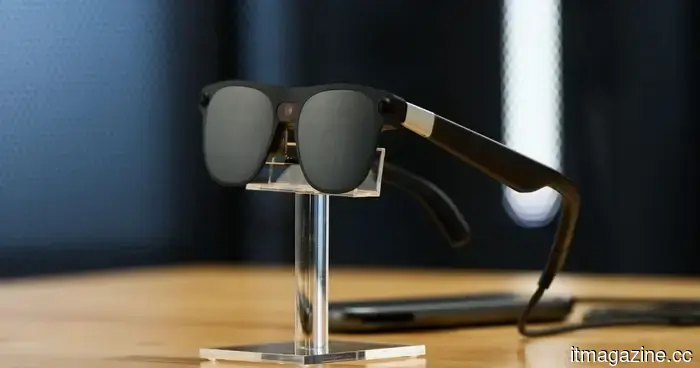 The smart glasses from Google and Xreal, known as Project Aura, are set to be released later this year.
Xreal's Project Aura smart glasses incorporate built-in display units, offering an extensive field of view.
The smart glasses from Google and Xreal, known as Project Aura, are set to be released later this year.
Xreal's Project Aura smart glasses incorporate built-in display units, offering an extensive field of view.
 Wove app examines garments for PFAS and microplastics | TNW
Wove is the inaugural app designed to scan common clothing items for PFAS, microplastics, and concealed toxins, providing safety ratings and cleaner options for consumers.
Wove app examines garments for PFAS and microplastics | TNW
Wove is the inaugural app designed to scan common clothing items for PFAS, microplastics, and concealed toxins, providing safety ratings and cleaner options for consumers.
OpenAI has launched a new website that allows you to determine whether an image is genuine or artificially generated.
OpenAI is collaborating with Google to simplify the identification of AI-generated images by employing invisible watermarks, metadata, and a public verification tool that is currently available for use.