

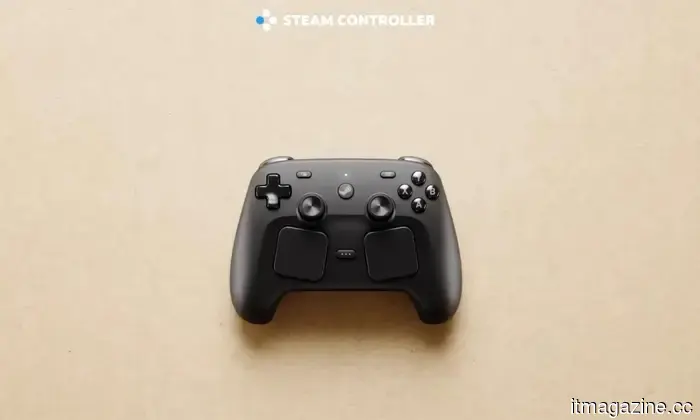
The Steam Controller from Valve has become significantly more valuable beyond the Steam platform.
The Steam Controller's most significant issue may already be undergoing a fix.
Valve's new Steam Controller has had a strong debut. Initial impressions have been favorable, and the $99 controller sold out rapidly after its release.
That high demand also attracted scalpers, who began listing the controller at inflated prices. In response, Valve has established a reservation queue to provide genuine purchasers a better chance at upcoming stock. Nonetheless, one recurring concern has emerged: for many gamers, the Steam Controller felt overly tied to Steam.
What limitations has the Steam Controller faced?
For gamers who use Steam as their primary platform, the setup is effective. Steam Input manages the controller's advanced features and offers users substantial control over its operation. However, numerous players do not keep all their games within Steam. For those users, the controller was harder to endorse since it did not function as seamlessly with alternative launchers and non-Steam games.
That situation is beginning to improve. As noted by Phoronix, support for the new Steam Controller has been incorporated into SDL (Simple DirectMedia Layer), a popular cross-platform library utilized by many games and applications for controller input. Additionally, a mapping update has been released, which should enable the controller to operate more like a standard third-party gamepad in SDL-compatible games.
How effective is it outside of Steam now?
Initial tests appear promising, even if it's not yet flawless. Testers in the SDL pull request reported that the controller functions with or without Steam running and that its touchpads, capacitive stick touch, grip sense, back buttons, gyro, accelerometer, and the QAM button are operational to some extent.
However, minor touchpad glitches remain, and having Steam open in the background can lead to double-input issues in certain scenarios.
For the time being, it seems that the Steam Controller will need to depend on SDL to play third-party games. Valve developer Pierre-Loup has already explained that implementing standard Windows XInput support would essentially make it function like an Xbox controller, potentially limiting its distinctive inputs, requiring a different mode-switching setup, and adding extra costs for users.




Other articles
 Exadel acquires London-based consultancy Tangent to enhance its AI engineering offerings with experience design.
Exadel has purchased the London-based digital experience consultancy Tangent, integrating its UX, product, and MarTech design expertise into Exadel’s AI-focused engineering services.
Exadel acquires London-based consultancy Tangent to enhance its AI engineering offerings with experience design.
Exadel has purchased the London-based digital experience consultancy Tangent, integrating its UX, product, and MarTech design expertise into Exadel’s AI-focused engineering services.
 CBA appoints Professor Mary-Anne Williams, an AI researcher, as Chief AI Scientist.
The Commonwealth Bank of Australia has named Professor Mary-Anne Williams, an AI researcher from UNSW and an AAAI Fellow, as its inaugural Chief AI Scientist.
Shein acquires Everlane for $100 million, transforming the radical-transparency brand into a fast-fashion asset.
Meta description: Shein is purchasing the San Francisco-based DTC clothing brand Everlane from L Catterton for approximately $100 million. The final terms of the deal have not been disclosed yet.
CBA appoints Professor Mary-Anne Williams, an AI researcher, as Chief AI Scientist.
The Commonwealth Bank of Australia has named Professor Mary-Anne Williams, an AI researcher from UNSW and an AAAI Fellow, as its inaugural Chief AI Scientist.
Shein acquires Everlane for $100 million, transforming the radical-transparency brand into a fast-fashion asset.
Meta description: Shein is purchasing the San Francisco-based DTC clothing brand Everlane from L Catterton for approximately $100 million. The final terms of the deal have not been disclosed yet.
 Two cryptocurrency billionaires are behind both the Trump family token and Iran's mechanism for evading sanctions.
A Reuters investigation associates $2.3 billion in transactions from Iran's largest cryptocurrency exchange, Nobitex, with Tron and BNB Chain.
Two cryptocurrency billionaires are behind both the Trump family token and Iran's mechanism for evading sanctions.
A Reuters investigation associates $2.3 billion in transactions from Iran's largest cryptocurrency exchange, Nobitex, with Tron and BNB Chain.
 Siri may be years behind in the AI landscape, but the revamp in iOS 27 might still deliver a beta-like experience.
Apple might introduce its revamped AI-driven Siri in iOS 27 as a beta feature, despite delays that have allegedly postponed the project by almost two years.
Siri may be years behind in the AI landscape, but the revamp in iOS 27 might still deliver a beta-like experience.
Apple might introduce its revamped AI-driven Siri in iOS 27 as a beta feature, despite delays that have allegedly postponed the project by almost two years.
 HSBC establishes a $4 billion credit facility for Chinese clean technology to expand internationally.
HSBC has introduced a $4 billion Sustainability and Transition Credit Facility aimed at Chinese clean technology firms looking to expand internationally, including sectors such as solar, batteries, electric vehicles, data centers, and AI infrastructure.
HSBC establishes a $4 billion credit facility for Chinese clean technology to expand internationally.
HSBC has introduced a $4 billion Sustainability and Transition Credit Facility aimed at Chinese clean technology firms looking to expand internationally, including sectors such as solar, batteries, electric vehicles, data centers, and AI infrastructure.
The Steam Controller from Valve has become significantly more valuable beyond the Steam platform.
The main early drawback of the Steam Controller was its strong reliance on Steam. However, with the addition of SDL support, it is expected to be far more practical for non-Steam titles.