

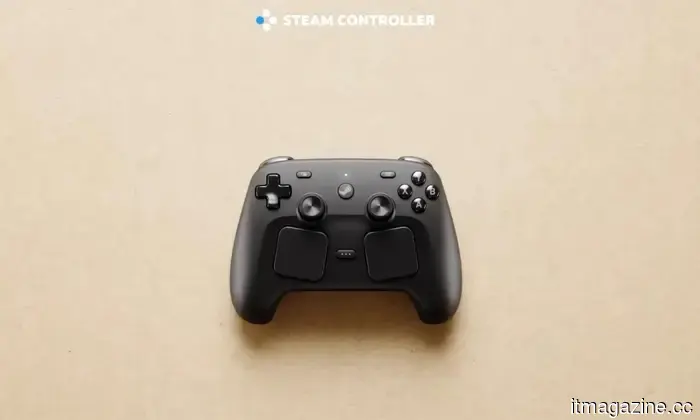
Valve's Steam Controller has significantly increased its utility beyond Steam.
The Steam Controller's most significant issue might already be on its way to resolution.
Valve's new Steam Controller had a solid launch, with positive early feedback and the $99 device selling out rapidly.
However, this popularity also attracted scalpers, who began listing it at marked-up prices. In response, Valve created a reservation queue to give genuine buyers a better chance at acquiring future stock. Nonetheless, one recurring criticism was that the Steam Controller felt too confined to the Steam platform.
What was hindering the Steam Controller's effectiveness?
For gamers who primarily use Steam, the setup functions efficiently. Steam Input manages the controller's additional features and offers extensive customization options. However, many players do not keep all their games on Steam, making the controller less appealing because it did not integrate well with other launchers and non-Steam games.
Now, a shift is occurring. As noted by Phoronix, support for the new Steam Controller has been integrated into SDL (Simple DirectMedia Layer), a popular cross-platform library utilized by numerous games and applications for controller input. Additionally, it has received a mapping update that should allow it to function more like a typical third-party gamepad in SDL-compatible games.
How effectively does it operate outside of Steam now?
Initial testing appears promising, though not flawless. Testers in the SDL pull request indicated that the controller operates regardless of whether Steam is running, with functionality for touchpads, capacitive stick touch, grip sense, back buttons, gyro, accelerometer, and the QAM button available in some manner.
However, there are still some minor issues with the touchpad, and running Steam in the background may lead to double input errors in certain situations.
For the time being, it seems that the Steam Controller will need to rely on SDL for compatibility with third-party games. Valve developer Pierre-Loup has clarified that introducing standard Windows XInput support would essentially cause it to operate like an Xbox controller, which could restrict its unique features, necessitate a separate mode-switching process, and impose additional costs on users.





Other articles
 Sony wants to emphasize that the AI camera on the new Xperia phone is quite impressive.
Sony claims that its AI Camera Assistant proposes settings rather than edits. However, the before-and-after images it provided to support this assertion inadvertently seemed to contradict its own argument.
Sony wants to emphasize that the AI camera on the new Xperia phone is quite impressive.
Sony claims that its AI Camera Assistant proposes settings rather than edits. However, the before-and-after images it provided to support this assertion inadvertently seemed to contradict its own argument.
 Siri may be years behind in the AI landscape, but the revamp in iOS 27 might still deliver a beta-like experience.
Apple might introduce its revamped AI-driven Siri in iOS 27 as a beta feature, despite delays that have allegedly postponed the project by almost two years.
Siri may be years behind in the AI landscape, but the revamp in iOS 27 might still deliver a beta-like experience.
Apple might introduce its revamped AI-driven Siri in iOS 27 as a beta feature, despite delays that have allegedly postponed the project by almost two years.
 Two cryptocurrency billionaires are behind both the Trump family token and Iran's mechanism for evading sanctions.
A Reuters investigation associates $2.3 billion in transactions from Iran's largest cryptocurrency exchange, Nobitex, with Tron and BNB Chain.
Two cryptocurrency billionaires are behind both the Trump family token and Iran's mechanism for evading sanctions.
A Reuters investigation associates $2.3 billion in transactions from Iran's largest cryptocurrency exchange, Nobitex, with Tron and BNB Chain.
 Japan has created robotic wolves to deter bear attacks, and they’re selling rapidly.
Japan's unusual "Monster Wolf" robot deterrents are experiencing a significant increase in demand as the nation faces an unprecedented number of bear sightings and incidents.
Japan has created robotic wolves to deter bear attacks, and they’re selling rapidly.
Japan's unusual "Monster Wolf" robot deterrents are experiencing a significant increase in demand as the nation faces an unprecedented number of bear sightings and incidents.
 Two cryptocurrency billionaires are involved in both the Trump family token and the sanctions-evasion mechanism for Iran.
A Reuters investigation connects $2.3 billion in transactions from Iran's largest cryptocurrency exchange, Nobitex, to Tron and BNB Chain.
Two cryptocurrency billionaires are involved in both the Trump family token and the sanctions-evasion mechanism for Iran.
A Reuters investigation connects $2.3 billion in transactions from Iran's largest cryptocurrency exchange, Nobitex, to Tron and BNB Chain.
 Japan has created robotic wolves to deter bear attacks, and they are selling rapidly.
Japan's unusual "Monster Wolf" robot deterrents are experiencing a surge in demand as the nation faces unprecedented bear sightings and attacks.
Japan has created robotic wolves to deter bear attacks, and they are selling rapidly.
Japan's unusual "Monster Wolf" robot deterrents are experiencing a surge in demand as the nation faces unprecedented bear sightings and attacks.
Valve's Steam Controller has significantly increased its utility beyond Steam.
The main early drawback of the Steam Controller was its significant reliance on Steam. However, with the introduction of SDL support, it is expected to be much more beneficial for non-Steam games.