
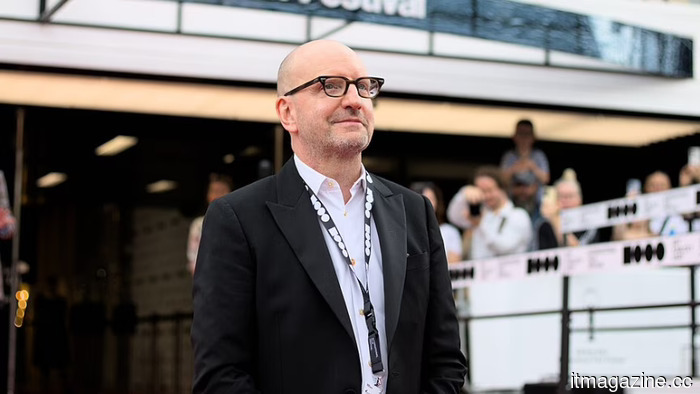
Soderbergh utilized Meta's AI in his documentary about Lennon, which received criticism from reviewers. He claims that this was intentional.
TL;DR: Steven Soderbergh utilized Meta’s AI for 10% of his documentary on John Lennon, which faced criticism. He claims the real issue is the lack of disclosure from others.
Soderbergh’s film “John Lennon: The Last Interview” debuted on Saturday at the 79th Cannes Film Festival. Centered on a previously unreleased two-hour-and-45-minute radio interview between Lennon and Yoko Ono recorded at their New York Dakota residence on December 8, 1980, just hours before Lennon's assassination, the 97-minute documentary has sparked more conversation at Cannes around its visual interpretation than its content.
About 10% of the film's visuals were created using Meta's AI software. Soderbergh announced this collaboration earlier this year and was upfront about the criticism that followed. “I anticipated the backlash,” he remarked to the Associated Press at Cannes on Saturday. “You don't agree to Meta providing these tools and completing the film without expecting some backlash. That was part of the deal.”
The AI-generated visuals, criticized by many at Cannes, are abstract and surreal: they include light circles, a black rose transforming into choreographed patterns, and paint colors intertwining on split screens alongside images of lovers. No deepfakes of Lennon are present; these sequences were designed for philosophical discussions that lack archival footage. Soderbergh utilized over 1,000 photographs and video clips from archives for the remainder of the film, editing them to match the conversation's rhythm in a style reviewers likened to a hyperkinetic photo album.
Soderbergh's criteria for justifying AI in filmmaking is straightforward: "It must be necessary. Is it the only way to achieve what I want to see? Is it genuinely the best approach?" He noted that the surreal visuals would have been too costly to produce with traditional effects, and the AI tools allowed him to quickly generate imagery he found difficult to articulate. “I wasn't very adept at expressing my vision,” he admitted. “The technology's advantage was providing me with something tangible I could react to quickly.”
Soderbergh argues that the broader issue is about transparency, not whether one can use AI. “In the realm outside creative contexts, we're unaware of its manipulation,” he stated. “We don't know because it's not being disclosed. We find out by chance or through whistleblowers. I consider myself a whistleblower.” His provocative stance emphasizes that the issue lies not in his use of AI, but in his choice to disclose it, while many others secretly utilize it.
This perspective is supported by recently released data from Canva, which indicates that 97% of marketing professionals now use AI daily, yet 78% of consumers still prefer human-created content, and 87% believe the best advertising involves a human element. Mentions of "AI slop" have surged ninefold, highlighting the gap between the widespread adoption of AI and creators' hesitance to admit its use—what Soderbergh identifies as structural dishonesty.
Soderbergh has a more balanced viewpoint on AI's potential impact on filmmaking jobs than many industry commentators. “I believe that most essential roles in movie-making cannot be replaced by this technology and never will be,” he remarked. “As it becomes easier for anyone to produce work that meets a certain level of technical excellence, distinct human imperfections will become more precious and intriguing.” This perspective flips typical concerns: rather than AI reducing demand for human labor, he posits it will enhance the value of unique human flaws.
The film industry has been cautiously employing AI tools for years. Flawless AI’s DeepEditor, which digitally adjusts video to synchronize actors' lip movements with dubbed audio, has been used in mainstream productions since 2022, with performers’ consent obtained via its Artistic Rights Treasury platform. The SAG-AFTRA strike of 2023 established that meaningful digital alterations to performances require explicit actor consent. However, Soderbergh's approach is different as he is not modifying pre-existing performances but creating new visuals to accompany audio lacking corresponding video, venturing into less defined ethical territory.
Regardless of the AI debate, critics generally agree the documentary itself is impactful. The Wrap described it as a film that “demystifies Lennon and Ono as much as ‘Get Back’ did for the Beatles.” Variety mentioned that the AI sections are the weakest aspect of an otherwise immersive experience. The conversation, which Soderbergh edited with Nancy Main from 165 minutes to 97, captures a clear-headed Lennon at 40 discussing love, parenthood, creativity, and his desire to dismantle the “male rock star myth” during a time when few in rock were willing to do so.
“What I hope is that young viewers recognize is that this man was truthful about everything from the very beginning until the end of his life,” Soderbergh expressed. “He was opinionated yet thoughtful, always questioning: Can
Other articles
 Google's Rambler might make voice typing an experience I actually enjoy.
Google's Rambler appears to be a minor enhancement to Gboard, yet it could discreetly address a genuine issue by transforming chaotic spoken ideas into messages that you would likely send.
In iOS 27, Apple's Siri app will automatically delete your conversations. It might also be re-released as a beta version.
The independent Siri application provides options for chat retention of 30 days, one year, or indefinitely. Apple seems to be using privacy as a justification for an AI assistant that is two years behind schedule.
Google's Rambler might make voice typing an experience I actually enjoy.
Google's Rambler appears to be a minor enhancement to Gboard, yet it could discreetly address a genuine issue by transforming chaotic spoken ideas into messages that you would likely send.
In iOS 27, Apple's Siri app will automatically delete your conversations. It might also be re-released as a beta version.
The independent Siri application provides options for chat retention of 30 days, one year, or indefinitely. Apple seems to be using privacy as a justification for an AI assistant that is two years behind schedule.
 YouTube is providing creators with a new tool to combat AI deepfakes.
YouTube is introducing a new AI safety feature designed to assist creators in identifying deepfake-style videos that use their likeness. This tool operates discreetly in the background, but its significance may grow as AI-generated content becomes more prevalent on the internet.
YouTube is providing creators with a new tool to combat AI deepfakes.
YouTube is introducing a new AI safety feature designed to assist creators in identifying deepfake-style videos that use their likeness. This tool operates discreetly in the background, but its significance may grow as AI-generated content becomes more prevalent on the internet.
 Why workplace infrastructure is a subtle catalyst for business performance.
Workplace infrastructure, including hybrid office arrangements, collaboration tools, and employee wellness, subtly influences a company's growth or stagnation. Here’s what to focus your investments on.
Why workplace infrastructure is a subtle catalyst for business performance.
Workplace infrastructure, including hybrid office arrangements, collaboration tools, and employee wellness, subtly influences a company's growth or stagnation. Here’s what to focus your investments on.
 Why workplace infrastructure is a key factor influencing business performance.
Workplace infrastructure, including hybrid office arrangements, collaboration tools, and employee wellness, subtly influences a company's ability to grow or stagnate. Here’s where to allocate your investments.
Why workplace infrastructure is a key factor influencing business performance.
Workplace infrastructure, including hybrid office arrangements, collaboration tools, and employee wellness, subtly influences a company's ability to grow or stagnate. Here’s where to allocate your investments.
 The seven new job titles that have emerged due to AI, ranging from Claude Evangelist to Chief AI Officer.
AI firms are employing philosophers, advocates, vibe coders, and engineers who are strategically placed. Salaries begin at $108,000 and can go up to almost $500,000.
The seven new job titles that have emerged due to AI, ranging from Claude Evangelist to Chief AI Officer.
AI firms are employing philosophers, advocates, vibe coders, and engineers who are strategically placed. Salaries begin at $108,000 and can go up to almost $500,000.
Soderbergh utilized Meta's AI in his documentary about Lennon, which received criticism from reviewers. He claims that this was intentional.
The director collaborated with Meta to create 10% of the visuals for his Cannes documentary. He describes transparency as the guiding principle and necessity as the measure of success.