
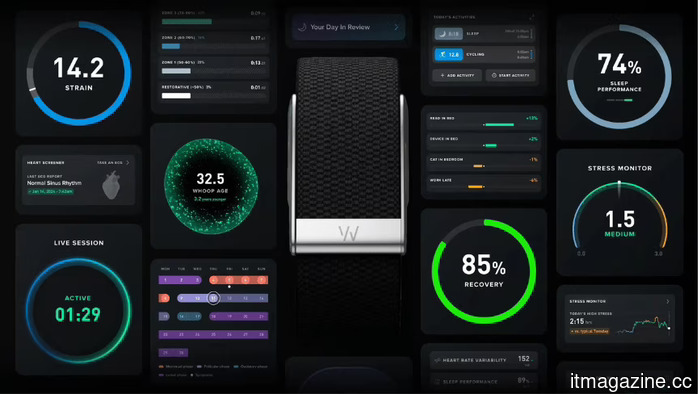
Whoop introduces consultations with licensed clinicians as Google unveils the $99 Fitbit Air featuring the Gemini AI health coach.
**TL;DR** Google introduced the $99 screenless Fitbit Air and a $9.99 monthly AI health coach powered by Gemini. The following day, Whoop announced the addition of on-demand video consultations with licensed clinicians in its app.
Google has launched the $99 screenless Fitbit Air alongside a $9.99 monthly Gemini-based AI health coach. Just a day later, Whoop revealed that it would offer on-demand video consultations with licensed healthcare professionals through its app. Google is banking on artificial intelligence to analyze health data, while Whoop maintains that human doctors are still essential. The US Food and Drug Administration, having eased its oversight of AI health tools and consumer wearables in January, seems to think that neither requires extensive regulation.
This sequence of announcements reflects a philosophical divide within the wearable health sector, highlighted by product releases that were merely 24 hours apart. Both companies are tackling the same question: what should occur after the wrist sensor gathers data? Google proposes an AI chatbot as the solution, while Whoop opts for a human with a medical license. The market will ultimately determine who consumers trust with their health.
**The Tracker**
The Fitbit Air is a screenless fitness band priced at $99, making it the smallest model Fitbit has created. It continuously monitors heart rate, heart rate variability, SpO2 levels, sleep stages, and activity, boasting a battery life of around one week. It lacks a display, with all data accessible through the new Google Health app, which will replace the Fitbit app on May 19.
The device will be available starting May 26, accompanied by a three-month free trial of Google Health Premium, typically costing $9.99 monthly or $99 annually. This premium service features the Google Health Coach, an AI assistant based on Gemini that crafts personalized workout plans, analyzes sleep patterns, summarizes health records, and responds to inquiries regarding a user's fitness and medical information.
Google's strategy focuses on selling the AI layer built on top of the data rather than hardware. The Google Health app is intended to be compatible with various wearables, with support for Apple Watch, Oura, and Garmin devices anticipated later this year. The Fitbit Air serves as an entry point rather than the end goal. Google aims to be the intelligence that mediates between wearable sensors and health decisions, regardless of the device used to collect the data.
**The Response**
Whoop's announcement came on May 8, precisely one day after Google's. The company plans to provide on-demand video consultations with licensed clinicians via its app for users in the United States, launching this summer. These consultations will start with a review of the user’s continuous biometric data collected by the Whoop band. If users have synced their blood work or medical history through HealthEx, an electronic health records integration also launching soon, that information will be included.
This difference from Google's approach is intentional. A clinician can pose follow-up questions, recognize patterns requiring context that a chatbot may miss, and bear the professional accountability associated with a medical license. An AI coach can inform you that your heart rate variability is declining; a doctor can explain why.
Blossom Health secured $20 million to develop AI copilots that support psychiatrists, viewing AI as an adjunct to clinicians rather than a replacement. Whoop applies the same logic to wearable health data: while AI processes the data, human input is crucial for interpretation.
Will Ahmed, Whoop’s founder and CEO, shared a picture on X of a Whoop circuit board that reads, “Don’t bother copying us, we will win.” Initially aimed at Amazon, which launched and then discontinued the Halo fitness band, it now appears to be a response to a much larger competitor.
**The Economics**
Whoop raised $575 million in March 2026, achieving a valuation of $10.1 billion with backing from the Qatar Investment Authority, Mubadala, Abbott, and the Mayo Clinic. The company reported an annual revenue of $1.1 billion in 2025, marking a 103% increase year over year, and claimed it is cash-flow positive, with over 2.5 million members.
Whoop’s subscription costs between $199 and $359 annually, depending on the tier selected. Meanwhile, Google Health Premium is priced at $99 per year, and the Fitbit Air itself costs $99. The combined total for a year with Fitbit Air and Google Health Premium is lower than the price of Whoop’s least expensive plan. Video consultations from Whoop will incur additional costs, with pricing details yet to be revealed.
This pricing disparity presents a competitive challenge. Google offers AI health coaching at a rate significantly lower than Whoop's subscription. In contrast, Whoop provides human medical consultations which will increase its overall pricing. One company aims to reduce the cost of health advice to nearly zero, while the other argues that the value of human medical professionals warrants a higher price. Both approaches are valid, though neither has been extensively
Otros artículos
.jpg) Apple might return to using Intel chips, but not in the way you might anticipate (or fear).
Apple and Intel are said to be considering a manufacturing partnership that could transform the production process of future Apple chips. However, contrary to the initial impression, this does not indicate that Apple is moving away from Apple Silicon or reverting to Macs with Intel processors. A recent report from the Wall Street Journal suggests that Apple and Intel have established a preliminary agreement for Intel to […]
Apple might return to using Intel chips, but not in the way you might anticipate (or fear).
Apple and Intel are said to be considering a manufacturing partnership that could transform the production process of future Apple chips. However, contrary to the initial impression, this does not indicate that Apple is moving away from Apple Silicon or reverting to Macs with Intel processors. A recent report from the Wall Street Journal suggests that Apple and Intel have established a preliminary agreement for Intel to […]
 What is the most effective method for monitoring income and expenses in a growing business?
Automated financial tracking aids expanding businesses in managing their income and expenses with greater precision. By substituting spreadsheets with integrated systems, companies achieve real-time insights, minimize errors, and enhance reporting efficiency as transaction volumes rise and financial operations grow more intricate.
What is the most effective method for monitoring income and expenses in a growing business?
Automated financial tracking aids expanding businesses in managing their income and expenses with greater precision. By substituting spreadsheets with integrated systems, companies achieve real-time insights, minimize errors, and enhance reporting efficiency as transaction volumes rise and financial operations grow more intricate.
 Apple requires you to confirm your identity before you can access the Education discount on products.
Students can verify their status through the school portal or by uploading their ID; homeschool teachers are required to provide a government ID along with a homeschooling document. Most verifications are done instantly, while manual reviews are finished within 24 hours.
Intruder introduces AI-powered pentesting agents as a startup supported by GCHQ automates $50,000 worth of manual security assessments.
Intruder, supported by GCHQ, has introduced AI-powered penetration testing agents that can mimic manual pen testing in just a few minutes. CEO Chris Wallis showcases this technology at KnowBe4's KB4-CON 2026.
Apple requires you to confirm your identity before you can access the Education discount on products.
Students can verify their status through the school portal or by uploading their ID; homeschool teachers are required to provide a government ID along with a homeschooling document. Most verifications are done instantly, while manual reviews are finished within 24 hours.
Intruder introduces AI-powered pentesting agents as a startup supported by GCHQ automates $50,000 worth of manual security assessments.
Intruder, supported by GCHQ, has introduced AI-powered penetration testing agents that can mimic manual pen testing in just a few minutes. CEO Chris Wallis showcases this technology at KnowBe4's KB4-CON 2026.
.jpg) This Oscar-nominated revenge thriller ranks among the top 3 movies on Peacock that you should check out this weekend (May 8-10).
From an Academy Award-winning revenge thriller to a popular Korean crime film, Peacock offers three overlooked movies that are worth checking out this weekend.
This Oscar-nominated revenge thriller ranks among the top 3 movies on Peacock that you should check out this weekend (May 8-10).
From an Academy Award-winning revenge thriller to a popular Korean crime film, Peacock offers three overlooked movies that are worth checking out this weekend.
 Amazon introduces vertical videos suitable for doomscrolling in the Prime Video app.
Discovering content on Prime Video might soon resemble scrolling through Shorts rather than navigating a traditional streaming menu.
Amazon introduces vertical videos suitable for doomscrolling in the Prime Video app.
Discovering content on Prime Video might soon resemble scrolling through Shorts rather than navigating a traditional streaming menu.
Whoop introduces consultations with licensed clinicians as Google unveils the $99 Fitbit Air featuring the Gemini AI health coach.
Google introduced the $99 Fitbit Air without a screen and a health coach service called Gemini for $9.99 per month. The following day, Whoop replied by offering on-demand video consultations with licensed professionals.