
Quantinuum submits plans for a $20 billion IPO, reporting $31 million in revenue, as the Honeywell-backed quantum computing company aims for a listing on Nasdaq.
Honeywell-supported Quantinuum has submitted its application for a US initial public offering (IPO) with aspirations of achieving a valuation exceeding 20 billion dollars. The quantum computing firm reported an annual revenue of 30.9 million dollars alongside losses of 192.6 million dollars, positioning itself with a fault-tolerant machine expected to launch in 2029.
Quantinuum's IPO filing indicates that the company could be valued at over 20 billion dollars. For the year ending December 31, 2025, it reported revenues of 30.9 million dollars and a net loss of 192.6 million dollars. The firm is seeking public market investors to agree to a valuation that is more than 600 times its revenue for a quantum computer that is not yet completed in its final state. The machine in development, known as Apollo, is a universal fault-tolerant device set to debut in 2029.
This filing is noteworthy not just for Quantinuum's current financial situation, which is modest by any benchmark, but also for what the investor appetite in the IPO market will indicate about pricing for a technology that has frequently been cited as five to ten years away from commercial viability for the past two decades. Honeywell owns 54 percent of Quantinuum, while JPMorgan and Morgan Stanley are leading the IPO process. The ticker symbol for the company will be QNT on the Nasdaq Global Select Market.
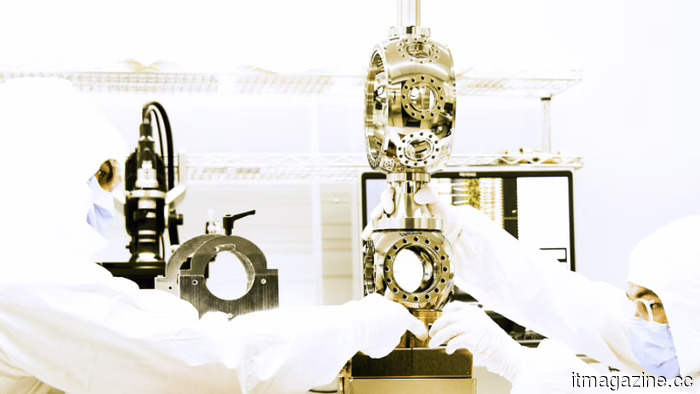
Quantinuum was established in 2021 through the merger of Honeywell Quantum Solutions and Cambridge Quantum Computing. It designs quantum computers based on trapped-ion architecture, where single atoms are held in electromagnetic fields and manipulated with lasers for calculations. As of December 2025, the company asserts it has the highest average two-qubit gate fidelity in the industry, which measures the accuracy of the machine's fundamental quantum operations.
Among its clients are BMW, Airbus, JPMorgan Chase, HSBC, Mitsui, and Thales. In May 2026, BMW expanded its multi-year collaboration with Quantinuum to utilize quantum computing for fuel cell catalyst chemistry research. Airbus is investigating quantum simulation for hydrogen-fueled aircraft, while JPMorgan has been engaged with Quantinuum since 2020 and is one of its most active corporate users.
These collaborations are focused on research rather than production, and no company is currently using quantum computing at a level that impacts its financial performance. The partnerships are driven by the belief that quantum computing will eventually revolutionize their sectors, motivating them to prepare for that potential. However, the term “eventually” carries considerable risk.
Quantinuum’s 2025 revenue of 30.9 million dollars marked a 34 percent increase over the prior year's 23 million dollars, while the net loss of 192.6 million dollars also represented a 34 percent rise from 144.1 million dollars the previous year. Revenue and losses grew at identical rates.
The first quarter of 2026 saw a decline in revenue, dropping to 5.2 million dollars from 19.1 million dollars in the same quarter of the previous year. The net loss increased to 136.6 million dollars from 30.5 million dollars. These quarterly figures indicate that revenues can be inconsistent and are often contingent on the timing of contract milestones, a common trend in pre-commercial deep technology firms.
A target valuation exceeding 20 billion dollars would signify a doubling from the 10 billion dollar pre-money valuation that Quantinuum achieved when it raised 600 million dollars in September 2025. Previously, the company raised 300 million dollars in January 2024 at a valuation of 5 billion dollars. Over two years, the valuation has increased fourfold, while revenue has risen from 23 million to 31 million dollars.
Quantinuum's hardware roadmap consists of four generations. The currently available system, Helios, is already being marketed. The next system, Sol, is expected to be introduced in 2027, while Apollo, touted as a universal and fully fault-tolerant system, is scheduled for 2029. A fault-tolerant quantum computer is capable of conducting complex calculations with sufficient error correction to yield reliable results, marking the shift from research to commercial application for quantum computing.
Riverlane has secured 75 million dollars to develop chips for quantum error correction, aiming for one million error-free operations by 2026. Error correction is a pivotal engineering challenge in the field; without it, quantum computers generate results that are too imprecise for practical applications, stymieing the technology's theoretical advantages. Quantinuum's Apollo aims to address this issue at the system level, but whether it will succeed, and whether the 2029 timeline can be met, remains uncertain—key factors influencing the IPO valuation.
European nations are investing billions into quantum computing, with Germany, the Netherlands, France, and the United Kingdom initiating or expanding national programs. France has allocated 500 million euros to five startups working
Other articles
 Apple requires you to confirm your identity prior to receiving the Education discount on products.
Students confirm their status through the school portal or by uploading an ID; homeschool educators must provide a government ID along with a homeschool document. Most verifications are done immediately, while manual reviews are finalized within 24 hours.
Apple requires you to confirm your identity prior to receiving the Education discount on products.
Students confirm their status through the school portal or by uploading an ID; homeschool educators must provide a government ID along with a homeschool document. Most verifications are done immediately, while manual reviews are finalized within 24 hours.
 The University of Michigan's $20 million early investment in OpenAI has now escalated to a valuation of $2 billion, as trial documents concerning Musk disclose details about the endowment's wager.
Court documents from the Musk v. Altman trial reveal that the University of Michigan invested $20 million in OpenAI prior to the launch of ChatGPT. This investment now has a projected redemption value of $2 billion.
The University of Michigan's $20 million early investment in OpenAI has now escalated to a valuation of $2 billion, as trial documents concerning Musk disclose details about the endowment's wager.
Court documents from the Musk v. Altman trial reveal that the University of Michigan invested $20 million in OpenAI prior to the launch of ChatGPT. This investment now has a projected redemption value of $2 billion.
 What is the most effective method for monitoring income and expenses in an expanding business?
Automated financial tracking assists expanding businesses in managing their income and expenses with greater precision. By substituting spreadsheets with integrated systems, companies achieve real-time insights, minimize mistakes, and enhance reporting efficiency as transaction amounts rise and financial processes grow more intricate.
What is the most effective method for monitoring income and expenses in an expanding business?
Automated financial tracking assists expanding businesses in managing their income and expenses with greater precision. By substituting spreadsheets with integrated systems, companies achieve real-time insights, minimize mistakes, and enhance reporting efficiency as transaction amounts rise and financial processes grow more intricate.
 Whoop introduces consultations with licensed clinicians, while Google unveils the $99 Fitbit Air featuring the Gemini AI health coach.
Google introduced the $99 screenless Fitbit Air and the $9.99/month Gemini health coach. The following day, Whoop countered with on-demand video consultations featuring licensed clinicians.
Whoop introduces consultations with licensed clinicians, while Google unveils the $99 Fitbit Air featuring the Gemini AI health coach.
Google introduced the $99 screenless Fitbit Air and the $9.99/month Gemini health coach. The following day, Whoop countered with on-demand video consultations featuring licensed clinicians.
 What is the most effective method for monitoring income and expenses in an expanding business?
Automated financial tracking assists expanding businesses in overseeing their income and expenses with greater accuracy. By substituting spreadsheets with integrated systems, businesses achieve real-time insights, minimize mistakes, and enhance reporting efficiency as transaction volumes rise and financial operations grow in complexity.
What is the most effective method for monitoring income and expenses in an expanding business?
Automated financial tracking assists expanding businesses in overseeing their income and expenses with greater accuracy. By substituting spreadsheets with integrated systems, businesses achieve real-time insights, minimize mistakes, and enhance reporting efficiency as transaction volumes rise and financial operations grow in complexity.
.jpg) This WWII thriller starring Tom Hanks is among the three best films to watch on Apple TV this weekend (May 8-10).
This weekend, Apple TV features three excellent movies, including a WWII thriller written by and starring Tom Hanks.
This WWII thriller starring Tom Hanks is among the three best films to watch on Apple TV this weekend (May 8-10).
This weekend, Apple TV features three excellent movies, including a WWII thriller written by and starring Tom Hanks.
Quantinuum submits plans for a $20 billion IPO, reporting $31 million in revenue, as the Honeywell-backed quantum computing company aims for a listing on Nasdaq.
Quantinuum has submitted paperwork for a Nasdaq IPO, aiming for a valuation exceeding $20 billion. The quantum computing firm, supported by Honeywell, declared revenues of $30.9 million and losses amounting to $192.6 million.