
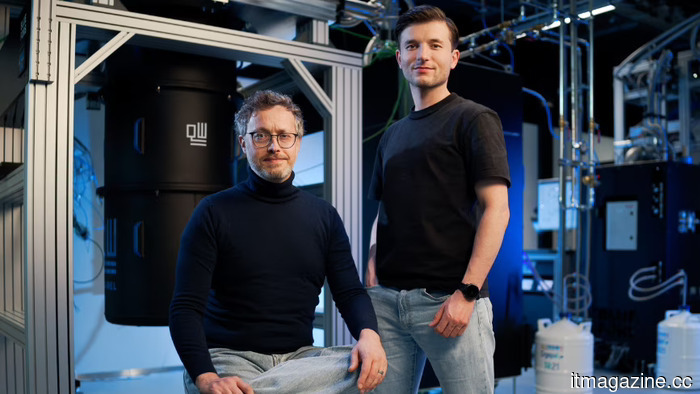
Inside QuantWare's €152 million funding round to develop KiloFab.
The Series B round represents the largest amount ever raised by a Dutch deeptech company, as well as the biggest private round completed by any dedicated quantum-processor firm globally. Intel Capital, In-Q-Tel, and ETF Partners are joining a syndicate that already includes FORWARD.one and Invest-NL.
By 2026, there is a particular type of European deeptech success narrative that policy-makers are actively trying to foster, yet the market only occasionally produces such outcomes. Delft-based QuantWare has announced the completion of a Series B funding round totaling €152 million ($178 million), marking the largest amount ever raised by a Dutch deeptech company and the largest private round for any quantum-processor company worldwide.
The funding round was oversubscribed. The new set of investors is notably substantial, with Intel Capital, In-Q-Tel (a strategic investor backed by the CIA), and ETF Partners joining an existing syndicate that includes FORWARD.one, Invest-NL Deep Tech Fonds, InnovationQuarter Capital, Ground State Ventures, and Graduate Ventures.
This is the second Series B round for a European quantum scale-up within the week, and it is significantly larger than the first.
**About QuantWare's Operations**
QuantWare was established in July 2021 by Matthijs Rijlaarsdam (CEO) and Dr. Alessandro Bruno (CTO), both of whom previously worked at QuTech, a quantum-research institute co-managed by TU Delft and TNO. TNW highlighted the company more than a year ago, when its commercial activities were already notable.
The company has delivered operational quantum processors to over 50 organizations across 20 countries and is, based on its own claims and descriptions from HPCwire, the largest commercial supplier of quantum processors globally in terms of volume.
What distinguishes QuantWare from the broader quantum-computing landscape is its architectural decision. While most superconducting-qubit systems rely on 2D chip designs, featuring signal lines routed laterally across the surface of a single processor, which limits scalability as qubit numbers increase, QuantWare has developed a three-dimensional VIO architecture. This architecture consists of stacked chiplet modules connected via ultra-high-fidelity chip-to-chip links, with signal lines traversing vertically between layers instead of laterally. In the company's view, this architecture enables scalability similar to traditional commercial semiconductor processes.
**VIO-40K and Its Promise**
The Series B funding follows the company's announcement in late April of VIO-40K, a next-generation architecture designed for processors containing 10,000 qubits. This qubit count is around 100 times greater than the current commercial standard, and the architecture allows for up to 40,000 input-output lines via the chiplet-stacking method.
Coverage of the architecture's launch by Quantum Computing Report positioned the design as the first viable commercial route to processors of this magnitude without depending on connecting numerous smaller systems, which can impose additional latency and fidelity limitations.
Reservations for the VIO-40K are currently being accepted, with the first shipments expected in 2028, as per QuantWare's announcement. The architecture is what has made the size of the Series B economically viable. Historically, no quantum-hardware company has attracted private funding of this magnitude without a convincing scaling roadmap. With one in place, the market opportunity considerably expands.
**KiloFab: Allocation of Funds**
Much of the new investment will be directed towards KiloFab, which QuantWare describes as the world's first dedicated fabrication facility for Quantum Open Architecture devices and one of the largest production sites for quantum processors. Located at the company’s Delft headquarters, this facility aims to increase QuantWare’s production capacity by approximately 20 times.
Currently, major quantum-computing companies either produce their processors in fully integrated facilities or source them from a limited number of academic-scale fabs with restricted capabilities. KiloFab aims to alleviate this limitation by functioning as an open-architecture commercial supplier to the broader industry.
If QuantWare can maintain its role as an open-architecture supplier during the next phase of quantum-processor demand, it could mirror TSMC's position in classical semiconductors: not the brand visible to the customer but the essential fabrication operation upon which others depend.
QuantWare boasts an unusually diverse customer base for this stage of the industry, selling to a mix of national technology institutes, large tech firms, and other commercial quantum-computing companies. Its distribution across 20 countries is significant, as most quantum hardware businesses primarily cater to local or regional customers, indicating that QuantWare's open-architecture model attracts buyers looking to manage their own quantum-software stack instead of purchasing a fully integrated system.
The configuration of existing investors reflects this same trend. Intel Capital's involvement serves as a strategic hedge, given Intel's own pursuits in trapped-ion quantum research, while acquiring a stake in the leading commercial superconducting-QPU supplier offers Intel flexibility across different architectures.
In-Q-Tel’s participation indicates interest from US-government-related customers,
Other articles
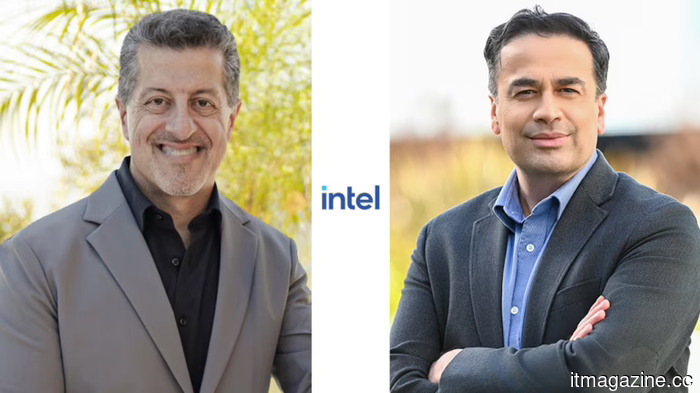 Intel has appointed Qualcomm veteran Alex Katouzian to head a new Client Computing and Physical AI division.
Intel has brought on Alex Katouzian, who spent 25 years at Qualcomm, to head a newly formed Client Computing and Physical AI division. This marks the second high-profile recruitment from Qualcomm during CEO Lip-Bu Tan's leadership.
Intel has appointed Qualcomm veteran Alex Katouzian to head a new Client Computing and Physical AI division.
Intel has brought on Alex Katouzian, who spent 25 years at Qualcomm, to head a newly formed Client Computing and Physical AI division. This marks the second high-profile recruitment from Qualcomm during CEO Lip-Bu Tan's leadership.
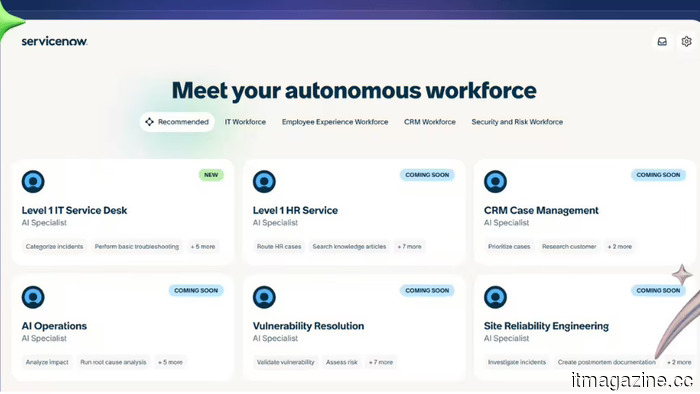 ServiceNow anticipates reaching $30 billion by 2030, with one-third of its annual contract value coming from AI.
ServiceNow anticipates achieving $30 billion in subscription revenue by 2030, with 30% of that annual contract value coming from Now Assist, its primary AI product. The presentation during investor day serves as a structural response to worries regarding AI-SaaS displacement.
ServiceNow anticipates reaching $30 billion by 2030, with one-third of its annual contract value coming from AI.
ServiceNow anticipates achieving $30 billion in subscription revenue by 2030, with 30% of that annual contract value coming from Now Assist, its primary AI product. The presentation during investor day serves as a structural response to worries regarding AI-SaaS displacement.
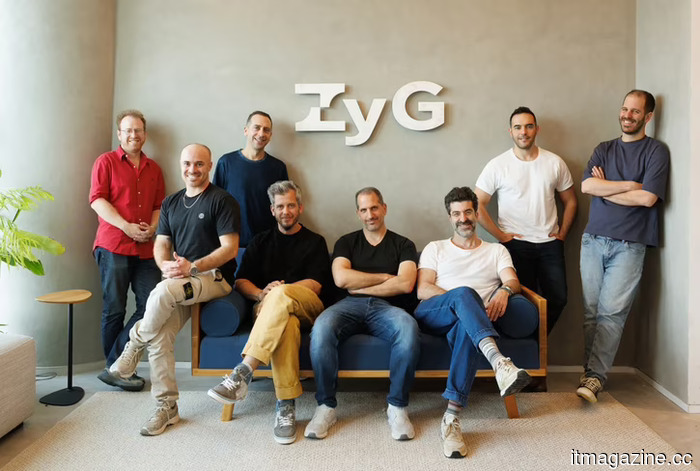 The founders of IronSource have raised $60 million, achieving a valuation of $500 million for Zyg, an AI platform designed to autonomously manage e-commerce advertising.
Zyg secured $60 million in funding, led by Accel, at a $500 million valuation just two months after emerging from stealth mode. The IronSource team is developing AI agents designed to take the place of human ad buyers for direct-to-consumer brands.
The founders of IronSource have raised $60 million, achieving a valuation of $500 million for Zyg, an AI platform designed to autonomously manage e-commerce advertising.
Zyg secured $60 million in funding, led by Accel, at a $500 million valuation just two months after emerging from stealth mode. The IronSource team is developing AI agents designed to take the place of human ad buyers for direct-to-consumer brands.
 Metalenz's innovative face scanning technology is embedded beneath the phone's display, eliminating the need for unsightly cutouts.
Metalenz has demonstrated that payment-grade facial authentication can function with a fully powered-on display, a feat that Apple has attempted to achieve for years without success.
Metalenz's innovative face scanning technology is embedded beneath the phone's display, eliminating the need for unsightly cutouts.
Metalenz has demonstrated that payment-grade facial authentication can function with a fully powered-on display, a feat that Apple has attempted to achieve for years without success.
 Coinbase reduces its workforce by 14% and reorganizes around AI-focused pods as cryptocurrency revenue declines by 26% and trading volumes reach an 18-month low.
Coinbase is reducing its workforce by 660 employees and reorganizing into AI-focused teams with a maximum of five layers of management. Revenue for Q1 is projected to decline by 26% due to a 48% decrease in cryptocurrency trading volumes.
Coinbase reduces its workforce by 14% and reorganizes around AI-focused pods as cryptocurrency revenue declines by 26% and trading volumes reach an 18-month low.
Coinbase is reducing its workforce by 660 employees and reorganizing into AI-focused teams with a maximum of five layers of management. Revenue for Q1 is projected to decline by 26% due to a 48% decrease in cryptocurrency trading volumes.
 iOS 26.5 introduces encryption for RCS messages sent between Android and iPhone devices.
iOS 26.5 introduces encrypted RCS support for both iPhone and Android messaging, but users should check for the lock symbol before assuming that cross-platform chats are secure.
iOS 26.5 introduces encryption for RCS messages sent between Android and iPhone devices.
iOS 26.5 introduces encrypted RCS support for both iPhone and Android messaging, but users should check for the lock symbol before assuming that cross-platform chats are secure.
Inside QuantWare's €152 million funding round to develop KiloFab.
QuantWare has secured a €152 million Series B funding round, led by Intel Capital, In-Q-Tel, and ETF Partners, marking the largest deeptech funding round in Dutch history.