

Snapchat's latest advertising format gives AI chatbots the tone of sales representatives.
Snapchat is allowing brand-sponsored chatbots to enter the Chat tab.
AI chatbots have spent the last few years managing tasks like handling refunds, tracking orders, resetting passwords, answering banking inquiries, scheduling appointments, and assisting companies in reducing the size of their support teams. Now, with Snapchat’s AI Sponsored Snaps, these chatbots may be shifting toward sales.
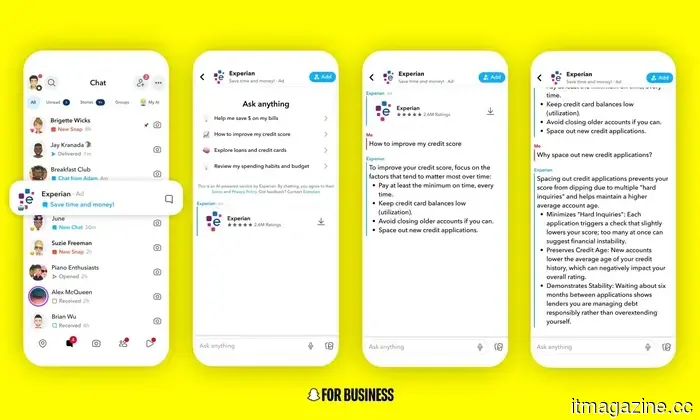
Snap has launched AI Sponsored Snaps, a novel advertising format that integrates brand-operated AI agents into Snapchat Chat. Users can interact with these ads, posing questions, receiving suggestions, exploring services, and progressing toward actions like app installations or purchases without exiting the chat.
In the initial phase, Snap has teamed up with Experian. Its AI Sponsored Snap appears in the Chat tab and opens to a branded interface where users can inquire about credit scores, loans, credit cards, and spending patterns. The AI agent from Experian responds in a typical chat manner, but the dialogue is specifically designed to guide users toward a brand’s offerings.
Are ads transforming into sales agents?
Here’s where it gets a bit concerning. AI chatbots have already demonstrated to companies how significantly tasks can be shifted away from human support teams. AI Sponsored Snaps build on that concept and bring it nearer to the sales pipeline.
These interactions are not merely addressing simple questions. They aim to assist users in discovering products, understanding services, receiving personalized recommendations, and moving closer to a purchase. This functions similarly to a sales representative's role, especially in industries where selling is conducted through chats, calls, and guided product explanations.
Could sales teams be the next target?
Ajit Mohan, Snap’s Chief Business Officer, stated that conversation is becoming “the most valuable real estate in advertising,” with AI facilitating real-time product discovery and decision-making. This statement speaks volumes about the direction this is heading.
While users seeking quick responses may find this beneficial, employees may view the situation less favorably. AI Sponsored Snaps may begin as an advertising format, although the work appears similar. They engage with customers, resolve queries, provide recommendations, and help drive purchases. Customer support has already experienced this transition, and sales could be next.
Every call you place is mapping your city — here’s who is watching.
You don’t actually have to share your location for your city to determine where you are. Every call you make and every message you send connects quietly to a nearby network antenna. Now, multiply that across millions of people doing the same every day, and what you get is not just data — it’s a dynamic, real-time illustration of how a city operates. Researchers at the University of Córdoba have developed a new tool to interpret these patterns.
The tool that observes without really observing.
KitKat has created a unique chocolate wrapper that disconnects your phone from the outside world.
KitKat has turned its famous slogan into a signal-blocking chocolate wrapper!
You know that feeling when you desperately need a break, but your phone keeps buzzing? KitKat got the message. The chocolate brand, in partnership with creative agency Ogilvy Colombia, has introduced Break Mode, a KitKat wrapper that acts as a Faraday cage for your phone.
For those unfamiliar, a Faraday cage is a conductive enclosure that blocks electromagnetic signals. This technology has typically been found in medical labs and data security centers. Now, it’s packaged in a red chocolate wrapper, which is certainly an unexpected twist.
This tiny brain implant could provide at-home treatment for depression.
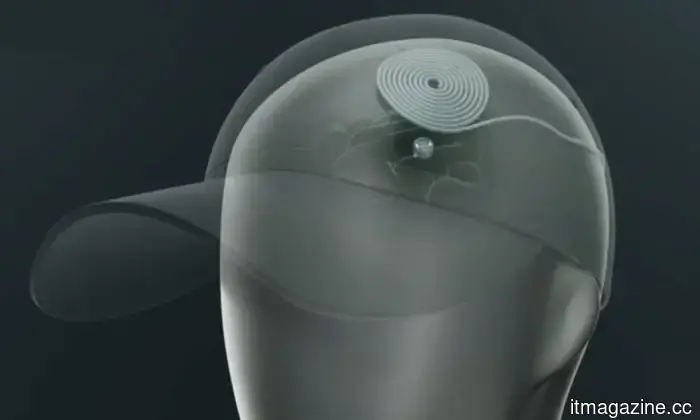
A small brain implant combined with a baseball cap could revolutionize depression treatment.
Nearly 3 million Americans experience treatment-resistant depression, meaning that standard antidepressants are ineffective for them. Motif Neurotech aims to change this with a small brain implant, which the FDA has recently approved for human trials.
As reported by Wired, the Houston-based startup has designed a tiny device that sits in the skull, just above the brain’s protective membrane. It targets the area of the brain associated with higher-level thinking, which often becomes inactive in individuals with major depressive disorder. The implant delivers targeted electrical pulses to reactivate that neural network.




Other articles
 ExpressVPN Simplifies Your Internet Experience and Continues to Be the Benchmark for Privacy in 2026
Concerned about your data being monitored or your connection being insecure? ExpressVPN sets the standard for a more secure online experience, enabling you to browse safely without interfering with your surfing, starting at just $3.49 per month.
ExpressVPN Simplifies Your Internet Experience and Continues to Be the Benchmark for Privacy in 2026
Concerned about your data being monitored or your connection being insecure? ExpressVPN sets the standard for a more secure online experience, enabling you to browse safely without interfering with your surfing, starting at just $3.49 per month.
 LG Electronics and Nvidia are discussing collaboration in the fields of robotics and AI data centers.
LG Electronics and Nvidia have announced discussions regarding robotics, AI data centers, and mobility, following a visit from Nvidia's Madison Huang to LG's headquarters in Seoul.
LG Electronics and Nvidia are discussing collaboration in the fields of robotics and AI data centers.
LG Electronics and Nvidia have announced discussions regarding robotics, AI data centers, and mobility, following a visit from Nvidia's Madison Huang to LG's headquarters in Seoul.
 Your GM vehicle has just become much smarter with the Google Gemini upgrade.
Google Gemini is being introduced in 4 million GM vehicles, transforming your everyday drive into a more intelligent, connected, and unexpectedly enjoyable experience.
Your GM vehicle has just become much smarter with the Google Gemini upgrade.
Google Gemini is being introduced in 4 million GM vehicles, transforming your everyday drive into a more intelligent, connected, and unexpectedly enjoyable experience.
 China warns the EU of extensive countermeasures.
China's commerce ministry has officially warned the EU of possible retaliation if the new Cybersecurity Act prohibits Huawei and ZTE.
China warns the EU of extensive countermeasures.
China's commerce ministry has officially warned the EU of possible retaliation if the new Cybersecurity Act prohibits Huawei and ZTE.
 LG Electronics and Nvidia are engaged in discussions regarding robotics and AI data centers.
LG Electronics and Nvidia have announced discussions regarding robotics, AI data centers, and mobility, following a visit from Nvidia’s Madison Huang to LG's headquarters in Seoul.
LG Electronics and Nvidia are engaged in discussions regarding robotics and AI data centers.
LG Electronics and Nvidia have announced discussions regarding robotics, AI data centers, and mobility, following a visit from Nvidia’s Madison Huang to LG's headquarters in Seoul.
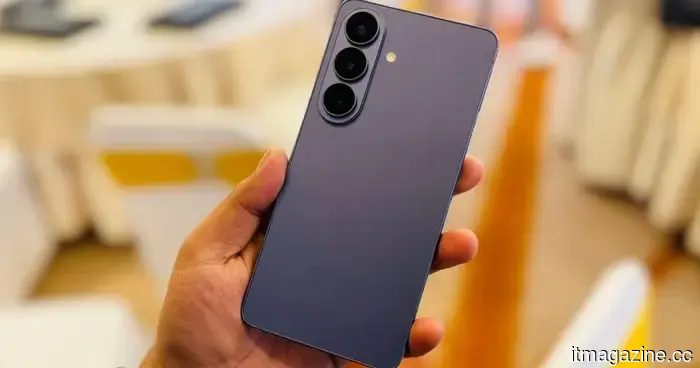 Samsung's Galaxy S27 series may finally move away from the unexciting camera design.
Samsung is said to be experimenting with a different camera arrangement for the Galaxy S27, and this modification may be due to the introduction of new magnetic charging capabilities.
Samsung's Galaxy S27 series may finally move away from the unexciting camera design.
Samsung is said to be experimenting with a different camera arrangement for the Galaxy S27, and this modification may be due to the introduction of new magnetic charging capabilities.
Snapchat's latest advertising format gives AI chatbots the tone of sales representatives.
Snapchat's AI Sponsored Snaps might appear to be a new advertising format, but they also illustrate the rapid shift of chatbots from handling complaints to pursuing sales.