
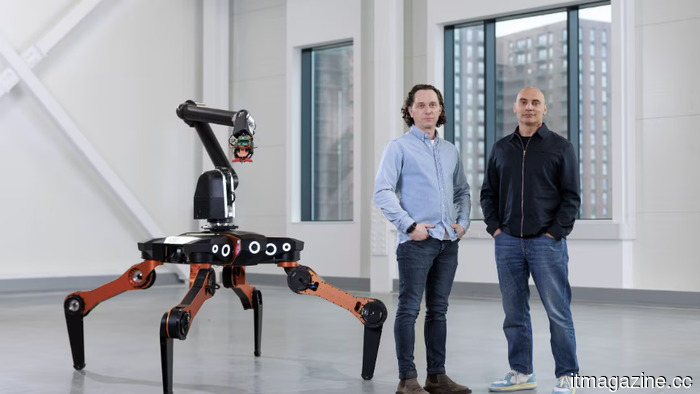
All3 secures $25 million to automate construction using legged robots.
The startup founded in London aims to transform the entire construction value chain, from the architect’s brief to a move-in-ready building, leveraging AI along with a specialized on-site robot known as the Mantis. Construction is the largest industry globally by value and is among the least automated. Today, a typical construction project follows a similar series of hand-offs, on-site labor, and bureaucratic obstacles as it did fifty years ago. Despite advancements in software and automation in sectors like manufacturing, logistics, and services, productivity in construction has hardly changed in five decades. This stagnation is precisely what All3 intends to address.
The European construction robotics startup has announced a seed funding round totaling $25 million. This round is spearheaded by RTP Global, an early-stage firm with a portfolio that includes Datadog, Delivery Hero, and SumUp, along with substantial contributions from SuperSeed and further investments by Begin Capital, s16vc, and VNV Global. Jelmer de Jong, a partner at RTP Global, has joined All3’s board.
Founded by Rodion Shishkov, a serial entrepreneur with expertise in industrial robotics and retail logistics, All3 operates throughout Europe, with offices in Berlin and Zug, as well as R&D facilities in London and Belgrade. The company emerged from stealth mode in mid-2025, having already begun testing its robotic system in Belgrade.
All3’s strategy is centered on vertical integration: rather than selling just one element of the construction process to builders who manage the rest, All3 aims to be a comprehensive alternative to the traditional construction value chain. “The developers identify the sites and manage permits and financing, while we handle the rest,” Shishkov explained to The Robot Report in June 2025.
The company’s system comprises three interconnected components. First, an AI-driven design platform that converts a brief or site address into a fully compliant building design, optimizing for space, local planning rules, and the constraints of robotic production. Second, robotic factories, referred to by All3 as compact, modular production cells, which manufacture custom timber composite parts with purported precision of 0.2mm, without requiring programmer input. Third, the All3 Mantis: a legged robot capable of carrying 100kg and reaching up to 4 meters, specifically designed for on-site assembly, including tasks such as placement, fastening, finishing, and inspection.
The material choice is intentional. All3 constructs with structural timber composites, a renewable resource that captures CO₂ instead of releasing it during production. In contrast, concrete is responsible for around 7-8% of global carbon emissions.
The company claims that its approach can lead to cost savings of up to 30%, timeline reductions of up to 50%, and a decrease of up to 25% in embodied carbon compared to conventional building methods, based on its own modeling and marketing data, which has not yet undergone independent verification.
The funding will primarily focus on enhancing R&D in London and Belgrade while deploying the robot fleet across All3’s initial commercial projects in Germany, its first market of operations. Construction on the first building is anticipated to commence in late 2026.
Choosing Germany is both strategically sound and narratively compelling. As reported by TNW on Europe's construction crisis, there is a significant shortage of both homes and construction labor across the continent, with Germany facing a particularly severe situation.
All3 has processed over 100,000 square meters of residential projects through its AI design platform, laying the groundwork for its construction pipeline in Germany for 2026-2027. The company asserts that this represents real customer engagement rather than internal forecasting, although it has not disclosed the number or identity of the participating developers.
However, All3 is not the first European startup to speculate that robotics could catalyze a productivity revolution in construction. As previously noted, the Dutch startup Monumental has developed a functioning bricklaying robot that has completed commercial projects in the Netherlands and secured $25 million in seed funding. Another example, Spain’s 011h, has embraced a software-first approach to prefab construction. All3’s unique value proposition is its extent of vertical integration: not merely automating a segment of construction, but fundamentally redesigning the entire process around robotic capabilities.
This ambitious approach also carries significant risks. Transforming a fragmented industry’s entire value chain necessitates not only effective technology but also regulatory approval, developer cooperation across various jurisdictions, and the capability to deploy a fleet of legged robots on active construction sites in densely populated urban areas—one of the most unpredictable environments imaginable. Shishkov’s background in industrial robotics and logistics lends him credibility in the manufacturing sector; however, the challenges on construction sites remain largely unresolved for most players in the industry.
Europe’s demand for deep physical AI is increasing, nonetheless. RTP Global partner de Jong articulated the investment within a larger investor narrative: “Europe needs its own physical AI champions.” Whether All3 becomes one of those champions will depend not
Other articles
 Amadeus has reached an agreement to acquire IDEMIA's public security division for $1.2 billion.
Amadeus has reached an agreement to acquire IDEMIA Public Security for $1.2 billion, which will enhance its airport technology offerings with biometric border control and law enforcement identity systems.
Amadeus has reached an agreement to acquire IDEMIA's public security division for $1.2 billion.
Amadeus has reached an agreement to acquire IDEMIA Public Security for $1.2 billion, which will enhance its airport technology offerings with biometric border control and law enforcement identity systems.
 The European Commission officially accuses Meta.
The EU has released initial findings indicating that Meta violated DSA regulations by not preventing underage children from accessing Facebook and Instagram, marking the first accusation of this kind against a widely used social media platform.
The European Commission officially accuses Meta.
The EU has released initial findings indicating that Meta violated DSA regulations by not preventing underage children from accessing Facebook and Instagram, marking the first accusation of this kind against a widely used social media platform.
 After 12 hours of discussions, the EU and Parliament could not reach an agreement on the modifications to the AI Act, delaying the deal until next month.
After 12 hours of discussions on April 29, EU member states and the European Parliament were unable to reach an agreement on amendments to the AI Act, leaving May as the final opportunity before the August 2026 deadline.
After 12 hours of discussions, the EU and Parliament could not reach an agreement on the modifications to the AI Act, delaying the deal until next month.
After 12 hours of discussions on April 29, EU member states and the European Parliament were unable to reach an agreement on amendments to the AI Act, leaving May as the final opportunity before the August 2026 deadline.
 Amadeus has reached an agreement to purchase IDEMIA's public security division for $1.2 billion.
Amadeus has reached an agreement to acquire IDEMIA Public Security for $1.2 billion, thereby enhancing its airport technology portfolio with biometric border control and identity systems for law enforcement.
Amadeus has reached an agreement to purchase IDEMIA's public security division for $1.2 billion.
Amadeus has reached an agreement to acquire IDEMIA Public Security for $1.2 billion, thereby enhancing its airport technology portfolio with biometric border control and identity systems for law enforcement.
 After 12 hours of discussions, the EU and Parliament could not reach a consensus on alterations to the AI Act, delaying the agreement until next month.
After 12 hours of discussions on April 29, EU member states and the European Parliament were unable to reach an agreement on the amendments to the AI Act, making May the final opportunity before the August 2026 deadline.
After 12 hours of discussions, the EU and Parliament could not reach a consensus on alterations to the AI Act, delaying the agreement until next month.
After 12 hours of discussions on April 29, EU member states and the European Parliament were unable to reach an agreement on the amendments to the AI Act, making May the final opportunity before the August 2026 deadline.
 The European Commission officially accuses Meta.
The EU has released initial results indicating that Meta violated DSA regulations by not preventing underage children from accessing Facebook and Instagram, marking the first accusation of this kind against a major social media platform.
The European Commission officially accuses Meta.
The EU has released initial results indicating that Meta violated DSA regulations by not preventing underage children from accessing Facebook and Instagram, marking the first accusation of this kind against a major social media platform.
All3 secures $25 million to automate construction using legged robots.
All3 secures $25 million in seed funding, led by RTP Global, to implement legged robots and AI software at construction sites in Germany, aiming to address the housing crisis.