
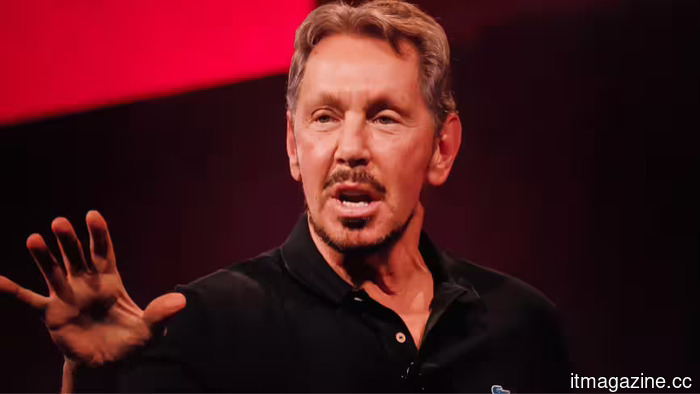
Oracle's $16.3 billion financing for data centers needed PIMCO to step in and provide $10 billion after U.S. banks withdrew.
In summary: Oracle has secured a $16.3 billion financing deal for a single data center campus in Saline Township, Michigan, marking the largest technology debt package for a single facility ever created. PIMCO took the lead on about $10 billion of the bond tranche as U.S. banks withdrew from the agreement, expressing concerns over the sustainability of demand for AI infrastructure. This financing is part of a larger $72 billion in data center partner debt that Oracle has accumulated across Michigan, Texas, Wisconsin, and New Mexico for the Stargate joint venture, which is heavily supported by OpenAI, a single counterparty with a BBB-negative credit outlook and $553 billion in performance obligations.
Oracle's $16.3 billion data center financing was finalized this week, representing the largest single-facility technology debt package ever put together. This required a bond fund to support it since U.S. banks were unwilling to participate. According to Bloomberg, PIMCO, the world’s leading active fixed-income manager, acquired around $10 billion of the approximately $14 billion bond tranche. The rest of the funding includes about $2 billion in equity from Related Digital Infrastructure and Blackstone, with Bank of America structuring the deal and Goldman Sachs and Wells Fargo advising Related Digital. This financing pertains to a single data center campus in Saline Township, Michigan, intended to exceed one gigawatt of capacity and serve the Stargate project, a joint venture announced in January 2025 with SoftBank, which is central to U.S. AI infrastructure investments.
The structure
The bonds feature a 7.5% coupon and a 19.5-year maturity, arranged with six years of only interest payments followed by 13 years of amortization. This financing is not inexpensive. Oracle’s corporate bonds trade at much narrower spreads. The premium is indicative of the project finance nature of this deal: the bonds are secured by the Michigan campus rather than Oracle’s overall financial standing, meaning investors are financing against the expected cash flows of a single facility instead of the credibility of a $400 billion company. This structure isolates the risk while pricing it accordingly. With a 7.5% rate over nearly two decades, the total interest cost will surpass the principal, and this financing model only makes economic sense if the facility begins generating revenue immediately and maintains occupancy for the loan’s length. Oracle's $553 billion in outstanding performance obligations, reported in the third quarter of fiscal 2026, supports this demand assumption, but the associated risk is considerable due to its concentration. A large portion of those obligations is linked to OpenAI.
Earlier this month, TD Cowen reported that U.S. banks have been stepping back from financing Oracle data centers, expressing doubts about the long-term viability of AI infrastructure demand at Oracle's projected scale. This withdrawal is why PIMCO ended up anchoring $10 billion of the bond offering. The departure of traditional lenders from a deal does not inherently indicate the deal is flawed; it suggests that the risk-reward assessment has shifted to a point where banks, bound by regulatory capital requirements and exposure limits, cannot rationalize the investment. Asset managers such as PIMCO, which manage discretionary capital with longer timeframes, can do so. However, this shift is significant. The largest data center financing in history required the bond market to step in where the banking sector hesitated.
The scale
The Michigan campus is not the sole megaproject from Oracle in the data center space. It is not even the biggest. Oracle has managed to gather at least $72 billion in total data center partner debt across three primary financing packages: the $16.3 billion Michigan deal, around $38 billion for campuses in Texas and Wisconsin, and about $18 billion for a facility in New Mexico. All these facilities are being developed to support the Stargate joint venture and Oracle's broader cloud infrastructure strategy. Oracle's capital expenditure for fiscal 2026 is projected to reach roughly $50 billion, more than double last year’s figure. This $50 billion capex plan announced by CFO Hilary Maxson marks Oracle's largest infrastructure investment cycle and has stretched its balance sheet to a point that led S&P and Moody's to assign negative outlooks to Oracle’s BBB and Baa2 credit ratings, respectively. Analysts at UBS have indicated a junk rating downgrade is improbable, but the trend is evident: Oracle is maximizing its investment-grade rating to the limit of market tolerance.
The immense capital influx into AI data centers has established a parallel financial infrastructure. Jane Street's participation in CoreWeave's $6 billion debt facility and $1 billion equity raise illustrates that Wall Street's leading trading entities view AI cloud infrastructure as a viable fixed-income opportunity. Blackstone’s $10 billion data center debt financing in Australia via Firmus showcased a similar trend occurring on a different continent. Bain Capital's $5 billion stake divestiture in Bridge Data Centres confirmed that private equity regards data center infrastructure as a tradable
Other articles
 AI stocks compared to the dot-com bubble: CAPE ratio at 38, concentration exceeds levels seen in 2000, but these companies are genuinely profitable.
The Shiller CAPE stands between 38 and 40, only surpassed by the dot-com peak of 44.19. The concentration in the top 10 exceeds levels seen in 2000. However, Nvidia generated $120 billion, and tech stocks are trading at 30 times earnings, not 50 times. Both perspectives hold validity.
Sequoia hands out 200 engraved Mac Minis at the AI event as OpenClaw establishes itself as the infrastructure layer that venture capitalists cannot possess.
Alfred Lin distributed 200 engraved Mac Minis that operate on OpenClaw, the open-source AI agent framework that has outperformed Apple's stock and exceeded React on GitHub. Sequoia is unable to invest in it. That is the approach being used.
Sequoia hands out 200 engraved Mac Minis at an AI event as OpenClaw emerges as the infrastructure layer that VCs cannot control.
Alfred Lin distributed 200 engraved Mac Minis that operate on OpenClaw, an open-source AI agent framework that has surpassed Apple's stock sales and outperformed React on GitHub. Sequoia is unable to invest in it. This is the approach being taken.
AI stocks compared to the dot-com bubble: CAPE ratio at 38, concentration exceeds levels seen in 2000, but these companies are genuinely profitable.
The Shiller CAPE stands between 38 and 40, only surpassed by the dot-com peak of 44.19. The concentration in the top 10 exceeds levels seen in 2000. However, Nvidia generated $120 billion, and tech stocks are trading at 30 times earnings, not 50 times. Both perspectives hold validity.
Sequoia hands out 200 engraved Mac Minis at the AI event as OpenClaw establishes itself as the infrastructure layer that venture capitalists cannot possess.
Alfred Lin distributed 200 engraved Mac Minis that operate on OpenClaw, the open-source AI agent framework that has outperformed Apple's stock and exceeded React on GitHub. Sequoia is unable to invest in it. That is the approach being used.
Sequoia hands out 200 engraved Mac Minis at an AI event as OpenClaw emerges as the infrastructure layer that VCs cannot control.
Alfred Lin distributed 200 engraved Mac Minis that operate on OpenClaw, an open-source AI agent framework that has surpassed Apple's stock sales and outperformed React on GitHub. Sequoia is unable to invest in it. This is the approach being taken.
 I'm still using the original Switch in 2026. It simply works since everything else has become too complicated.
The original Switch from Nintendo may be less powerful than current handheld devices, but by 2026, its straightforwardness seems less of a drawback and more like a key feature.
Foundation Future Industries secures $24 million in Pentagon contracts for humanoid robot soldiers, supported by Eric Trump and trialed in Ukraine.
Foundation Future Industries has obtained $24 million in contracts from the Pentagon for humanoid robots that have been tested in Ukraine. The company's CEO previously led a bankrupt fintech firm, an adviser to the company is Eric Trump, and it is seeking $500 million with a valuation exceeding $3 billion.
I'm still using the original Switch in 2026. It simply works since everything else has become too complicated.
The original Switch from Nintendo may be less powerful than current handheld devices, but by 2026, its straightforwardness seems less of a drawback and more like a key feature.
Foundation Future Industries secures $24 million in Pentagon contracts for humanoid robot soldiers, supported by Eric Trump and trialed in Ukraine.
Foundation Future Industries has obtained $24 million in contracts from the Pentagon for humanoid robots that have been tested in Ukraine. The company's CEO previously led a bankrupt fintech firm, an adviser to the company is Eric Trump, and it is seeking $500 million with a valuation exceeding $3 billion.
Oracle's $16.3 billion financing for data centers needed PIMCO to step in and provide $10 billion after U.S. banks withdrew.
PIMCO acquired $10 billion of Oracle's unprecedented $16.3 billion data center bond offering after U.S. banks stepped back. The Michigan campus is included in the $72 billion Stargate infrastructure debt, which has a maturity of 19.5 years.