
Foundation Future Industries secures $24 million in Pentagon contracts for humanoid robotic soldiers, with support from Eric Trump and having undergone testing in Ukraine.
**TL;DR** Foundation Future Industries, a San Francisco startup led by a CEO with a history in a bankrupt fintech, has acquired $24 million in Pentagon research contracts for testing humanoid robots intended for enemy position breaches. Two Phantom MK-1 units were deployed to Ukraine in February for logistics and reconnaissance evaluations. With Eric Trump as the chief strategy adviser, Senator Warren has labeled the contracts as “corruption in plain sight.” Foundation is aiming to raise $500 million at a valuation exceeding $3 billion; however, its goal to produce 50,000 units by 2027 from an initial 40 requires a significant scaling of 250 times on about $21 million in funding.
Foundation Future Industries, established in April 2024 in San Francisco, has landed $24 million in research contracts with the US Army, Navy, and Air Force for humanoid robots engineered for breaching enemy defenses. The Phantom MK-1 stands 5 feet 9 inches tall, weighs 176 pounds, possesses 19 upper-body degrees of freedom, features five-fingered hands, incorporates a camera-first vision system, and includes an LLM-driven autonomy framework that enables both independent and supervised teleoperation. Two units were dispatched to Ukraine in February for testing in logistics and reconnaissance, marking the first deployment of humanoid robots in a combat environment. The company seeks $500 million in funding at a valuation of over $3 billion. Its chief strategy adviser is Eric Trump, the son of the current president, which prompted Senator Elizabeth Warren to criticize the Pentagon contracts as blatant corruption. The company’s CEO had a prior fintech venture that went bankrupt, leaving millions in consumer deposits unaccounted for.
**The machine**
The Phantom MK-1 moves at a speed of 1.7 meters per second, carries a payload of 44 pounds, operates with eight cameras instead of bulky LiDAR, and employs proprietary cycloidal actuators delivering up to 160 newton-metres of torque. Its AI architecture converts high-level task instructions into movement through an LLM pipeline, allowing operators to retain ultimate authority over lethal decisions. The unit costs roughly $150,000, with a leasing option at $100,000 annually. The MK-2, set to release this month, will streamline electronics to minimize short-circuit risks, introduce waterproofing and larger batteries, augment payload capacity to 175 pounds, and utilize cast-moulded bodywork to accelerate manufacturing and cut costs. Foundation's production goals are to manufacture 40 units in 2025, 10,000 in 2026, and 50,000 by the conclusion of 2027, aiming for a consistent output of 30,000 annually. Achieving these target numbers would necessitate a 250-fold increase in manufacturing capacity within two years based on a funding base of approximately $21 million.
The company was founded by Sankaet Pathak, who previously served as CEO of Synapse, a banking-as-a-service entity that went bankrupt in 2024; Arjun Sethi, CEO of Tribe Capital, which contributed to Foundation's $11 million pre-seed funding; and Mike LeBlanc, a 14-year Marine Corps veteran and co-founder of Cobalt Robotics. LeBlanc lends military credibility to the venture and has stated that there is a “moral imperative” to deploy these robots in warfare instead of human soldiers. In June 2024, CNBC reported that Foundation had been raising funds while making inflated claims about its connections to General Motors, including claims of GM’s commitment to invest and a $300 million purchase order. GM categorically denied these assertions. LeBlanc acknowledged the denial, expressing embarrassment over the marketing materials. For a company urging the Pentagon to trust its robots in combat, maintaining credibility is vital.
The $24 million in Pentagon contracts includes an SBIR Phase 3 designation, confirming Foundation as an authorized military vendor, along with specific research agreements for testing humanoid robots in breaching scenarios. Some contracts were acquired through the purchase of a company called Boardwalk, including a US Air Force SBIR award worth around $1.8 million. Eric Trump promoted the contracts on Fox Business. Warren responded quickly, questioning, “Is the Pentagon a cash machine for Trump’s kids?” The political aspect is unavoidable. The involvement of a sitting president’s son as chief strategy adviser to a company receiving Defense Department contracts raises governance concerns irrespective of the company’s technological capabilities. While the contracts are genuine, they are relatively small-scale. In comparison, Shield AI raised $2 billion to enhance its autonomous combat pilot system, known as Hivemind, which operates aircraft autonomously. Anduril secured a significant $20 billion, ten-year contract with the US Army in March for its AI-enabled Lattice platform. Foundation's $24 million represents a research agreement rather than a production order. The gap between a research contract and an operational weapons system spans billions of dollars and years of testing.
**
Other articles
 Tesla provides one year of complimentary Supercharging with the Model 3 Premium and Performance options.
Tesla is providing a year of complimentary Supercharging for the Model 3 Premium and Performance models, which helps to lower ownership expenses while enhancing its charging network benefits.
Tesla provides one year of complimentary Supercharging with the Model 3 Premium and Performance options.
Tesla is providing a year of complimentary Supercharging for the Model 3 Premium and Performance models, which helps to lower ownership expenses while enhancing its charging network benefits.
 I never imagined that AI would introduce typos – but it actually makes some sense.
A new AI tool intentionally introduces typos into emails, highlighting a trend where flawed writing is perceived as more genuine and reliable in an era of AI-generated messages.
I never imagined that AI would introduce typos – but it actually makes some sense.
A new AI tool intentionally introduces typos into emails, highlighting a trend where flawed writing is perceived as more genuine and reliable in an era of AI-generated messages.
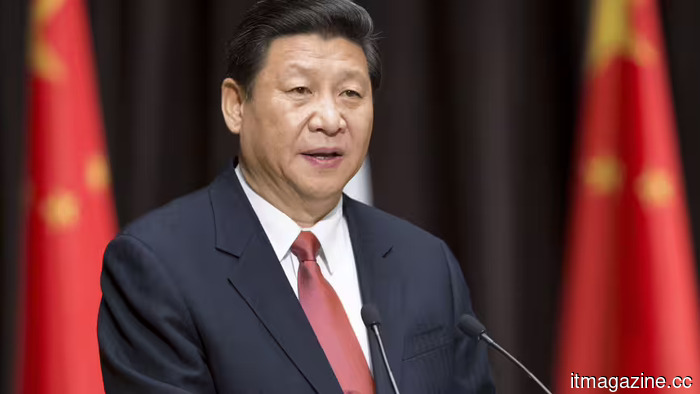 Beijing issues a warning to the EU following the inclusion of 27 Chinese companies in the 20th sanctions package against Russia and responds by taking action against European defense firms.
China criticized the European Union's 20th sanctions package, which affects 27 Chinese entities, and responded within a day by targeting seven EU defense companies. Europe's rearmament relies on the rare earth materials that Beijing possesses.
Foundation Future Industries secures $24 million contracts from the Pentagon for humanoid robot soldiers, supported by Eric Trump and evaluated in Ukraine.
Foundation Future Industries has obtained $24 million in contracts from the Pentagon for humanoid robots that were tested in Ukraine. The company's CEO previously led a bankrupt fintech, one of its advisers is Eric Trump, and it is seeking $500 million at a valuation exceeding $3 billion.
Beijing issues a warning to the EU following the inclusion of 27 Chinese companies in the 20th sanctions package against Russia and responds by taking action against European defense firms.
China criticized the European Union's 20th sanctions package, which affects 27 Chinese entities, and responded within a day by targeting seven EU defense companies. Europe's rearmament relies on the rare earth materials that Beijing possesses.
Foundation Future Industries secures $24 million contracts from the Pentagon for humanoid robot soldiers, supported by Eric Trump and evaluated in Ukraine.
Foundation Future Industries has obtained $24 million in contracts from the Pentagon for humanoid robots that were tested in Ukraine. The company's CEO previously led a bankrupt fintech, one of its advisers is Eric Trump, and it is seeking $500 million at a valuation exceeding $3 billion.
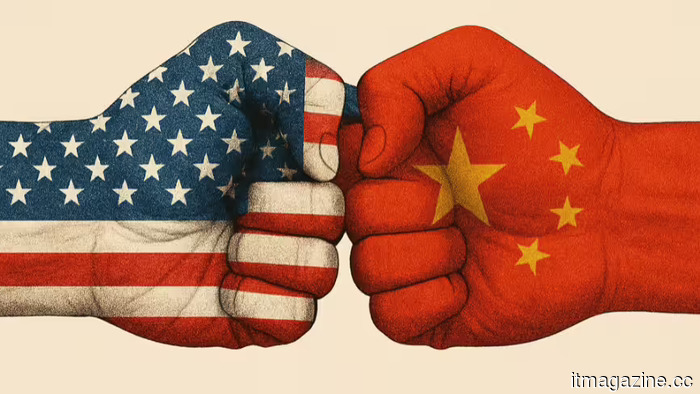 The United States aims to restrict China's access to chip manufacturing equipment. In response, China claims that this move will disrupt the supply chain for all parties involved.
China cautions that the MATCH Act could disturb global chip supply chains as the U.S. Congress moves forward with the most extensive export control markup in history.
The United States aims to restrict China's access to chip manufacturing equipment. In response, China claims that this move will disrupt the supply chain for all parties involved.
China cautions that the MATCH Act could disturb global chip supply chains as the U.S. Congress moves forward with the most extensive export control markup in history.
Foundation Future Industries secures $24 million in Pentagon contracts for humanoid robotic soldiers, with support from Eric Trump and having undergone testing in Ukraine.
Foundation Future Industries has obtained $24 million in contracts from the Pentagon for humanoid robots that were tested in Ukraine. The company's CEO previously led a fintech that went bankrupt, and Eric Trump serves as an adviser. They are seeking $500 million at a valuation exceeding $3 billion.