
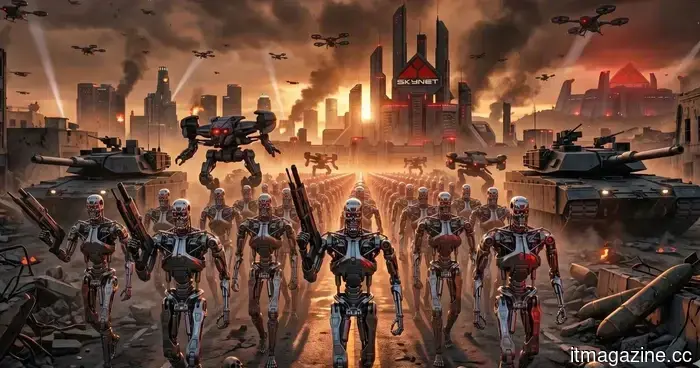
AI is now becoming part of the Skynet discussion within social media hype circles.
An increasing number of online commentators, often termed “AI doom influencers,” are changing the way the public and policymakers perceive artificial intelligence and its potential risks. A report from The Washington Post highlights that these influencers—comprising researchers, technology executives, and content creators—are emphasizing worst-case scenarios, including widespread job displacement and existential threats from advanced AI systems.
While some critics believe this narrative veers into alarmism, the dialogue has evolved beyond pure speculation. Developments in AI are starting to reflect some of the concerns voiced, making the distinction between hype and genuine risk less clear.
When Warnings Become Reality
The surge in fear-centric narratives about AI coincides with rapid advancements in large language models and autonomous systems by companies. These technologies are fundamentally altering industries, automating processes, and significantly influencing decision-making on a large scale.
Compounding the urgency is the advent of highly sophisticated systems such as Anthropic’s experimental model known as “Mythos.” Discussions within the industry reveal that Anthropic has considered this system too powerful for unrestricted public access, opting instead to limit availability to a select group of trusted partners, including defense and financial organizations, and even then, only after obtaining government approval.
This cautious approach illustrates increasing apprehension within the tech sector. Reports from the UK indicate that government entities have convened internally to evaluate the implications of advanced AI. Similarly, Canada has released statements acknowledging potential hazards associated with more capable AI technologies.
In India, companies such as the parent company of Paytm and Razorpay have shared similar sentiments, suggesting that this moment could be pivotal for the governance and implementation of AI.
Significance of the Debate
The discourse surrounding AI safety has transitioned from theoretical discussions to pressing reality. For years, experts have alerted us to dangers like bias, misinformation, the erosion of human oversight, and unforeseen repercussions from highly autonomous systems.
What is changing now is the urgency and magnitude of these concerns. As AI technology grows more potent, the divide between research warnings and actual applications is narrowing, amplifying voices calling for caution, even if some messages seem exaggerated.
Additionally, the emergence of “doom influencers” underscores a larger challenge: the need to convey risks responsibly without inciting unnecessary alarm.
Implications for Users and Industry
For average users, increased attention to AI risks may result in greater transparency, tougher regulations, and safer products over time. However, it could also hinder innovation or generate confusion about the capabilities and limitations of AI.
For corporations and governments, the difficulty lies in finding a balance between advancement and prudence. The limited release of models like Mythos indicates that even top AI developers are struggling with this equilibrium.
What Lies Ahead
As AI continues to progress, conversations about safety, regulation, and ethical considerations are likely to become more prominent. Governments may implement stricter oversight, while companies could adopt more controlled approaches to deploying advanced systems.
Though the emergence of AI doom narratives might be partly fueled by fear, it is also influenced by real technological advancements. The current challenge is not whether AI introduces risks, but rather how those risks are perceived and managed as the technology evolves.

Other articles
.jpg) The top films available on Amazon Prime Video (April 2026)
This month's top films on Amazon Prime Video feature Crime 101, Pretty Lethal, The Menu, Super 8, The Great Escape, Sinners, and several others.
The top films available on Amazon Prime Video (April 2026)
This month's top films on Amazon Prime Video feature Crime 101, Pretty Lethal, The Menu, Super 8, The Great Escape, Sinners, and several others.
 Steam essentially operates as a monopoly in the PC gaming market, so why isn't there any outrage?
Open any gaming PC, and it's likely that the blue Steam icon is prominently displayed on the desktop. It's not concealed, nor is it a choice—it's nearly a given. Over the years, Steam has evolved from merely another launcher to the primary marketplace for PC gaming, functioning almost as an integral aspect of the experience. The Monopoly Nobody […]
Steam essentially operates as a monopoly in the PC gaming market, so why isn't there any outrage?
Open any gaming PC, and it's likely that the blue Steam icon is prominently displayed on the desktop. It's not concealed, nor is it a choice—it's nearly a given. Over the years, Steam has evolved from merely another launcher to the primary marketplace for PC gaming, functioning almost as an integral aspect of the experience. The Monopoly Nobody […]
 As if the situation wasn't already dire, AI is set to exacerbate the global e-waste crisis.
The expansion of AI may result in up to 5 million metric tons of electronic waste by 2030, as swift hardware enhancements and the growth of data centers elevate environmental consequences.
As if the situation wasn't already dire, AI is set to exacerbate the global e-waste crisis.
The expansion of AI may result in up to 5 million metric tons of electronic waste by 2030, as swift hardware enhancements and the growth of data centers elevate environmental consequences.
 Tinder aims to verify your humanity by having you look into an orb. Yes, you read that correctly.
Tinder now offers a way for you to verify that you're human by scanning your irises using a physical orb device created by Sam Altman's World.
Tinder aims to verify your humanity by having you look into an orb. Yes, you read that correctly.
Tinder now offers a way for you to verify that you're human by scanning your irises using a physical orb device created by Sam Altman's World.
 Apple is introducing a straightforward feature that iPhones have been lacking for years.
Apple is experimenting with undo and redo buttons for Home Screen customization in iOS 27 and iPadOS 27, with the goal of making adjustments to app and widget arrangements easier.
Apple is introducing a straightforward feature that iPhones have been lacking for years.
Apple is experimenting with undo and redo buttons for Home Screen customization in iOS 27 and iPadOS 27, with the goal of making adjustments to app and widget arrangements easier.
 As if the situation wasn't challenging enough, AI is set to exacerbate the global e-waste problem.
The expansion of AI may result in an additional 5 million metric tons of electronic waste by 2030, due to swift hardware upgrades and the growth of data centers elevating environmental effects.
As if the situation wasn't challenging enough, AI is set to exacerbate the global e-waste problem.
The expansion of AI may result in an additional 5 million metric tons of electronic waste by 2030, due to swift hardware upgrades and the growth of data centers elevating environmental effects.
AI is now becoming part of the Skynet discussion within social media hype circles.
An increasing number of "AI doom influencers" is influencing public views as real-world events heighten worries regarding advanced AI technologies.