

8 top supplier management software solutions for 2026
As of 2026, I have over a decade of experience in analyzing procurement technology and supply chain logistics for public companies. One key takeaway from these evaluations is that effective supplier management can significantly influence a business's success or failure. The current levels of third-party risk are unprecedented, with tariffs, taxes, and supply chain complexities leading to increased volatility. Additionally, there is a growing emphasis on regulatory compliance. Relying on disconnected systems, spreadsheets, and isolated email communications to manage suppliers is no longer a viable approach; thus, contemporary organizations are adopting next-generation supplier management software.
Supplier management software serves as a digital framework to oversee every interaction your business has with third-party vendors. It centralizes supplier information, tracks performance metrics, monitors compliance, and manages risks.
However, the functionalities expected of this software are rapidly changing in 2026. Traditionally, such tools were viewed merely as digital filing cabinets. Nowadays, the most advanced platforms actively engage in your procurement strategies. They employ AI to analyze documents, assess risks, and notify you of compliance issues before they escalate into costly problems. Effective supplier management software supports you from the initial request for a supplier, ensuring no vendor enters your network without adequate vetting.
How to select the best supplier management software in 2026
Selecting the appropriate platform necessitates a strategic mindset. First, assess the total cost of ownership. Many outdated platforms may seem affordable upfront but require costly external consultants for implementation and upkeep.
Second, emphasize user adoption. If the software is overly complicated or bloated, it will create challenges for your procurement and legal teams, hindering uptake.
Third, seek unification. A common error I observe is organizations opting for a point solution for vendor onboarding, another for contract management, and yet another for spend analysis. This leads to data silos and increases complexity and risk. The most successful companies choose platforms that integrate contracting, third-party compliance, and spend management into a cohesive source of truth.
Our Methodology
To identify the leading supplier management software for 2026, I carried out a thorough market evaluation based on the following criteria:
Verified User Reviews: Examined feedback from independent platforms like G2 and Capterra to gauge real-world performance.
Common Pain Points: Focused on customer concerns regarding implementation duration, user interface issues, and customer support response times.
Data Unification: Assessed each platform’s ability to unify contracting, compliance, and spending data.
Native AI Capabilities: Evaluated the availability and effectiveness of built-in AI tools, along with their practical utility.
Overall Value: Considered the value proposition for mid-market and enterprise organizations.
The following list highlights the most competent tools currently available.
The 8 best supplier management software platforms for 2026
1. Gatekeeper
Best for: Unified contracting, compliance, and spend management.
Pros:
The sole unified platform linking vendors, contracts, and spending.
An integrated AI layer automates monitoring without additional add-ons.
Built for ease of use, requiring no training for rapid value realization.
Cons:
Not a complete Procure to Pay suite for those seeking legacy ERP replacements.
Summary:
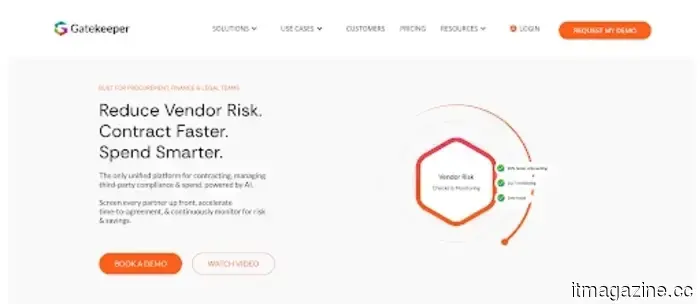
Gatekeeper is the only unified solution connecting contracting, third-party compliance, and spend management within a single system. Unlike competitors that offer point solutions addressing just one of these areas, Gatekeeper removes fragmentation. It provides a single audit trail and a unified source of truth for each contract, third-party engagement, and every monetary commitment. Its built-in AI, LuminIQ, automates monitoring, extraction, scoring, and alerts without needing a separate tool.
2. Coupa
Best for: Comprehensive procure-to-pay workflow automation.
Pros:
Strong ERP integration with SAP and Oracle.
Robust financial tracking audit trails.
Cons:
Overly complex and expensive for businesses not requiring full P2P overhaul.
Customer service is often reported as inadequate.
Summary:
Coupa is a leading player in the spend management arena, providing extensive tools for enterprises seeking to revamp their financial systems. However, G2 users frequently describe the platform as tough to customize to specific needs, often necessitating reliance on external resources post-setup. Additionally, many reviews point out the slow response times of customer service. If a massive Procure to Pay transformation isn't required, Coupa might be overly complicated for your organization.
3. Ivalua
Best for: Manufacturing and intricate supply chains.
Pros:
Effectively centralizes supplier information.
Well-suited for direct materials sourcing.
Cons:
Implementation is infamously slow.
Requires substantial technical resources for maintenance.
Summary:
Ivalua caters to large organizations with complex source-to-pay needs, particularly popular in manufacturing. While it boasts robust supplier relationship management features, it is not known for flexibility. Capterra users have noted the system's rigidity and challenges in adaptation without developer assistance. It is a substantial platform demanding a dedicated internal team for effective management, making it less ideal for agile teams.
4. SAP Ariba
Best for: Global




Other articles
 Google forms a four-partner chip supply chain with Broadcom, MediaTek, and Marvell to compete with Nvidia in inference.
Google's custom chip initiative involves four design partners and a dual-track TPU v8 roadmap at TSMC's 2nm process, making its inference silicon a significant competitor to Nvidia.
Google forms a four-partner chip supply chain with Broadcom, MediaTek, and Marvell to compete with Nvidia in inference.
Google's custom chip initiative involves four design partners and a dual-track TPU v8 roadmap at TSMC's 2nm process, making its inference silicon a significant competitor to Nvidia.
 Lego Batman seems like the top Dark Knight game in a long time, and I eagerly anticipate it.
Lego Batman hasn't been released yet, but it's already achieving more for the Dark Knight than recent major failures. Fans of Arkham may finally have a reason to be happy.
Lego Batman seems like the top Dark Knight game in a long time, and I eagerly anticipate it.
Lego Batman hasn't been released yet, but it's already achieving more for the Dark Knight than recent major failures. Fans of Arkham may finally have a reason to be happy.
 Google's upcoming wearable might be the screen-free Fitbit Air, aiming to challenge Whoop's dominance.
Google's forthcoming screen-less band will be named the Fitbit Air. The company intends to rebrand Fitbit Premium as Google Health, integrating wellness features more closely with the Google brand.
Google's upcoming wearable might be the screen-free Fitbit Air, aiming to challenge Whoop's dominance.
Google's forthcoming screen-less band will be named the Fitbit Air. The company intends to rebrand Fitbit Premium as Google Health, integrating wellness features more closely with the Google brand.
 OnePlus' gaming controller for smartphones features an impressive charging trick that you're sure to appreciate.
At first glance, the OnePlus Ace 6 Ultra controller appears to be a typical gaming accessory; however, its open mid-section design might simplify charging and cooling during extended mobile gaming sessions.
OnePlus' gaming controller for smartphones features an impressive charging trick that you're sure to appreciate.
At first glance, the OnePlus Ace 6 Ultra controller appears to be a typical gaming accessory; however, its open mid-section design might simplify charging and cooling during extended mobile gaming sessions.
 What’s the truth behind the absence of MagSafe on the iPhone Fold?
Leaked cases for the iPhone Fold indicate that MagSafe remains included, even though previous dummy units lacked it, emphasizing the significant difficulty of incorporating magnets into a super-slim foldable design.
What’s the truth behind the absence of MagSafe on the iPhone Fold?
Leaked cases for the iPhone Fold indicate that MagSafe remains included, even though previous dummy units lacked it, emphasizing the significant difficulty of incorporating magnets into a super-slim foldable design.
 Motorola has recently released the Android 17 beta for additional Razr and Edge devices.
Motorola is expanding access to the Android 17 beta for more premium devices, including two Razr models and the Edge 50 Ultra in different regions.
Motorola has recently released the Android 17 beta for additional Razr and Edge devices.
Motorola is expanding access to the Android 17 beta for more premium devices, including two Razr models and the Edge 50 Ultra in different regions.
8 top supplier management software solutions for 2026
Evaluate the top supplier management software solutions for 2026, highlighting AI functionalities, compliance features, and tools designed to integrate supplier, contract, and spending information.