
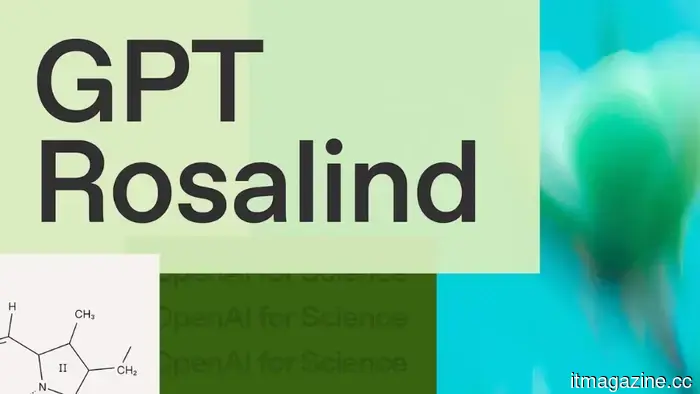
OpenAI introduces GPT-Rosalind, an AI model designed for research in life sciences.
Named after the crystallographer who played a crucial role in uncovering the structure of DNA, GPT-Rosalind is OpenAI's inaugural series of models tailored for specific domains, specialized in biochemistry, genomics, and protein engineering. Access is limited to a trusted-access program for approved enterprise clients, including Amgen, Moderna, and Thermo Fisher Scientific.
On Thursday, OpenAI introduced GPT-Rosalind, a cutting-edge reasoning model created specifically for life sciences research. The model aims to assist with evidence synthesis, hypothesis generation, experimental planning, and multi-step scientific workflows in biochemistry, genomics, and protein engineering, marking OpenAI's first series of models designed for specific purposes.
It is available as a research preview within ChatGPT, Codex, and the OpenAI API, but access is confined to a trusted-access program for qualified enterprise customers situated in the United States. The model is named in honor of Rosalind Franklin, the British chemist and X-ray crystallographer whose diffraction images of DNA were crucial in revealing the structure of the double helix, and whose contributions were notably absent from the 1962 Nobel Prize awarded to Watson, Crick, and Wilkins.
This naming serves as a significant acknowledgment: Franklin's work is now widely considered foundational to modern molecular biology, and she is a central figure in discussions concerning the marginalization of women in scientific history.
OpenAI presents GPT-Rosalind as a means to shorten the duration from scientific concept to clinical evidence. The company estimates that it typically takes about 10 to 15 years to transition a drug from target discovery to regulatory approval in the U.S. GPT-Rosalind is positioned to aid during the initial phases: it can access specialized databases, analyze scientific literature, engage with computational tools, and propose new experimental approaches all within a single interface.
In conjunction with the model, OpenAI is also launching a Life Sciences research plugin for Codex that links models to over 50 scientific tools and data sources, allowing researchers programmatic access to biological databases and computational workflows.
Launch partners encompass Amgen, Moderna, Thermo Fisher Scientific, and the Allen Institute. OpenAI is also collaborating with Los Alamos National Laboratory on AI-assisted protein and catalyst design.
According to benchmark performance data provided by OpenAI, GPT-Rosalind achieved a 0.751 pass rate on BixBench, a bioinformatics benchmark created by Edison Scientific that assesses models on real-world computational biology tasks. On LABBench2, a broader research task benchmark, the model surpassed GPT-5.4 in six out of eleven tasks, with its most notable advantage seen in CloningQA, which involves the complete design of reagents for molecular cloning protocols.
Remarkably, a third-party evaluation performed with Dyno Therapeutics, a gene therapy company focused on designing AAV capsid proteins, provided striking performance signals. Utilizing unpublished RNA sequences to prevent benchmark contamination, GPT-Rosalind was evaluated on sequence-to-function prediction and sequence generation tasks. The best submission out of ten ranked in the above 95th percentile of human experts for the prediction task and around the 84th percentile for sequence generation, as reported by OpenAI and corroborated by multiple sources covering the launch.
The rollout comes with significant dual-use warnings that OpenAI has addressed through its access model. Experts have cautioned that AI models trained on biological data might be misused to design harmful pathogens. OpenAI's choice to limit access solely to a vetted trusted-access program—requiring organizations to demonstrate their commitment to enhancing human health and upholding stringent security and governance measures—directly responds to this concern. During the research preview stage, usage will not count against existing API credits.
Other articles
 Canva can now automate repetitive tasks and assist you in creating interactive experiences without the need for coding.
Canva is launching automation features that enable users to schedule tasks such as weekly content creation and meeting briefings to operate automatically. Furthermore, its enhanced no-code tools permit users to create and improve interactive experiences using straightforward prompts.
Canva can now automate repetitive tasks and assist you in creating interactive experiences without the need for coding.
Canva is launching automation features that enable users to schedule tasks such as weekly content creation and meeting briefings to operate automatically. Furthermore, its enhanced no-code tools permit users to create and improve interactive experiences using straightforward prompts.
 Envision AESC is contemplating a $2 billion initial public offering in Hong Kong.
Envision AESC, the electric vehicle battery manufacturer backed by GIC and owned by China's Envision Group, is considering an initial public offering in Hong Kong that might generate as much as $2 billion.
Envision AESC is contemplating a $2 billion initial public offering in Hong Kong.
Envision AESC, the electric vehicle battery manufacturer backed by GIC and owned by China's Envision Group, is considering an initial public offering in Hong Kong that might generate as much as $2 billion.
 A $400 discount on the Samsung Galaxy Z Fold7 makes the most daring Android phone of 2025 significantly more accessible.
The Samsung Galaxy Z Fold7 is now available for $1,719.99 in a limited-time offer, which is a $400 discount from its original price of $2,119.99. This is the 512GB variant that is definitely worth considering. Foldable phones have significantly developed over the past two generations, and the Z Fold7 strongly demonstrates that the form factor has […]
A $400 discount on the Samsung Galaxy Z Fold7 makes the most daring Android phone of 2025 significantly more accessible.
The Samsung Galaxy Z Fold7 is now available for $1,719.99 in a limited-time offer, which is a $400 discount from its original price of $2,119.99. This is the 512GB variant that is definitely worth considering. Foldable phones have significantly developed over the past two generations, and the Z Fold7 strongly demonstrates that the form factor has […]
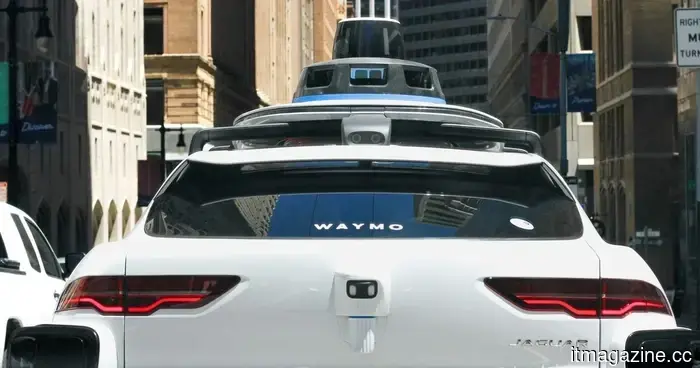 This AI enables self-driving cars to "remember" previous journeys in order to determine safer routes.
A new planning approach named KEPT enables self-driving vehicles to compare their current observations with similar past traffic scenarios, which helps reduce prediction errors and minimizes the likelihood of collisions.
This AI enables self-driving cars to "remember" previous journeys in order to determine safer routes.
A new planning approach named KEPT enables self-driving vehicles to compare their current observations with similar past traffic scenarios, which helps reduce prediction errors and minimizes the likelihood of collisions.
 The upcoming Pixel phone may feature a luminous back, based on insights from Android 17’s code.
Google is developing a new feature named Pixel Glow that utilizes soft lights on the back of your device to alert you without illuminating the screen.
The upcoming Pixel phone may feature a luminous back, based on insights from Android 17’s code.
Google is developing a new feature named Pixel Glow that utilizes soft lights on the back of your device to alert you without illuminating the screen.
 Stockholm's BioLamina obtains a €20 million loan from the EIB.
BioLamina has obtained a €20 million loan from the EIB to enhance its laminin protein technologies utilized in stem cell therapies and animal-free drug safety evaluations.
Stockholm's BioLamina obtains a €20 million loan from the EIB.
BioLamina has obtained a €20 million loan from the EIB to enhance its laminin protein technologies utilized in stem cell therapies and animal-free drug safety evaluations.
OpenAI introduces GPT-Rosalind, an AI model designed for research in life sciences.
OpenAI has introduced GPT-Rosalind, its inaugural AI model focused on life sciences, aimed at drug discovery and genomics. The model is named in honor of Rosalind Franklin.