
Gmail on mobile now features end-to-end encryption to protect your emails from prying eyes.
A year after its initial launch on desktop, Gmail's premier privacy feature finally makes its way to where the majority of enterprise emails are written: mobile.
Your most confidential emails on Gmail now have improved privacy protection on your mobile device. Google has officially begun the rollout of end-to-end encryption (E2EE) for Gmail on Android and iOS devices.
For the first time, eligible Android and iOS users can compose and read encrypted emails directly within the Gmail app, eliminating the need to download and install third-party applications.
How does E2EE function in Gmail for mobile?
Gmail's E2EE was first introduced for desktop users in April 2025, coinciding with its 21st anniversary. Support for external recipients was added later in October 2025. However, the feature was not available on smartphones, creating a significant privacy gap.
The April 2026 update finally addresses this issue. If you're familiar with E2EE from other messaging applications, you can easily understand how it operates in Gmail: only you and your recipient can access the content of the email.
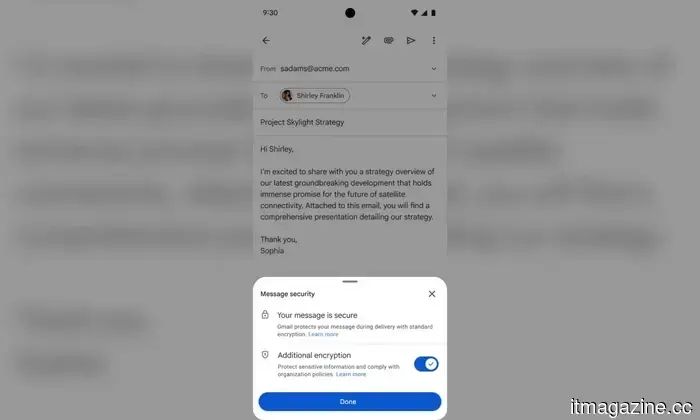
When composing an email, you can tap the lock icon, enable the “additional encryption” option, and send the email. If the recipient uses Gmail, the email will appear in their inbox like a standard message. If they're using another platform, they'll receive a secure link to read and respond through a web browser (without needing a Gmail account).
Who can access E2EE on Gmail for mobile?
Here’s the stipulation: Gmail's E2EE on mobile is available only for Google Workspace Enterprise Plus accounts with the Assured Controls or Assured Controls Plus add-on. Administrators must first enable mobile access through the client-side encryption interface.
This means that personal Gmail users on mobile will not have access to this feature. Nevertheless, by aligning Gmail for web and mobile, Google has alleviated a major concern for businesses assessing Workspace in comparison to Microsoft 365.
For over five years, Shikhar has been accurately simplifying advancements in consumer technology and sharing insights...
The invisible workers of the influencer economy face the first wave of job losses due to AI advancements. The stars will continue to post, but the freelancers in the Philippines, India, and Latin America who helped build their influence may not be as fortunate.
During a 2024 visit to Dharamshala, a renowned spiritual center in India, I was taken aback by the number of remote workers at cafes, engrossed in their laptops. At least three of my dorm mates mentioned they manage social media content for US-based creators with large followings. One ambitious 17-year-old explained that she handled regional YouTube channels for a popular US creator with more than three million subscribers and was eager to capture audiences in the densely populated Southeast Asian market.
NVIDIA's much-anticipated N1 chip recently re-emerged in unofficial leaks, suggesting exciting developments for future laptops. A listing discovered on a Chinese resale site appears to reveal an engineering sample motherboard featuring Nvidia's upcoming System-on-Chip. While this is not an official announcement and skepticism is reasonable, the details are noteworthy.
Microsoft is attempting to clarify a confusing inconsistency regarding its Copilot AI. Following a revelation from internal documents that seemed to downplay the AI's usefulness compared to the company's promotional claims, users noticed a disclaimer in Microsoft's Copilot terms of service. This statement indicated that the service is for "entertainment purposes only," warning that it may make errors, not function as intended, and should not be relied on for critical advice. This raised concerns among users, particularly given how aggressively Microsoft promotes Copilot as a productivity tool across Windows, Microsoft 365, and enterprise software.




Other articles
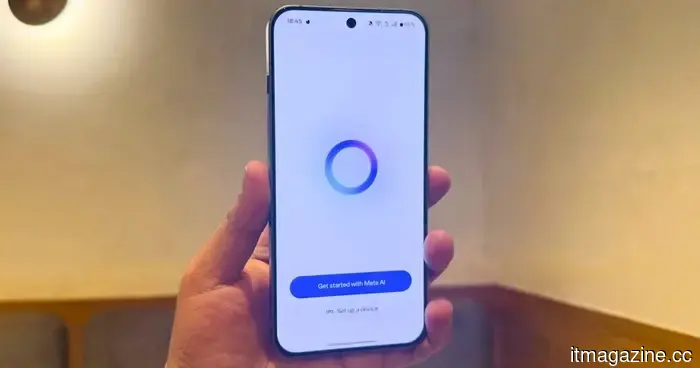 It's best not to rely on Meta's new Muse Spark AI for health-related guidance.
Meta's latest Muse Spark AI prompts users to share their health data, yet it still generates unreliable and possibly harmful recommendations.
It's best not to rely on Meta's new Muse Spark AI for health-related guidance.
Meta's latest Muse Spark AI prompts users to share their health data, yet it still generates unreliable and possibly harmful recommendations.
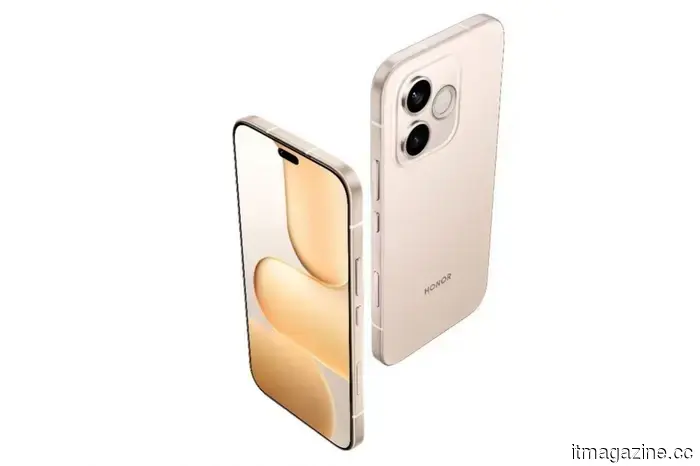 Thin, lightweight, and with a "long-lasting" battery
The HONOR 600 Lite has appeared in Russian electronics stores. The manufacturer has focused on a slim body, a solid metal frame, and a battery that serves as a small power bank inside the phone. Its stated capacity is 6520 mAh, and it is expected to help the device last until the evening charge even for those who forget to turn off the flashlight.
Thin, lightweight, and with a "long-lasting" battery
The HONOR 600 Lite has appeared in Russian electronics stores. The manufacturer has focused on a slim body, a solid metal frame, and a battery that serves as a small power bank inside the phone. Its stated capacity is 6520 mAh, and it is expected to help the device last until the evening charge even for those who forget to turn off the flashlight.
 The unseen laborers of the influencer economy are the first to face the threat of AI.
AI is beginning to take the place of the often unseen global workforce of clippers, editors, and virtual assistants who assisted creators in generating "organic" reach on a large scale.
The unseen laborers of the influencer economy are the first to face the threat of AI.
AI is beginning to take the place of the often unseen global workforce of clippers, editors, and virtual assistants who assisted creators in generating "organic" reach on a large scale.
 The mobile version of Gmail now includes end-to-end encryption to protect your emails from being intercepted.
The Gmail app by Google on Android and iOS has introduced end-to-end encryption for Workspace Enterprise Plus users, marking a notable improvement in mobile privacy by ensuring that encrypted email content does not pass through Google's servers.
The mobile version of Gmail now includes end-to-end encryption to protect your emails from being intercepted.
The Gmail app by Google on Android and iOS has introduced end-to-end encryption for Workspace Enterprise Plus users, marking a notable improvement in mobile privacy by ensuring that encrypted email content does not pass through Google's servers.
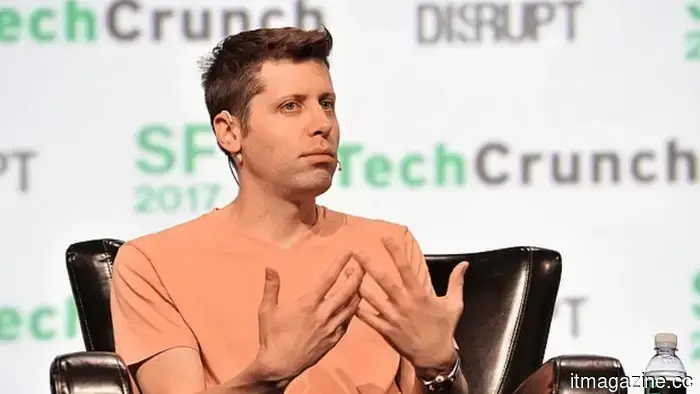 Police apprehend a 20-year-old following the throwing of a Molotov cocktail at Sam Altman's residence in San Francisco.
A 20-year-old was apprehended for hurling a Molotov cocktail at the San Francisco residence of OpenAI CEO Sam Altman and for making threats against the company's offices. There were no reported injuries.
Police apprehend a 20-year-old following the throwing of a Molotov cocktail at Sam Altman's residence in San Francisco.
A 20-year-old was apprehended for hurling a Molotov cocktail at the San Francisco residence of OpenAI CEO Sam Altman and for making threats against the company's offices. There were no reported injuries.
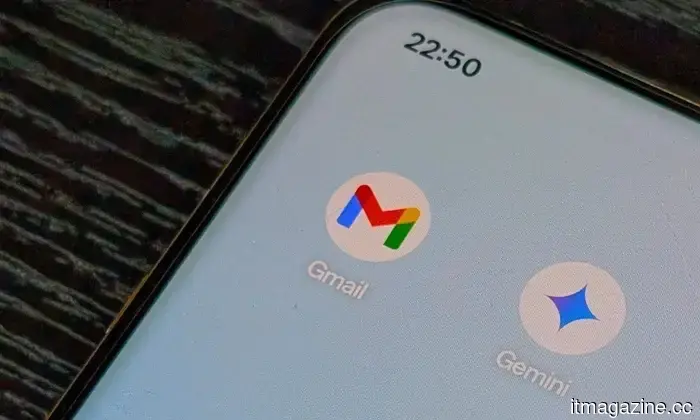 Gmail on mobile has introduced end-to-end encryption to protect your emails from prying eyes.
Google's Gmail application for Android and iOS now offers end-to-end encryption for users of Workspace Enterprise Plus, marking an important enhancement in mobile privacy that prevents encrypted email content from being stored on Google's servers.
Gmail on mobile has introduced end-to-end encryption to protect your emails from prying eyes.
Google's Gmail application for Android and iOS now offers end-to-end encryption for users of Workspace Enterprise Plus, marking an important enhancement in mobile privacy that prevents encrypted email content from being stored on Google's servers.
Gmail on mobile now features end-to-end encryption to protect your emails from prying eyes.
Google's Gmail application on Android and iOS now offers end-to-end encryption for Workspace Enterprise Plus users, marking a substantial enhancement in mobile privacy by ensuring that encrypted email content is not stored on Google's servers.