
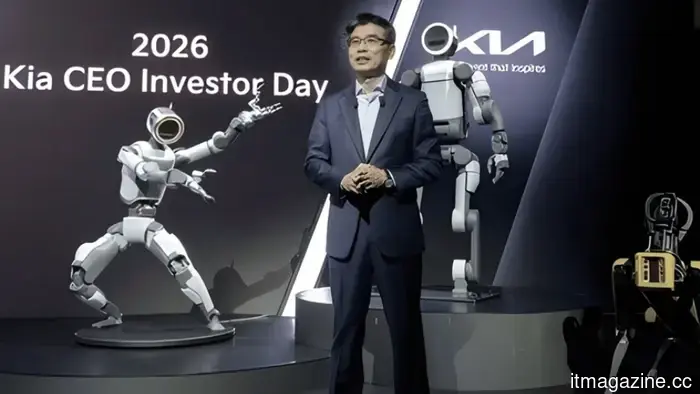
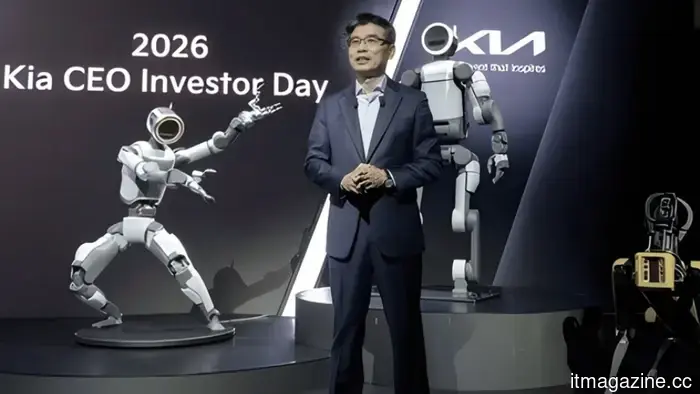
Kia reduces its EV target, announces an electric pickup, and intends to deploy Atlas robots in its factories in Georgia.
In summary: On the day when 25% US tariffs on South Korean imports were implemented, Kia hosted its 2026 CEO Investor Day in Seoul. The company introduced a plan adapted for a transformed landscape: a subtly lowered EV sales goal for 2030, a significant expansion of its hybrid lineup, the first announcement of a North American electric pickup truck, and a commitment to utilize Boston Dynamics’ Atlas humanoid robots in its Georgian factories starting from 2028. The five-year investment strategy totals KRW 49 trillion, with Kia aiming for KRW 170 trillion in revenue by 2030.
Kia President and CEO Ho-sung Song commenced the event with a forward-looking statement: “EVs, HEVs, autonomous driving, and robotics will be key growth drivers for Kia.” This broad perspective acknowledges that Kia’s 2030 aspirations no longer exclusively depend on battery-electric vehicles, and the company must generate revenue across various technology ventures simultaneously.
A reduced EV goal and an expanded hybrid initiative
The most notable announcement at this year’s event was one that Kia framed not as a retreat. The company's 2030 EV sales target has now been adjusted to 1 million units annually, with plans to expand its lineup to 14 models. This figure is about a 20% decrease from the previous target of approximately 1.26 million set at last year’s event and a notable drop from the 1.6 million target established at its 2023 event. The reasons for this are well understood: the end of US EV subsidies, a slowdown in battery-electric sales in the US, and the burden of import tariffs, which cost the group KRW 3.3 trillion (around $2.3 billion) in just 2025.
To compensate for the lost EV volume, Kia plans to significantly boost its hybrid offerings. Its annual HEV sales target is set at 1.1 million units by 2030, supported by an expanded lineup of 13 models. Together with the EV target, Kia aims to sell 2.1 million electrified passenger vehicles each year by the end of the decade, within a total forecast of 4.13 million units and a targeted global market share of 4.5%. The purpose-built vehicle (PBV) range, consisting of the PV5, PV7, and PV9 commercial variants, adds another target of 232,000 units by 2030. Regionally, Kia's targets include 1.02 million units in the US, 746,000 in Europe, and 1.48 million in emerging markets.
The immediate financial outlook is more urgent than the 2030 ambitions. For 2026, Kia projects sales of KRW 122.3 trillion and an operating profit of KRW 10.2 trillion — a rebound from the tariff-affected previous year, based on the 15% tariff rate set by the Korea-US agreement in late 2025, which replaces the earlier 25% rate. Whether this rate will remain amidst ongoing trade policy pressures is still uncertain.
A pickup truck for the American market and the tariff period
The announcement that drew the most attention was Kia’s confirmation of plans to produce a mid-size electric pickup truck specifically for North America. This model will be built on a next-generation EV platform, with Kia aiming for a 7% share of the North American pickup truck market, which translates to approximately 90,000 units in annual sales in the medium to long term.
Kia did not specify the manufacturing location for the vehicle, but the strategic rationale is clear. Both of Kia’s facilities in the US — Hyundai Motor Group Metaplant America in Georgia and Kia’s plant in West Point, Georgia — are equipped to produce vehicles that bypass import tariffs, including the longstanding “Chicken Tax” on light trucks and the newer EV import tariffs. The announcement's timing, coinciding with the enforcement of 25% reciprocal tariffs on South Korean imports, emphasizes Kia's shift in product strategy towards US production.
Atlas on the factory floor
Kia also took the opportunity at the investor day to expedite its timeline for introducing Boston Dynamics’ Atlas humanoid robots in its manufacturing processes. The Atlas robots — trained at Hyundai Motor Group’s Robotics Metaplant Application Centre — are expected to begin executing sequencing tasks at HMGMA in 2028, with more intricate assembly operations commencing by 2030. The program will be extended to Kia AutoLand Georgia in the latter half of 2029.
The competition to deploy humanoid robots in production at scale has been intensifying over the past few years, with automakers emerging as early adopters due to the structured and predictable nature of assembly line work. Boston Dynamics revealed a production-ready version of Atlas at CES 2026 and mentioned that all deployments for 2026 were already secured. As humanoid robots transition from demonstrations to production lines, manufacturers are figuring out which tasks the technology can reliably handle
Other articles
 A leak regarding the Razr 70 Ultra reveals Motorola's intentions to captivate users with striking new designs.
Leaked images of the Razr 70 Ultra indicate striking new finishes, such as Alcantara and wood textures.
A leak regarding the Razr 70 Ultra reveals Motorola's intentions to captivate users with striking new designs.
Leaked images of the Razr 70 Ultra indicate striking new finishes, such as Alcantara and wood textures.
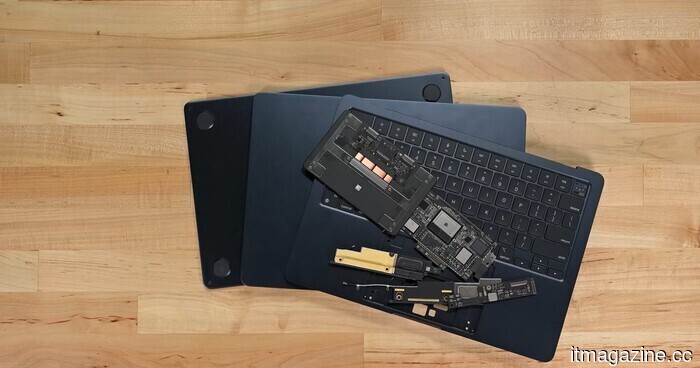 According to a consumer group, MacBooks remain the most challenging laptops to repair.
A recent report by the U.S. PIRG Education Fund indicates that Apple’s MacBooks are the most challenging laptops to repair among the major brands assessed, with Apple placing last in the 2026 rankings.
According to a consumer group, MacBooks remain the most challenging laptops to repair.
A recent report by the U.S. PIRG Education Fund indicates that Apple’s MacBooks are the most challenging laptops to repair among the major brands assessed, with Apple placing last in the 2026 rankings.
 BILL enables enterprise suppliers to gather payments from any SMB, including those not using its platform.
BILL's Supplier Payments Plus expansion introduces payment links, direct card processing, and check conversion, reducing enterprise collection times by approximately 7 days.
BILL enables enterprise suppliers to gather payments from any SMB, including those not using its platform.
BILL's Supplier Payments Plus expansion introduces payment links, direct card processing, and check conversion, reducing enterprise collection times by approximately 7 days.
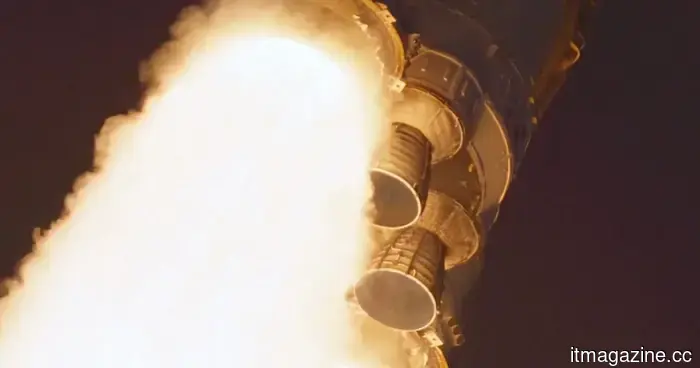 Breathtaking close-up videos capture NASA's moon rocket launching into space.
As the astronauts of NASA’s Artemis II make their return to Earth after an incredible near-moon experience earlier this week, the space agency has released some spectacular footage (below) of the rocket launch that launched the crew on April 1. The detailed tracking shot captures the remarkable force of the Space […]
Breathtaking close-up videos capture NASA's moon rocket launching into space.
As the astronauts of NASA’s Artemis II make their return to Earth after an incredible near-moon experience earlier this week, the space agency has released some spectacular footage (below) of the rocket launch that launched the crew on April 1. The detailed tracking shot captures the remarkable force of the Space […]
 YouTubers are taking legal action against Amazon for reportedly using their videos to train Nova Reel without permission.
H3H3 Productions and two golf channels claim that Amazon circumvented YouTube’s safeguards by utilizing rotating IPs and virtual machines to develop its Nova Reel video AI model.
YouTubers are taking legal action against Amazon for reportedly using their videos to train Nova Reel without permission.
H3H3 Productions and two golf channels claim that Amazon circumvented YouTube’s safeguards by utilizing rotating IPs and virtual machines to develop its Nova Reel video AI model.
 Three reasons why I feel envy towards Apple’s macOS in 2026.
An honest list from a Windows user highlighting macOS features that still seem more intelligent, seamless, and frustratingly more advanced than Windows PCs in 2026.
Three reasons why I feel envy towards Apple’s macOS in 2026.
An honest list from a Windows user highlighting macOS features that still seem more intelligent, seamless, and frustratingly more advanced than Windows PCs in 2026.
Kia reduces its EV target, announces an electric pickup, and intends to deploy Atlas robots in its factories in Georgia.
Kia's 2026 investor day has reduced its 2030 electric vehicle target to 1 million units, announced a North American electric pickup truck, and established a timeline for Atlas robot deployment in 2028.