

Space data centers: SpaceX and Blue Origin compete for orbit as scientists raise questions about the physics involved.
The proposition is appealing in its straightforwardness: AI requires more energy than Earth's power grids can provide, so the idea is to relocate data centers to orbit, where sunlight is constant and electricity is free. Companies like SpaceX, Blue Origin, and a number of emerging startups are now vying to turn that vision into reality. However, experts point out that this vision overlooks essential chapters of thermodynamics, economics, and orbital mechanics that remain unwritten.
On January 30, SpaceX submitted a request to the Federal Communications Commission (FCC) to launch up to one million satellites into low Earth orbit, each equipped with computing hardware that would collectively create a constellation with an "unprecedented computing capacity to power advanced artificial intelligence models." These satellites would function at altitudes ranging from 500 to 2,000 kilometers, in orbits designed to maximize sun exposure, and would utilize SpaceX’s existing Starlink network for data routing. SpaceX also sought a waiver from the FCC's typical deployment requirements, which generally necessitate that half of a constellation operates within six years.
Seven weeks later, Blue Origin put forth its own proposal. Project Sunrise aims to deploy 51,600 satellites in sun-synchronous orbits between 500 and 1,800 kilometers, supported by the previously announced TeraWave constellation of 5,408 satellites delivering ultra-high-speed optical backhaul. While SpaceX's application focused on sheer scale, Blue Origin’s highlighted infrastructure: the system would conduct computing in orbit and send results to Earth via TeraWave’s mesh network.
The startup ecosystem is advancing even more rapidly. Starcloud, previously known as Lumen Orbit, secured $170 million at a valuation of $1.1 billion in March, becoming the fastest unicorn in Y Combinator's history just 17 months after completing the program. The company launched its first satellite equipped with an Nvidia H100 GPU in November 2025 and filed with the FCC in February to establish a constellation of up to 88,000 satellites. Aethero, a startup focused on defense, is developing space-grade computers with Nvidia Orin NX chips shielded from radiation and has raised $8.4 million to test hardware in orbit this year.
The commercial rationale is based on a genuine issue. In 2024, global data center electricity consumption reached around 415 terawatt-hours, and the International Energy Agency predicts it might surpass 1,000 TWh by 2026, driven by accelerated AI servers fueling 30 percent annual growth. Data centers in Virginia alone account for 26 percent of the total electricity supply, while Ireland’s share may hit 32 percent by year’s end. The limitations of the current grid are tangible, the delays in permitting are significant, and there is real political resistance to expanding terrestrial infrastructure.
However, scientists contend that the physics involved in orbital computing presents substantial challenges, especially at any significant scale. The primary hurdle is heat management. In space, there is no atmosphere to dissipate heat from processors; only radiative cooling, which necessitates extensive surface areas. For instance, dissipating just one megawatt of thermal energy while maintaining electronic components at a stable 20 degrees Celsius requires about 1,200 square meters of radiator space, equivalent to roughly four tennis courts. A data center with several hundred megawatts—considered the minimum size for commercial viability—would need radiators thousands of times larger than anything currently on the International Space Station.
Radiation constitutes the second major issue. Low Earth orbit subjects unshielded chips to cosmic rays and trapped particles that can cause bit flips and irreversible damage to circuits. Hardening against radiation increases hardware costs by 30 to 50 percent and decreases performance by 20 to 30 percent. The alternative, triple modular redundancy, requires launching three copies of each chip, along with tripled cooling solutions, electricity, and mass. Starcloud's strategy of using commercial GPUs with external shielding is an intriguing experiment, but no one has shown that it can be effectively implemented at scale or over hardware lifetimes measured in years instead of months.
The third limitation is latency. A constellation of a million satellites spread across orbital altitudes from 500 to 2,000 kilometers can't achieve the close coupling necessary for frontier model training, which requires inter-node communication latencies to remain in the microsecond range. Low Earth orbit introduces minimum latencies of several milliseconds for inter-satellite connections and 60 to 190 milliseconds for ground-to-orbit round trips, compared to 10 to 50 milliseconds for terrestrial content delivery networks. This makes orbital infrastructure potentially feasible for inference tasks, but not for training, which currently accounts for the bulk of AI computational demands.
Cost is another significant factor. IEEE Spectrum calculated that a one-gigawatt orbital data center would cost over $50 billion, approximately three times that of a similar terrestrial facility, including five years of operation. Google has indicated that launch expenses must drop below $200 per kilogram for
Other articles
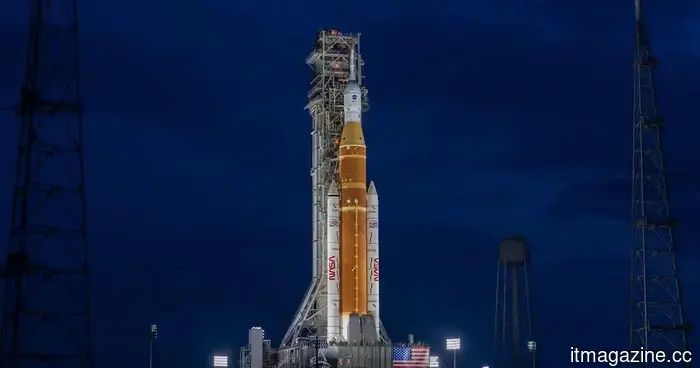 Even astronauts en route to the moon encounter issues with Outlook.
During the Artemis II mission, astronauts encountered a known Outlook failure while in flight, prompting mission control to intervene and resolve the issue. This incident highlights the reliance on everyday software, even in deep space missions.
Even astronauts en route to the moon encounter issues with Outlook.
During the Artemis II mission, astronauts encountered a known Outlook failure while in flight, prompting mission control to intervene and resolve the issue. This incident highlights the reliance on everyday software, even in deep space missions.
 If you're relying on AI to improve your dating life, this actor's experience suggests otherwise.
Actor and writer Rhik Samadder allowed AI to create his dating profile, messages, and conversation starters, only to discover that the chatbot's confidence quickly crumbles in actual dating situations.
If you're relying on AI to improve your dating life, this actor's experience suggests otherwise.
Actor and writer Rhik Samadder allowed AI to create his dating profile, messages, and conversation starters, only to discover that the chatbot's confidence quickly crumbles in actual dating situations.
 For the first time, YouTube will broadcast Coachella in 4K, and there will also be a feed filmed on Pixel devices.
YouTube will be streaming Coachella 2026 for free beginning April 10, featuring seven stages running at the same time, 4K streams for the first time, a vertical feed captured with Pixel, and a Multiview option that allows viewers to watch four stages simultaneously.
For the first time, YouTube will broadcast Coachella in 4K, and there will also be a feed filmed on Pixel devices.
YouTube will be streaming Coachella 2026 for free beginning April 10, featuring seven stages running at the same time, 4K streams for the first time, a vertical feed captured with Pixel, and a Multiview option that allows viewers to watch four stages simultaneously.
 For only $3, Google's magic stick can revive your old PC.
Google and Back Market have introduced a $3 ChromeOS Flex USB Kit aimed at reviving older Windows 10 computers. This kit comes with the free operating system, instructional guides, and video tutorials, offering a more affordable solution than purchasing a new laptop.
For only $3, Google's magic stick can revive your old PC.
Google and Back Market have introduced a $3 ChromeOS Flex USB Kit aimed at reviving older Windows 10 computers. This kit comes with the free operating system, instructional guides, and video tutorials, offering a more affordable solution than purchasing a new laptop.
 Space Data Centers: SpaceX and Blue Origin Compete for Orbit as Scientists Scrutinize the Physics
SpaceX has submitted a request for 1 million data center satellites, while Blue Origin has applied for 51,600. Experts indicate that the challenges related to cooling, radiation, and expenses suggest that orbital computing is still many years off.
Space Data Centers: SpaceX and Blue Origin Compete for Orbit as Scientists Scrutinize the Physics
SpaceX has submitted a request for 1 million data center satellites, while Blue Origin has applied for 51,600. Experts indicate that the challenges related to cooling, radiation, and expenses suggest that orbital computing is still many years off.
 Space data centers: SpaceX and Blue Origin compete for orbital dominance as scientists raise questions about the underlying physics.
SpaceX has submitted a proposal for one million data center satellites, while Blue Origin has aimed for 51,600. Experts indicate that the principles of cooling, radiation, and expenses render orbital computing a prospect that is decades away.
Space data centers: SpaceX and Blue Origin compete for orbital dominance as scientists raise questions about the underlying physics.
SpaceX has submitted a proposal for one million data center satellites, while Blue Origin has aimed for 51,600. Experts indicate that the principles of cooling, radiation, and expenses render orbital computing a prospect that is decades away.
Space data centers: SpaceX and Blue Origin compete for orbit as scientists raise questions about the physics involved.
SpaceX submitted an application for 1 million data center satellites, while Blue Origin filed for 51,600. Experts indicate that the challenges of cooling, radiation, and expenses suggest that orbital computing is still several decades away.