

How NinjaOne emerged as a $5 billion competitor in unified IT operations.
Sal Sferlazza has a track record of creating companies that end up being acquired. Prior to founding NinjaOne, the serial entrepreneur sold four startups in a row: a gaming studio to NCSoft, a data-protection company to SonicWall, a network management firm to Quest Software, and a file-sync service to eFolder. Each of these businesses addressed a specific IT challenge and was absorbed by a larger platform. By the time Sferlazza and his longtime co-founder Chris Matarese established NinjaRMM in 2013 (later renamed NinjaOne), they had gained insight into the IT tools market: point solutions can trap both buyers and sellers.
This understanding now supports a company valued at $5 billion, generating over $500 million in annual recurring revenue, with 35,000 customers and a growth rate that makes most enterprise software vendors appear sluggish. In the first quarter of 2026 alone, NinjaOne entered the Leader quadrant of Gartner’s Magic Quadrant for Endpoint Management Tools on its debut, formed a multi-year partnership with Audi's inaugural Formula 1 team, launched two entirely new product lines, and noted a rapid adoption of its platform by healthcare organizations that nearly doubled its sector-specific revenue. After years in relative obscurity, the company’s rapid ascent is notable. In a year that has already seen a resurgence of European unicorns in cybersecurity, defense tech, and cloud optimization, NinjaOne's $5 billion valuation does not seem like an anomaly; it resembles a trend.
The consolidation theory
To comprehend NinjaOne’s growth, one must grasp the disarray it is addressing. As of 2026, the typical mid-market IT department utilizes between six and twelve distinct tools for managing endpoints, deploying patches, tracking assets, backing up data, offering remote support, and monitoring network health. Each tool requires its own console, alert logic, pricing model, and concept of what an "endpoint" entails. This scenario results in what the industry calls “tool sprawl,” a more accurate descriptor for IT administrators’ struggles with constant context-switching and alert fatigue.
This fragmentation is not coincidental. For two decades, the prevailing strategy in IT management was “best of breed”: select the best tool for each job and integrate them using scripts and middleware. This approach was somewhat effective when corporate networks primarily consisted of desktop PCs. However, it proves less effective as the network expands to include laptops, tablets, phones, IoT sensors, cloud workloads, and medical devices distributed across numerous locations, many of which have remote staff.
The shift in CIO spending habits has been growing since 2023, but in 2026, it transformed into actual purchasing actions. Research by Futurum Group revealed that early intentions to consolidate platforms have now turned into budget allocations. Paessler, a firm specializing in network monitoring, has stated that 2026 marks “the year of monitoring consolidation.” Vendors are responding accordingly: Fortinet has ventured into unified security operations, ServiceNow is deepening its cross-functional IT orchestration, and a wave of smaller players is branding themselves as platforms instead of simple products. As TNW’s 2025 tech recap indicated, the burgeoning demand for AI infrastructure is prompting CIOs to reconsider their security strategies and the overall operational framework supporting them.
A platform built from the ground up, not pieced together
NinjaOne emphasizes that it was developed as a unified platform from inception, rather than being formed through acquisitions layered onto an outdated codebase. This distinction is crucial. Kaseya, which controls approximately 25.9 percent of the remote monitoring and management market, has largely expanded through acquisitions, purchasing Datto for $6.2 billion in 2022, along with Unitrends, IT Glue, and several other products, each with its unique architecture. ConnectWise, holding 25.4 percent of the market, has followed a similar path. The outcome, as reported by IT administrators who engage with these platforms daily, is inconsistent user interfaces, redundant features, and a lingering awareness that various segments of the product were developed by disparate companies—because they were.
NinjaOne opted for the more deliberate approach. Instead of acquiring in pursuit of feature completeness, the organization developed each functionality natively on a single cloud-native, multi-tenant architecture. Endpoint management, patch management, remote access, backup, mobile device management, IT asset management, and vulnerability management (added in early 2026) are all integrated on the same platform, sharing a data model and appearing within the same console. The trade-off involved time: NinjaOne spent years as a more specialized product while its competitors could fulfill more procurement checklist items. The reward is that when an IT administrator implements a patch via NinjaOne, the platform already knows which devices are affected, their current vulnerability status, warranty coverage, and backup conditions—no integration needed.
That architectural decision is now yielding measurable results. Over the past year, NinjaOne's customer base expanded by more than 60
Other articles
 Space Data Centers: SpaceX and Blue Origin Compete for Orbit as Scientists Scrutinize the Physics
SpaceX has submitted a request for 1 million data center satellites, while Blue Origin has applied for 51,600. Experts indicate that the challenges related to cooling, radiation, and expenses suggest that orbital computing is still many years off.
Space Data Centers: SpaceX and Blue Origin Compete for Orbit as Scientists Scrutinize the Physics
SpaceX has submitted a request for 1 million data center satellites, while Blue Origin has applied for 51,600. Experts indicate that the challenges related to cooling, radiation, and expenses suggest that orbital computing is still many years off.
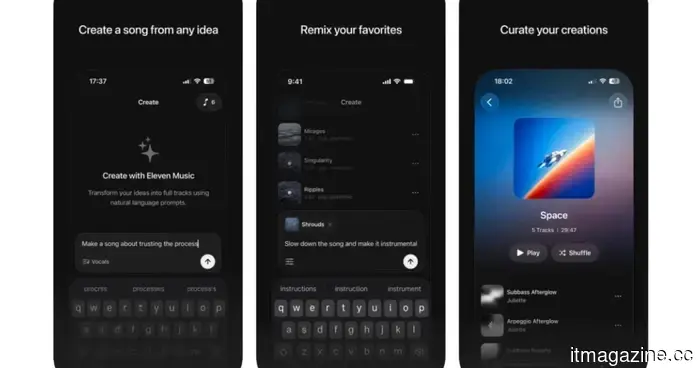 The ElevenLabs AI music generator transforms your concepts into three-minute tracks.
Following closely behind Google's music AI release, ElevenLabs has introduced ElevenMusic, an iOS app that transforms text into songs, demonstrating the company's strong intention to expand significantly beyond voice cloning.
The ElevenLabs AI music generator transforms your concepts into three-minute tracks.
Following closely behind Google's music AI release, ElevenLabs has introduced ElevenMusic, an iOS app that transforms text into songs, demonstrating the company's strong intention to expand significantly beyond voice cloning.
 Space Data Centers: SpaceX and Blue Origin Compete for Orbital Position as Scientists Raise Questions About the Physics
SpaceX has submitted an application for 1 million data center satellites, while Blue Origin has applied for 51,600. According to scientists, factors such as cooling physics, radiation, and expenses indicate that orbital computing is still several decades in the future.
Space Data Centers: SpaceX and Blue Origin Compete for Orbital Position as Scientists Raise Questions About the Physics
SpaceX has submitted an application for 1 million data center satellites, while Blue Origin has applied for 51,600. According to scientists, factors such as cooling physics, radiation, and expenses indicate that orbital computing is still several decades in the future.
 Microsoft introduces three proprietary AI models as a direct competitor to OpenAI.
Microsoft launched MAI-Transcribe-1, MAI-Voice-1, and MAI-Image-2 through Foundry, developed by Mustafa Suleyman's superintelligence team. These models directly rival those of OpenAI.
Microsoft introduces three proprietary AI models as a direct competitor to OpenAI.
Microsoft launched MAI-Transcribe-1, MAI-Voice-1, and MAI-Image-2 through Foundry, developed by Mustafa Suleyman's superintelligence team. These models directly rival those of OpenAI.
 Space data centers: SpaceX and Blue Origin compete for orbital dominance as scientists raise questions about the underlying physics.
SpaceX has submitted a proposal for one million data center satellites, while Blue Origin has aimed for 51,600. Experts indicate that the principles of cooling, radiation, and expenses render orbital computing a prospect that is decades away.
Space data centers: SpaceX and Blue Origin compete for orbital dominance as scientists raise questions about the underlying physics.
SpaceX has submitted a proposal for one million data center satellites, while Blue Origin has aimed for 51,600. Experts indicate that the principles of cooling, radiation, and expenses render orbital computing a prospect that is decades away.
 For the first time, YouTube will broadcast Coachella in 4K, and there will also be a feed filmed on Pixel devices.
YouTube will be streaming Coachella 2026 for free beginning April 10, featuring seven stages running at the same time, 4K streams for the first time, a vertical feed captured with Pixel, and a Multiview option that allows viewers to watch four stages simultaneously.
For the first time, YouTube will broadcast Coachella in 4K, and there will also be a feed filmed on Pixel devices.
YouTube will be streaming Coachella 2026 for free beginning April 10, featuring seven stages running at the same time, 4K streams for the first time, a vertical feed captured with Pixel, and a Multiview option that allows viewers to watch four stages simultaneously.
How NinjaOne emerged as a $5 billion competitor in unified IT operations.
NinjaOne's growth to a $5 billion valuation underscores the movement towards integrated IT platforms, operations driven by AI, and the reduction of tool sprawl.