

Space Data Centers: SpaceX and Blue Origin Compete for Orbital Position as Scientists Raise Questions About the Physics
The concept is alluring in its straightforwardness: since AI requires more energy than Earth’s power grids can provide, the solution is to relocate data centers into orbit, where sunlight is constant and energy is free. Companies like SpaceX, Blue Origin, and a rising number of startups are now competing to turn this idea into reality. However, scientists and engineers point out that this vision overlooks critical principles of thermodynamics, economics, and orbital mechanics that remain unresolved.
On January 30, SpaceX submitted a request to the Federal Communications Commission (FCC) seeking permission to deploy as many as one million satellites into low Earth orbit. Each satellite would carry computing equipment, collectively creating a network with what SpaceX describes as "unprecedented computing capacity for advanced AI models." The satellites are designed to operate at altitudes ranging from 500 to 2,000 kilometers, in orbits that maximize sun exposure while managing traffic through SpaceX’s existing Starlink network. SpaceX also requested a waiver for the FCC's usual deployment timelines, which generally necessitate half of the constellation to be operational within six years.
Seven weeks later, Blue Origin submitted its proposal. Project Sunrise aims to deploy 51,600 satellites in sun-synchronous orbits at heights between 500 and 1,800 kilometers, along with the previously mentioned TeraWave constellation comprising 5,408 satellites for ultra-high-speed optical backhaul. While SpaceX focused on sheer scale in its application, Blue Origin emphasized the system's architecture: it would perform computations in orbit while transmitting results to Earth through TeraWave’s mesh network.
The startup space is progressing even more rapidly. Starcloud, previously known as Lumen Orbit, secured $170 million at a valuation of $1.1 billion in March, becoming the quickest unicorn in Y Combinator history just 17 months after finishing the program. The company launched its first satellite carrying an Nvidia H100 GPU in November 2025 and filed with the FCC in February for a constellation of up to 88,000 satellites. Aethero, a defense-oriented startup, is developing space-grade computers using Nvidia Orin NX chips housed in radiation protection and has raised $8.4 million, with plans to test its hardware in orbit this year.
The commercial rationale is based on a genuine issue. In 2024, global electricity consumption by data centers approached approximately 415 terawatt-hours, with the International Energy Agency estimating it could rise beyond 1,000 TWh by 2026, propelled by a 30% annual growth rate driven by advanced AI servers. In Virginia alone, data centers account for 26% of overall electricity usage, while Ireland’s share might reach 32% by the end of the year. The constraints on existing grids are palpable, as are the delays in permitting and the political pushback against expanding terrestrial capabilities.
However, scientists contend that the physics involved in orbital computing presents major challenges at any significant scale. The most pressing issue is thermal management. In space, there is no air to dissipate heat from processors; instead, they rely on radiative cooling, which necessitates large surface areas. To effectively dissipate just one megawatt of heat while maintaining electronic components at a stable 20 degrees Celsius, around 1,200 square meters of radiator space is needed—about the size of four tennis courts. A data center with several hundred megawatts, the minimum for commercial viability, would require radiators vastly larger than any ever used on the International Space Station.
Radiation presents the next fundamental issue. Low Earth orbit exposes unprotected chips to cosmic rays and trapped particles that can cause bit errors and permanent damage to circuits. Hardening hardware against radiation can increase costs by 30% to 50% and diminish performance by 20% to 30%. Alternatively, triple modular redundancy means launching three copies of each chip, tripling the cooling requirements, electricity consumption, and weight. Though Starcloud’s method of using commercial GPUs with external shielding is an intriguing experiment, scalability and long-term viability remain unproven.
Latency is another significant limitation. A million satellites spread across altitudes from 500 to 2,000 kilometers cannot achieve the close coupling necessary for advanced model training, where communication latencies between nodes must remain in the microsecond range. Low Earth orbit imposes minimum latencies of several milliseconds for inter-satellite links and 60 to 190 milliseconds for round trips between ground stations and satellites, in contrast to 10 to 50 milliseconds for terrestrial content delivery networks. As such, orbital systems could potentially serve inference workloads but are ill-suited for training—where the bulk of AI computational demand lies.
Cost is another critical factor. IEEE Spectrum estimated that a one-gigawatt orbital data center could cost over $50 billion, roughly three times more than a comparable ground facility, including five years of operational expenses. Google has indicated that launch costs would need to drop below $200 per kilogram for space-based
Other articles
 Tesla surpasses BYD in electric vehicle sales for Q1 2026, but an increase in inventory and a decline in Europe overshadow the victory.
In the first quarter of 2026, Tesla delivered 358,023 electric vehicles, surpassing BYD's 310,389, yet fell short of Wall Street predictions. The company produced 50,000 more vehicles than needed and experienced a significant decline in European registrations.
Tesla surpasses BYD in electric vehicle sales for Q1 2026, but an increase in inventory and a decline in Europe overshadow the victory.
In the first quarter of 2026, Tesla delivered 358,023 electric vehicles, surpassing BYD's 310,389, yet fell short of Wall Street predictions. The company produced 50,000 more vehicles than needed and experienced a significant decline in European registrations.
 How NinjaOne emerged as a $5 billion competitor in unified IT operations.
NinjaOne's growth to a $5 billion valuation underscores the movement towards integrated IT platforms, operations driven by AI, and the reduction of tool sprawl.
How NinjaOne emerged as a $5 billion competitor in unified IT operations.
NinjaOne's growth to a $5 billion valuation underscores the movement towards integrated IT platforms, operations driven by AI, and the reduction of tool sprawl.
 Microsoft introduces three proprietary AI models as a direct competition to OpenAI.
Microsoft launched MAI-Transcribe-1, MAI-Voice-1, and MAI-Image-2 through Foundry, developed by the superintelligence team led by Mustafa Suleyman. These models are in direct competition with OpenAI.
Microsoft introduces three proprietary AI models as a direct competition to OpenAI.
Microsoft launched MAI-Transcribe-1, MAI-Voice-1, and MAI-Image-2 through Foundry, developed by the superintelligence team led by Mustafa Suleyman. These models are in direct competition with OpenAI.
 Space data centers: SpaceX and Blue Origin compete for orbital dominance as scientists raise questions about the underlying physics.
SpaceX has submitted a proposal for one million data center satellites, while Blue Origin has aimed for 51,600. Experts indicate that the principles of cooling, radiation, and expenses render orbital computing a prospect that is decades away.
Space data centers: SpaceX and Blue Origin compete for orbital dominance as scientists raise questions about the underlying physics.
SpaceX has submitted a proposal for one million data center satellites, while Blue Origin has aimed for 51,600. Experts indicate that the principles of cooling, radiation, and expenses render orbital computing a prospect that is decades away.
 Microsoft introduces three proprietary AI models as a direct competitor to OpenAI.
Microsoft launched MAI-Transcribe-1, MAI-Voice-1, and MAI-Image-2 through Foundry, developed by Mustafa Suleyman's superintelligence team. These models directly rival those of OpenAI.
Microsoft introduces three proprietary AI models as a direct competitor to OpenAI.
Microsoft launched MAI-Transcribe-1, MAI-Voice-1, and MAI-Image-2 through Foundry, developed by Mustafa Suleyman's superintelligence team. These models directly rival those of OpenAI.
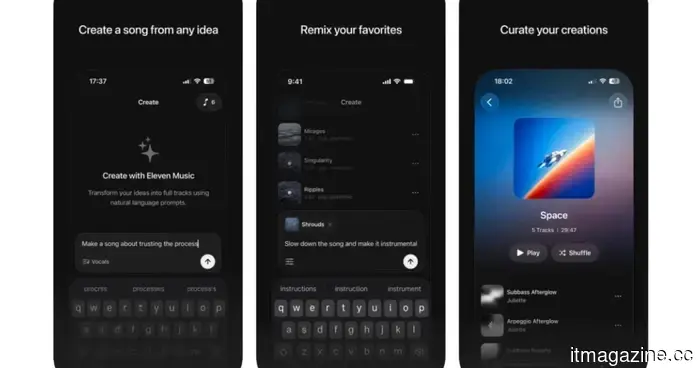 The ElevenLabs AI music generator transforms your concepts into three-minute tracks.
Following closely behind Google's music AI release, ElevenLabs has introduced ElevenMusic, an iOS app that transforms text into songs, demonstrating the company's strong intention to expand significantly beyond voice cloning.
The ElevenLabs AI music generator transforms your concepts into three-minute tracks.
Following closely behind Google's music AI release, ElevenLabs has introduced ElevenMusic, an iOS app that transforms text into songs, demonstrating the company's strong intention to expand significantly beyond voice cloning.
Space Data Centers: SpaceX and Blue Origin Compete for Orbital Position as Scientists Raise Questions About the Physics
SpaceX has submitted an application for 1 million data center satellites, while Blue Origin has applied for 51,600. According to scientists, factors such as cooling physics, radiation, and expenses indicate that orbital computing is still several decades in the future.