
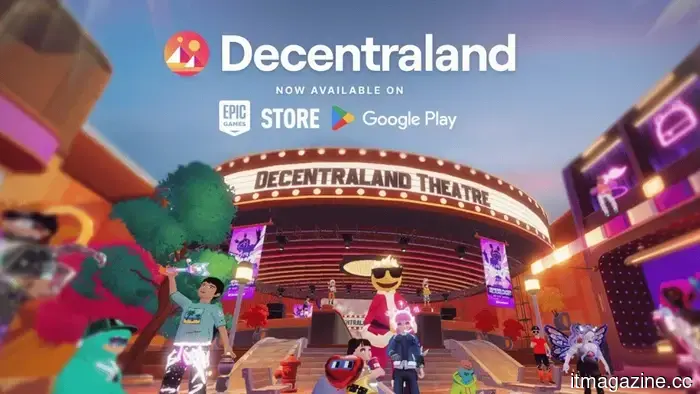
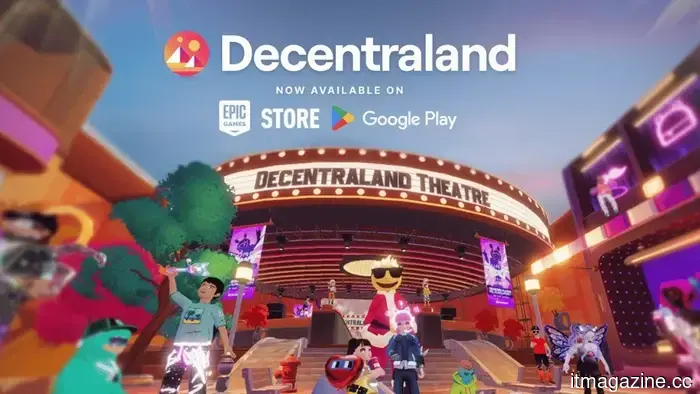
Decentraland debuts on the Epic Games Store and Android as the metaverse becomes available on multiple platforms.
The metaverse was envisioned as its own unique destination. Users would don headsets, immerse themselves in a virtual world, and never need to consider the platform that facilitated their arrival. That was the pitch, at least. However, Decentraland, one of the earliest and most enduring experiments in decentralized virtual worlds, seems to have reached a different conclusion. On Monday, the project debuted on the Epic Games Store and released an Android app on Google Play, with an iOS version to follow. The message is straightforward: if people are not inclined to visit the metaverse, then the metaverse will go to where people already are.
The Epic Games Store listing is the more strategically important of the two developments. Epic’s platform saw 317 million registered PC users in 2025, setting a record with 78 million monthly active users in December of that year, according to the company's annual report. Spending on third-party games on the store grew 57 percent year on year to over $400 million. For Decentraland, which has long battled the perception—and at times the reality—of being sparsely populated, positioning itself alongside popular titles like Fortnite on a storefront with such traffic aims to address a distribution issue that no amount of blockchain technology alone could resolve.
Yemel Jardi, the executive director of Decentraland, framed the launch in distribution terms instead of technological ones. He noted that Epic Games has become a key discovery channel for desktop experiences, and being part of that enhances how users find and access Decentraland. He described it as a piece of a larger strategy to meet people where they already are, with intentions to expand to more stores over time.
The mobile launch follows a similar logic. Decentraland’s Android app is now available on Google Play, and the iOS version is expected soon. The project cites data from Mordor Intelligence indicating that mobile devices account for 71.55 percent of the social gaming market, and DataReportal statistics show that the average internet user spends three hours and 46 minutes a day on their phone. The Consumer Technology Association reports that 61 percent of gamers engage in cross-platform play. Gino Cingolani, executive director of DCL Regenesis Labs, stated that the mobile experience aims to lower access barriers, allowing users to join from their phones rather than planning a session on a desktop.
The timing is significant. Meta, which committed to the metaverse in 2021 and invested roughly $70 billion into Reality Labs before shifting direction, announced in March that it would close Horizon Worlds on VR headsets (a decision it partially reversed after user backlash, though the platform's future remains uncertain). In January 2026, Meta laid off 1,500 Reality Labs employees, shut down three internal game studios, and reduced its metaverse budget by 30 percent. The company that popularized the term "metaverse" has effectively stepped back from the concept to focus on AI infrastructure and wearable technology.
Decentraland’s positioning suggests that this retreat presents an opportunity. While Meta constructed a proprietary virtual world controlled by a single entity, Decentraland functions as a community-governed platform backed by a non-profit foundation. Users possess their virtual land parcels and avatars as tokens on the Ethereum blockchain. The governance system is decentralized, with decisions made through transparent community votes, meaning there’s no single company that can shut it down—an issue that Horizon Worlds users discovered when Meta deemed the economics unworkable.
The pressing question is whether Decentraland’s own economics are viable. The project's native MANA token trades at around $0.08, a significant drop from its peak above $5 during the 2021 crypto surge. Measuring active users has been a consistently contentious issue. A widely referred to 2022 DappRadar report suggested the platform had merely 38 daily active wallet users, although Decentraland challenged the methodology, claiming it focused only on on-chain transactions rather than total visitors. The project’s own figures for late 2025 report approximately 847,000 monthly unique visitors to its web client, with daily unique visitors up 23 percent since mid-2025 following the rollout of a lighter, faster desktop client. In January 2026 alone, the platform claims to have hosted 312 community events with an average attendance of 127 unique visitors each.
Such numbers are modest compared to mainstream gaming but noteworthy for a platform that has navigated the metaverse downturn relatively unscathed. Secondary market sales of Decentraland LAND parcels hit $4.2 million in the fourth quarter of 2025, reflecting a 31 percent quarter-on-quarter increase. Founded in 2015 by Argentine developers Ari Meilich and Esteban Ordano, the project raised $26 million in its 2017 initial coin offering and went public in February 2020. It has outlasted or surpassed most of its contemporaries.
The launch on the Epic Games Store includes a promotional incentive:
Другие статьи
 Opera's newest update transforms it into an independent browsing agent for ChatGPT and Claude.
Opera's latest MCP Connector transforms Neon into an independent browsing agent, enabling AI tools such as ChatGPT and Claude to directly manage your browser and accomplish tasks on various websites.
Opera's newest update transforms it into an independent browsing agent for ChatGPT and Claude.
Opera's latest MCP Connector transforms Neon into an independent browsing agent, enabling AI tools such as ChatGPT and Claude to directly manage your browser and accomplish tasks on various websites.
 Get a $500 discount on the Dell Plus Copilot+ PC: equipped with a Core Ultra 9, 32GB RAM, and a 2.5K Mini-LED touchscreen for less than $1,100.
The Dell Plus Copilot+ PC is now available for $1,099.99 at Best Buy, marking a savings of $500 from its regular price of $1,599.99. This represents a significant discount on a 16-inch 2-in-1 device that combines an Intel Core Ultra 9 processor with 32GB of LPDDR5X RAM, a 2.5K Mini-LED touchscreen, and Microsoft’s Copilot+ AI features. For a convertible laptop at […]
Get a $500 discount on the Dell Plus Copilot+ PC: equipped with a Core Ultra 9, 32GB RAM, and a 2.5K Mini-LED touchscreen for less than $1,100.
The Dell Plus Copilot+ PC is now available for $1,099.99 at Best Buy, marking a savings of $500 from its regular price of $1,599.99. This represents a significant discount on a 16-inch 2-in-1 device that combines an Intel Core Ultra 9 processor with 32GB of LPDDR5X RAM, a 2.5K Mini-LED touchscreen, and Microsoft’s Copilot+ AI features. For a convertible laptop at […]
-integrate-with-3rd-party-apps?.jpg) Is Intuit Enterprise Suite (IES) compatible with third-party applications?
Intuit Enterprise Suite (IES) connects with third-party applications via APIs and the larger QuickBooks ecosystem. These integrations enable businesses to unify accounting with tools like project management, payroll, payments, and marketing platforms. By connecting systems, IES can minimize manual data entry, enhance data consistency, and assist teams in managing financial information more effectively across […]
Is Intuit Enterprise Suite (IES) compatible with third-party applications?
Intuit Enterprise Suite (IES) connects with third-party applications via APIs and the larger QuickBooks ecosystem. These integrations enable businesses to unify accounting with tools like project management, payroll, payments, and marketing platforms. By connecting systems, IES can minimize manual data entry, enhance data consistency, and assist teams in managing financial information more effectively across […]
 Iran's IRGC has identified 18 US technology companies, including Apple, Microsoft, and Nvidia, as military targets.
Iran's Revolutionary Guards labeled 18 American technology firms as "legitimate targets," claiming that their AI and cloud services facilitated the assassinations of high-ranking Iranian officials.
Iran's IRGC has identified 18 US technology companies, including Apple, Microsoft, and Nvidia, as military targets.
Iran's Revolutionary Guards labeled 18 American technology firms as "legitimate targets," claiming that their AI and cloud services facilitated the assassinations of high-ranking Iranian officials.
 Multi-Hop Transactions in Cryptocurrency: The Compliance Risks Associated with Indirect Exposure
Multi-hop blockchain transactions complicate the detection of indirect cryptocurrency exposure, leading to significant challenges in compliance, sanctions, and regulations.
Multi-Hop Transactions in Cryptocurrency: The Compliance Risks Associated with Indirect Exposure
Multi-hop blockchain transactions complicate the detection of indirect cryptocurrency exposure, leading to significant challenges in compliance, sanctions, and regulations.
 ByteDance implements watermarking and IP protection measures for Seedance 2.0 prior to its global launch.
ByteDance has reintroduced Seedance 2.0, featuring C2PA watermarking, face-blocking, and copyright filters in response to the backlash from Hollywood. This update is being launched via CapCut in seven different markets.
ByteDance implements watermarking and IP protection measures for Seedance 2.0 prior to its global launch.
ByteDance has reintroduced Seedance 2.0, featuring C2PA watermarking, face-blocking, and copyright filters in response to the backlash from Hollywood. This update is being launched via CapCut in seven different markets.
Decentraland debuts on the Epic Games Store and Android as the metaverse becomes available on multiple platforms.
Decentraland has launched on the Epic Games Store and Google Play, hoping that distribution via popular storefronts will achieve success where Meta's $70 billion metaverse investment did not.