
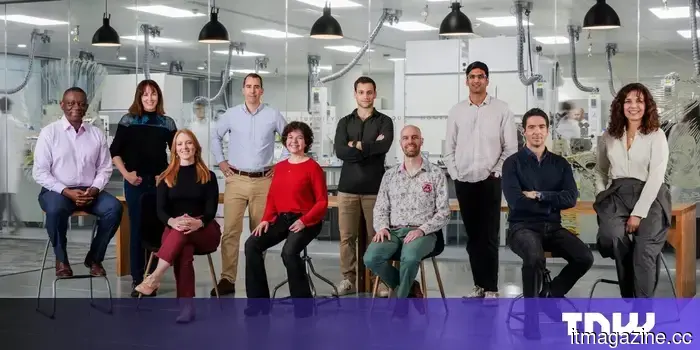
Epoch Biodesign secures $12 million in funding.
The London-based startup utilizes AI-designed enzymes to decompose nylon 6,6 waste—from leggings to airbags and carpets—back into its original monomers, achieving over 90% recovery and eliminating the dependence on new petroleum feedstock. The total funding has surpassed $50 million.
Nylon 6,6 is one of the most beneficial materials ever produced. First synthesized by DuPont scientists in the 1930s, it has been continuously manufactured since then, finding applications in high-performance athletic wear, car airbags, climbing ropes, and industrial carpets.
However, it is rarely recycled. The polymer's structure, which provides its strength and heat resistance, makes it incredibly challenging to decompose without damaging the very monomers intended for recovery.
Epoch Biodesign, founded by Jacob Nathan in 2019, has dedicated six years to developing enzymes capable of achieving this task. The company has successfully raised $12 million to transition from pilot production to a demonstration-scale facility.
The funding round was led by the apparel company lululemon, with participation from Extantia, Happiness Capital, KOMPAS VC, Leitmotif, and others. With this latest investment, Epoch's total funding now exceeds $50 million, following an $11 million seed round in 2022 led by Lowercarbon Capital and an $18.3 million Series A in March 2025 led by Extantia, which also included Inditex, the parent company of Zara.
The investor roster is significant for merging major fashion brands (like lululemon and Inditex) with specialist climate investors (such as Lowercarbon Capital and Extantia), indicating that Epoch's commercial proposition is compelling enough to draw interest from companies that would actually purchase its output.
The technology operates using a series of enzyme treatments. Instead of employing the full biological machinery of microbes, Epoch focuses solely on the enzymes themselves, sourced from industrial suppliers who already manufacture them at scale. Each enzyme in the series targets a specific bond within the nylon 6,6 polymer, gradually breaking it down into its primary monomers: adipic acid and hexamethylenediamine (HMDA).
A significant commercial benefit is that the process can handle mixed inputs. Epoch's enzymes are effective on blended textiles, coated fibers, and mixed plastic waste, which conventional mechanical and chemical recycling methods struggle to process.
This is particularly important, as the majority of discarded textiles are blended; for instance, a garment made of 60% nylon and 40% elastane is currently non-recyclable via standard methods. Epoch’s platform processes the entire waste bale and sorts the chemistry at the molecular level.
The $12 million will be allocated to establishing a demonstration-scale facility close to Imperial College London, which Epoch intends to use to confirm commercial-scale output before constructing a full production facility. This commercial plant is aimed for completion by 2028 and is planned to produce 20,000 metric tons of monomer annually.
In February, Epoch revealed a partnership with Invista, a subsidiary of Koch Industries and one of the largest producers of nylon 6,6 globally, to collaboratively develop post-consumer recycled nylon at a commercial scale.
The timing of this funding round serves an additional commercial purpose. The price of nylon 6,6 precursors has surged by as much as 150% recently due to fluctuations in the petrochemical supply, as noted by Nathan. Epoch’s process, which starts with waste textiles rather than fossil feedstocks, is inherently insulated from this volatility, making the case for its model significantly stronger in 2026 compared to 2022.
Other articles
 The team password manager is priced at $1.50 and has recently introduced features that are essential for businesses.
Passpack's 2026 update introduces Active Directory integration, Just-In-Time provisioning, and SOC 2 Type II certification for its business password manager, beginning at $1.50 per user per month.
The team password manager is priced at $1.50 and has recently introduced features that are essential for businesses.
Passpack's 2026 update introduces Active Directory integration, Just-In-Time provisioning, and SOC 2 Type II certification for its business password manager, beginning at $1.50 per user per month.
 Amazon purchases Fauna Robotics.
Amazon has purchased Fauna Robotics, the creator of Sprout, a 3.5-foot tall, 50-pound humanoid designed for residential and research environments.
Amazon purchases Fauna Robotics.
Amazon has purchased Fauna Robotics, the creator of Sprout, a 3.5-foot tall, 50-pound humanoid designed for residential and research environments.
 This new Android flagship competitor is taking zoom capabilities beyond those of Apple and Samsung.
The forthcoming Oppo Find X9 Ultra will include a new 10x optical zoom camera equipped with a revamped periscope system, with the goal of advancing smartphone photography.
This new Android flagship competitor is taking zoom capabilities beyond those of Apple and Samsung.
The forthcoming Oppo Find X9 Ultra will include a new 10x optical zoom camera equipped with a revamped periscope system, with the goal of advancing smartphone photography.
 Galtea secures $3.2 million to assist businesses in evaluating AI agents.
Galtea, a spin-off from BSC, has secured $3.2M in funding from 42CAP and Mozilla Ventures to enhance its AI evaluation platform aimed at enterprise teams implementing generative AI.
Galtea secures $3.2 million to assist businesses in evaluating AI agents.
Galtea, a spin-off from BSC, has secured $3.2M in funding from 42CAP and Mozilla Ventures to enhance its AI evaluation platform aimed at enterprise teams implementing generative AI.
 The OpenAI Foundation intends to allocate a minimum of $1 billion this year.
The OpenAI Foundation is dedicating $1 billion this year to research on Alzheimer's, job creation, AI resilience, and community grants.
The OpenAI Foundation intends to allocate a minimum of $1 billion this year.
The OpenAI Foundation is dedicating $1 billion this year to research on Alzheimer's, job creation, AI resilience, and community grants.
 Amazon purchases Fauna Robotics.
Amazon has purchased Fauna Robotics, the company behind Sprout, a 3.5-foot tall, 50-pound humanoid intended for residential and research environments.
Amazon purchases Fauna Robotics.
Amazon has purchased Fauna Robotics, the company behind Sprout, a 3.5-foot tall, 50-pound humanoid intended for residential and research environments.
Epoch Biodesign secures $12 million in funding.
Epoch Biodesign has secured $12 million to expand its enzymatic nylon recycling method with the aim of establishing a 20,000-ton commercial facility by 2028.