
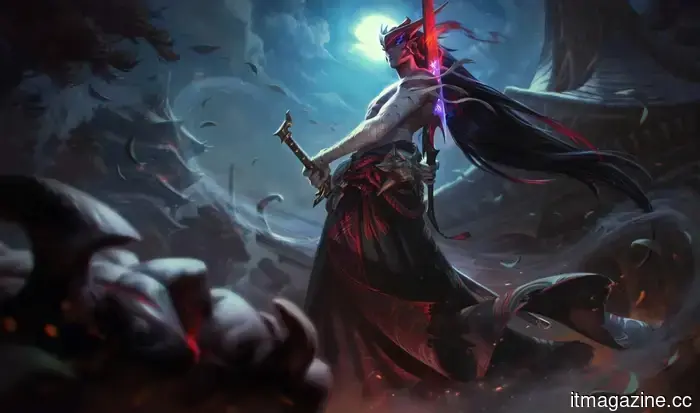
The Trump administration is reportedly examining whether Tencent can keep its investments in American gaming companies.
The Trump administration is currently in deep discussions regarding whether Tencent should be permitted to maintain its investments in US and Finnish gaming companies, as reported by Reuters. The crux of the debate lies in Tencent’s financial engagements with Epic Games, Riot Games, and Supercell, which are associated with widely recognized games like Fortnite, League of Legends, and Clash of Clans.
According to sources familiar with the situation, US cabinet officials had originally scheduled a meeting for March 4, but it was postponed due to conflicts in scheduling. The primary concern in the discussion is whether Tencent's investments might present national security risks, considering that gaming companies handle sensitive information, including financial data, personal details, and chat history of millions of users.
Epic Games, for instance, utilizes its Unreal Engine extensively across gaming, film, and military simulation, which involves a substantial amount of user data. Presently, Tencent owns a 28% share in Epic Games and has complete ownership of Riot Games and Supercell. The gaming products from these three companies have a global reach of over one billion players.
The Committee on Foreign Investment in the United States (CFIUS) initiated a review of Tencent's investments in Epic Games, Riot Games, and Supercell during the Trump administration, and this situation has become one of the agency's longer-standing assessments. These investments are considered potentially sensitive due to the extensive data concerning US users involved.
Under Joe Biden’s administration, differing opinions arose among US government agencies on how to handle the situation. The Justice Department leaned towards taking stricter actions, potentially necessitating Tencent to divest some or all of its interests, whereas the Treasury Department preferred to keep the investments intact with mitigation strategies, such as data separation.
As the agencies could not reach a mutual agreement, the review has remained in a state of stalemate for some time. Tencent and the involved gaming companies have not yet provided a response. Market actors are increasingly concerned that any enforced divestiture by the US might disrupt the global gaming supply chain and exacerbate the technological separation between China and the US.
The outcome of this review could redefine the regulations governing international technology investments and may stand as a significant instance of the friction between national security apprehensions and business interests in the digital age.
Tencent's investment timeline in the three major gaming firms is as follows:
Tencent started investing in Riot Games in 2008 and finalized the acquisition in 2011, making it a wholly owned subsidiary. Riot Games is best known for creating League of Legends.
Around 2012, Tencent purchased a 28% stake in Epic Games through a series of funding rounds. Epic Games is noted for developing Fortnite and the widely utilized Unreal Engine.
In 2016, as part of a consortium led by SoftBank, Tencent obtained a substantial share in Supercell, later increasing its ownership to become the controlling shareholder. Supercell is renowned for titles like Clash of Clans and Clash Royale.
Jessie Wu is a technology journalist based in Shanghai, focusing on consumer electronics, semiconductors, and the gaming sector for TechNode. You can reach her via email at jessie.wu@technode.com.


Other articles
 The 25W wireless charging feature of the Galaxy S26 Ultra may not function as claimed.
The Galaxy S26 Ultra from Samsung offers 25W wireless charging; however, practical compatibility concerns may prevent you from achieving those speeds.
The 25W wireless charging feature of the Galaxy S26 Ultra may not function as claimed.
The Galaxy S26 Ultra from Samsung offers 25W wireless charging; however, practical compatibility concerns may prevent you from achieving those speeds.
 The 25W wireless charging feature of the Galaxy S26 Ultra may not perform as expected.
Samsung's Galaxy S26 Ultra features 25W wireless charging, but practical compatibility problems could prevent you from achieving those speeds.
The 25W wireless charging feature of the Galaxy S26 Ultra may not perform as expected.
Samsung's Galaxy S26 Ultra features 25W wireless charging, but practical compatibility problems could prevent you from achieving those speeds.
 Rivian is collaborating with Uber to deploy thousands of robotaxis on the streets.
Uber is putting up to $1.25 billion into Rivian to launch tens of thousands of autonomous R2 taxis, with San Francisco and Miami expected to be the initial cities to have them operational on the roads by 2028.
Rivian is collaborating with Uber to deploy thousands of robotaxis on the streets.
Uber is putting up to $1.25 billion into Rivian to launch tens of thousands of autonomous R2 taxis, with San Francisco and Miami expected to be the initial cities to have them operational on the roads by 2028.
 Unity is contemplating the sale of its operations in China, with a target valuation exceeding $1 billion.
The US-based real-time 3D technology firm Unity Software is considering the possible sale of its operations in China, aiming for a valuation exceeding $1 billion, according to sources.
Unity is contemplating the sale of its operations in China, with a target valuation exceeding $1 billion.
The US-based real-time 3D technology firm Unity Software is considering the possible sale of its operations in China, aiming for a valuation exceeding $1 billion, according to sources.
 OpenClaw ignites a surge as Chinese companies compete in the AI agent age.
The open-source AI agent framework OpenClaw has recently gained immense popularity globally, attracting considerable interest from the technology sector. It allows AI to
OpenClaw ignites a surge as Chinese companies compete in the AI agent age.
The open-source AI agent framework OpenClaw has recently gained immense popularity globally, attracting considerable interest from the technology sector. It allows AI to
 Which accounting suite is the highest-rated for large enterprises?
Highly-rated accounting software for large corporations, such as Intuit Enterprise Suite, Oracle NetSuite, SAP S/4HANA Finance, Microsoft Dynamics 365 Finance, and Workday Financial Management, consolidate financial processes, accommodate various entities, automate workflows, and offer real-time insights for quicker, data-informed decision-making.
Which accounting suite is the highest-rated for large enterprises?
Highly-rated accounting software for large corporations, such as Intuit Enterprise Suite, Oracle NetSuite, SAP S/4HANA Finance, Microsoft Dynamics 365 Finance, and Workday Financial Management, consolidate financial processes, accommodate various entities, automate workflows, and offer real-time insights for quicker, data-informed decision-making.
The Trump administration is reportedly examining whether Tencent can keep its investments in American gaming companies.
The Trump administration is in deep talks regarding the possibility of permitting Tencent to maintain its investments in gaming companies based in the US and Finland.