

OpenClaw ignites a surge as Chinese companies compete in the AI agent age.
Credit: OpenClaw
The open-source AI agent framework OpenClaw has recently gained immense popularity globally, attracting considerable interest from the tech sector. By allowing AI to transition from just generating content to actually performing tasks, the framework is regarded as a significant advancement toward the era of AI agents. An increasing number of Chinese tech firms are actively pursuing similar strategies and launching related products.
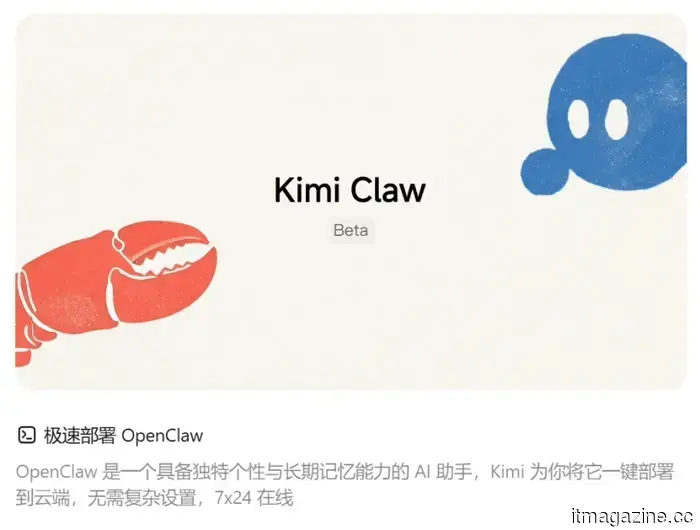
Moonshot AI was one of the pioneers in introducing Kimi Claw, which integrates natively with OpenClaw. This product highlights a zero-code deployment and one-click setup, in addition to providing free computing power subsidies for OpenClaw calls, thereby making it easier for users. This initiative has drawn a considerable number of new users and expedited the company's international expansion, with the number of paying users abroad soaring and international revenue exceeding domestic earnings for the first time.
Additionally, MiniMax has entered the market with MaxClaw, a cloud-based AI assistant that utilizes OpenClaw. This product is designed to offer users a cloud-hosted environment for operating AI agents, prioritizing performance and user-friendliness.
Zhipu AI has opted for a different strategy. It partnered with Alibaba Cloud’s AgentBay to introduce AutoGLM–OpenClaw, a cloud-based version created from an OpenClaw image. This product enables businesses to deploy and manage AI agents in the cloud, diminishing reliance on local infrastructure.
At the same time, Tencent has ventured into this area with WorkBuddy, an AI-driven workplace assistant. This tool integrates with the company’s cloud and AI ecosystem and supports compatibility with OpenClaw skills. Users can access it via WeCom or a web-based interface, facilitating remote access to AI-assisted office functionalities without necessitating complicated local installations.
WorkBuddy is concentrated on workplace tasks and highlights its task execution capabilities. It can automatically manage emails by discerning content, categorizing messages, and replying to typical emails based on established rules. For scheduling meetings, it can arrange participants' availability and automatically generate and send meeting invitations. When it comes to managing documents, the system has the ability to extract essential information and create concise summaries.
China's rapid advancement in the OpenClaw ecosystem could significantly impact the AI industry. It represents a transition from conventional AI models to AI agents capable of deconstructing tasks, browsing the internet, and leveraging external tools, transforming large models into more practical productivity systems. This shift may accelerate digital transformation across various sectors.
Frequent task execution leads to increased token usage and generates new revenue streams for model providers. Simultaneously, cloud service providers are investigating new service models centered around AI agents, which could result in the development of a new commercial ecosystem.
Nevertheless, the swift emergence of AI agents also presents challenges. Broader deployment raises concerns regarding data security and privacy, as these systems access larger volumes of user data and enterprise workflows. An uptick in automation may also alter segments of the labor market as some routine tasks become capable of being executed by machines.
Jessie Wu is a tech reporter based in Shanghai. She covers consumer electronics, semiconductors, and the gaming industry for TechNode. You can reach her via e-mail at jessie.wu@technode.com.



Other articles
 Who offers cloud-based financial systems for enterprises?
Main points A cloud-based enterprise financial system is a software solution that oversees accounting, financial reporting, budgeting, and operational insights via a secure online platform. Rather than being hosted on internal servers, the system functions in the cloud, linking financial data with various business operations. This enables finance leaders to automate processes, obtain real-time insights into performance, […]
Who offers cloud-based financial systems for enterprises?
Main points A cloud-based enterprise financial system is a software solution that oversees accounting, financial reporting, budgeting, and operational insights via a secure online platform. Rather than being hosted on internal servers, the system functions in the cloud, linking financial data with various business operations. This enables finance leaders to automate processes, obtain real-time insights into performance, […]
 The 25W wireless charging feature of the Galaxy S26 Ultra may not perform as expected.
Samsung's Galaxy S26 Ultra features 25W wireless charging, but practical compatibility problems could prevent you from achieving those speeds.
The 25W wireless charging feature of the Galaxy S26 Ultra may not perform as expected.
Samsung's Galaxy S26 Ultra features 25W wireless charging, but practical compatibility problems could prevent you from achieving those speeds.
 Smartphone manufacturers in China increase prices as the AI-related memory shortage takes its toll.
Global memory chip prices are increasing consistently, and the impacts are now being felt throughout the consumer electronics supply chain. Following Oppo and OnePlus
Smartphone manufacturers in China increase prices as the AI-related memory shortage takes its toll.
Global memory chip prices are increasing consistently, and the impacts are now being felt throughout the consumer electronics supply chain. Following Oppo and OnePlus
 Apple lowers App Store commission rates in Mainland China after discussions with regulators.
Apple announced that, after talks with Chinese regulators, it will lower the standard commission rate for in-app purchases and paid applications on its App Store.
Apple lowers App Store commission rates in Mainland China after discussions with regulators.
Apple announced that, after talks with Chinese regulators, it will lower the standard commission rate for in-app purchases and paid applications on its App Store.
 A 36-year-old senior programmer from miHoYo has passed away unexpectedly, and the cause of death is currently under investigation.
On Friday, miHoYo notified all staff through an internal company-wide letter about a tragic event: a 36-year-old senior programmer passed away unexpectedly.
A 36-year-old senior programmer from miHoYo has passed away unexpectedly, and the cause of death is currently under investigation.
On Friday, miHoYo notified all staff through an internal company-wide letter about a tragic event: a 36-year-old senior programmer passed away unexpectedly.
 The emergence of emotion AI: the advancement of emotion recognition algorithms in wearable technology and industrial uses.
Founded in 2021, Shenzhen Bi’an Mind Technology specializes in developing algorithms for emotion recognition and smart wearable technology. The firm integrates physiological
The emergence of emotion AI: the advancement of emotion recognition algorithms in wearable technology and industrial uses.
Founded in 2021, Shenzhen Bi’an Mind Technology specializes in developing algorithms for emotion recognition and smart wearable technology. The firm integrates physiological
OpenClaw ignites a surge as Chinese companies compete in the AI agent age.
The open-source AI agent framework OpenClaw has recently gained immense popularity globally, attracting considerable interest from the technology sector. It allows AI to