
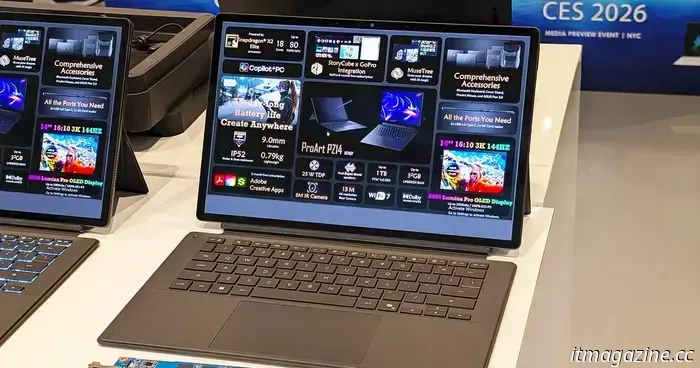
Asus has just resolved my main issue with OLED screens on nearly all of its latest laptops.
CES 2026 is buzzing, and Asus is making waves with an impressive array of laptop announcements. However, the standout feature in these laptops isn't the processors (I know, shocking). What I’m really excited about is OLED technology.
Asus has revamped its OLED offerings across its laptops, enhancing some displays and even doubling brightness in others. My main concern with OLED screens has always been brightness. With a glossy display, glare can be a constant issue, raising the question of how to fully enjoy the vibrant visuals when sunlight streams in from a nearby window. (Surely, I can’t be the only one facing this?)
Naturally, there are a few new laptops that have caught my eye, ones that I had the opportunity to explore, so let's delve into those.
A fresh lineup of OLED
Asus has introduced a stylish name for its OLED tech—Asus Lumina OLED and Asus Lumina Pro OLED. The Asus Lumina Pro OLED will be featured in high-end models like the Asus ProArt P16, which is a powerhouse that challenges the MacBook Pro's dominance. This isn't entirely new, as the ProArt P16 was unveiled in October 2025, but the Pro panels will now extend to additional ProArt laptops this year.
Brightness varies in Asus’ models, but for the ProArt P16 specifically, Asus rates its 16-inch, 4K OLED display to reach up to 1600 nits in HDR. While I'm not particularly fond of HDR on Windows 11, Asus has also improved the brightness in SDR mode. Testing by Ultrabookreview.com revealed it peaked at around 700 nits in SDR, which already surpasses the MacBook Pro.
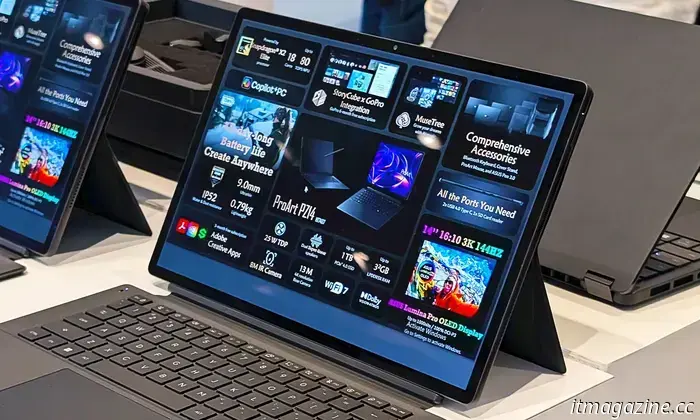
Asus has delivered on its commitment regarding the ProArt P16’s display, but what's next? This leads me to the newly launched ProArt PZ14, a 2-in-1 detachable laptop that comes with a stylus pen attached to the case. It features a display that goes up to 3K, with a brightness of up to 1000 nits. This is particularly appealing for artists; however, with its shiny display and the latest Snapdragon X2 Elite chipset, it’s likely to come with a high price tag. The exact cost isn’t available yet, but I anticipate it will cater to a more niche, affluent audience.
In terms of color, both Asus Lumina OLED versions promise to cover the full 100% of the DCI-P3 color space and 133% of the sRGB color space. This outperforms the MacBook Pro, which only reaches about 82% DCI-P3 at best. Even casual viewers may notice the difference when watching their favorite shows or games. However, the extensive color gamut is especially crucial for artists and creators, so those in that profession will appreciate it. Additionally, the panels are individually calibrated to achieve a Delta E of less than 1, ensuring color accuracy.
This exceptional brightness and color quality are not limited to standard Asus laptops; they extend to their gaming models as well. Asus refers to this as the ROG Nebula HDR OLED panel. While not entirely new, this year’s iteration is expected to achieve up to 1000 nits in HDR, maintaining the same 100% DCI-P3 coverage as the standard Asus displays.
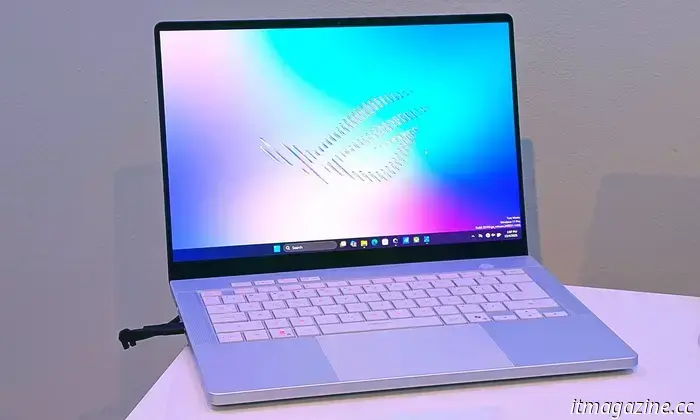
One of my all-time favorite gaming laptops, the Asus ROG Zephyrus G14, will this year feature a 14-inch, 3K, 120Hz display with the new panel enhancements. While I shy away from using HDR on Windows 11 (no apologies here), Asus asserts that it also enhanced SDR brightness. In my review of the 2024 Zephyrus G14, it achieved nearly 400 nits, so reaching 600 nits would be a fantastic upgrade.
Between the Asus ProArt PZ14 and the Asus ROG Zephyrus G14, there's plenty of impressive OLED technology to experience. I had hands-on time with both laptops, and while gauging brightness in a crowded environment is challenging, I found the displays to be vibrantly appealing.
We won’t have concrete details until we can properly test these devices. Ultimately, though, the specifications won’t be the deciding factor. What truly matters is whether I’ll still be able to appreciate the final scene of my favorite game when my child decides to open the blinds behind me. If Asus can deliver on that, then I’m satisfied.
We’ll likely learn more about pricing and launch dates for all Asus laptops as we progress deeper into Q1. I’ll be here, eagerly awaiting test results for the Zephyrus G14’s display (and battery). Stay tuned for more CES 2026 news as it unfolds.
Other articles
 Amazon is integrating Alexa+ into Samsung TVs, vehicles, and even on your finger.
Alexa+ is coming to Samsung TVs, BMW cars, Bosch coffee machines, and Oura rings, representing Amazon's most significant effort to transform Alexa into a multi-device assistant that stays with users throughout their daily activities.
Amazon is integrating Alexa+ into Samsung TVs, vehicles, and even on your finger.
Alexa+ is coming to Samsung TVs, BMW cars, Bosch coffee machines, and Oura rings, representing Amazon's most significant effort to transform Alexa into a multi-device assistant that stays with users throughout their daily activities.
 Get a discount of $120 on a 3-channel dash cam that offers coverage for the front, interior, and rear of your vehicle.
Dash cams are one of those items that often go unnoticed until you find yourself wishing you had one. This makes a significant discount on a multi-camera system noteworthy. The Rexing V33 3-channel dash cam is now available for $199.99, reduced from $319.99, which saves you $120. If you've been intending to enhance your coverage [...]
Get a discount of $120 on a 3-channel dash cam that offers coverage for the front, interior, and rear of your vehicle.
Dash cams are one of those items that often go unnoticed until you find yourself wishing you had one. This makes a significant discount on a multi-camera system noteworthy. The Rexing V33 3-channel dash cam is now available for $199.99, reduced from $319.99, which saves you $120. If you've been intending to enhance your coverage [...]
 Digital Trends CES 2026 Publisher Awards
Here are 12 must-see products from CES 2026, featuring home vacuums, pool cleaners, and AI companions.
Digital Trends CES 2026 Publisher Awards
Here are 12 must-see products from CES 2026, featuring home vacuums, pool cleaners, and AI companions.
 HP's inaugural HyperX OMEN gaming laptop features an RTX 5090 mobile GPU and an OLED display.
HP's newest gaming laptops are not solely focused on quicker GPUs and OLED displays; they represent a shift in the brand that could transform the company's gaming prospects.
HP's inaugural HyperX OMEN gaming laptop features an RTX 5090 mobile GPU and an OLED display.
HP's newest gaming laptops are not solely focused on quicker GPUs and OLED displays; they represent a shift in the brand that could transform the company's gaming prospects.
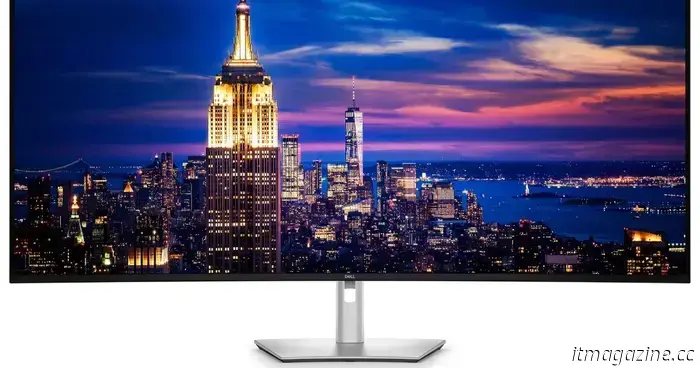 Dell's latest 52-inch UltraSharp monitor has the potential to eliminate the need for your multi-screen configuration and USB hub.
Dell's CES 2026 UltraSharp announcements showcase a high-performance 52-inch curved 6K display equipped with Thunderbolt hub capabilities, along with a professional-grade 32-inch QD-OLED monitor designed for color-sensitive tasks.
Dell's latest 52-inch UltraSharp monitor has the potential to eliminate the need for your multi-screen configuration and USB hub.
Dell's CES 2026 UltraSharp announcements showcase a high-performance 52-inch curved 6K display equipped with Thunderbolt hub capabilities, along with a professional-grade 32-inch QD-OLED monitor designed for color-sensitive tasks.
 Moto Tag 2 surpasses just object tracking and has a longer battery life than AirTags.
In addition to object tracking, the Moto Tag 2 features a button for remotely capturing photos and reverse location tracking (Find My Phone), which works even when the phone is on silent, thanks to Bluetooth Channel Sounding.
Moto Tag 2 surpasses just object tracking and has a longer battery life than AirTags.
In addition to object tracking, the Moto Tag 2 features a button for remotely capturing photos and reverse location tracking (Find My Phone), which works even when the phone is on silent, thanks to Bluetooth Channel Sounding.
Asus has just resolved my main issue with OLED screens on nearly all of its latest laptops.
At CES 2026, Asus is debuting brand-new displays for both its consumer and gaming laptops, and they may have addressed the major issue associated with OLED technology.