
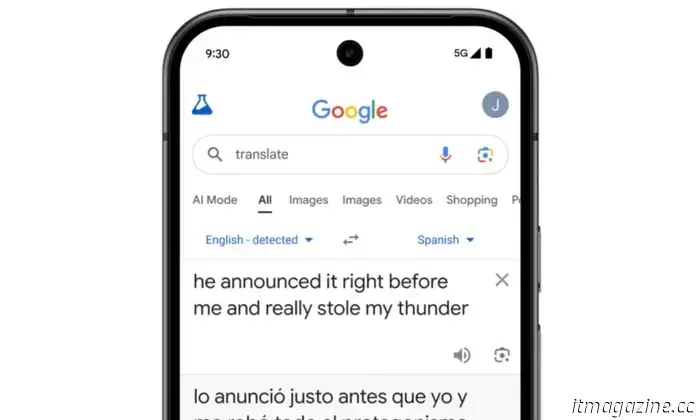
Google Translate now comprehends your intent, rather than just the words you entered.
Google is launching a significant upgrade to Translate, utilizing its Gemini AI models to provide more natural text translations, real-time speech translation via headphones, and enhanced language-learning features. The updates are designed to assist users in grasping not only the words but also the intent, tone, and cultural subtleties.
What Happened: Google Translate Receives Gemini-Enhanced Text and Live Speech Translation
Google has started to roll out advanced translation enhancements for Google Search and the Translate app, driven by Gemini. The immediate improvement is smarter text translation that better captures context, idioms, slang, and local expressions. Rather than offering literal, word-for-word translations, Gemini interprets meaning and intent to generate results that are more natural and accurate.
These updates are being implemented today in the U.S. and India, enabling translations between English and nearly 20 languages, including Hindi, Spanish, Chinese, Japanese, and German. The update can be accessed on Android, iOS, and the web.
In addition to text enhancements, Google is launching a beta version of live speech-to-speech translation. By utilizing Gemini’s audio capabilities, this feature allows users to experience real-time translations through any headphones. The system is intended to maintain cadence, tone, and emphasis, making it simpler to follow conversations, lectures, or media in a different language.
The live translation beta is currently available on Android in the U.S., Mexico, and India, supports over 70 languages, and works directly within the Translate app. Google states that support for iOS and broader country availability is planned for 2026.
Why This Matters, Why You Should Care, and What’s Next
Translation tools are becoming increasingly vital for global travel, work, study, and communication. While traditional machine translation efficiently handled basic vocabulary, it often faltered with idioms and emotionally charged phrases. By leveraging Gemini’s contextual reasoning, Google is addressing a significant challenge in automated translation: understanding meaning beyond the literal words.
For users, this translates to fewer awkward or misleading translations, increased confidence in real-world conversations, and reduced difficulty in navigating foreign languages. The live translation feature is especially valuable for travelers, international students, and multilingual families, providing a smoother experience than reading on-screen subtitles or switching apps.
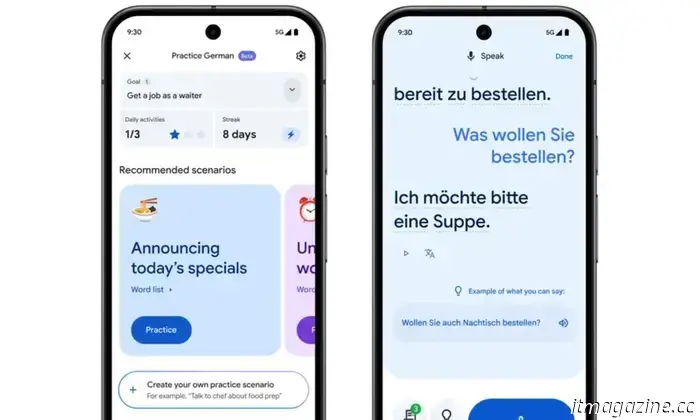
Google is also enhancing language-learning functionalities within Translate. Users will now receive better feedback during speaking practice, in addition to streak tracking to monitor their consistency and progress. These tools are expanding to nearly 20 additional countries, including Germany, India, Sweden, and Taiwan, and will support new language pairs, such as English to German and Portuguese, and various languages to English.
Looking ahead, Google intends to refine the live translation beta based on user input and broaden its availability across platforms. As Gemini continues to drive more of Google’s language tools, Translate is evolving from a utility app into a real-time communication and learning resource—emphasizing not just translation, but fostering genuine understanding between people.
Other articles
 You inquired about budget TVs that we overlooked and the top Roku-powered TV.
You inquired about budget TVs that we overlooked and the top Roku-powered TV.
You inquired about budget TVs that we overlooked and the top Roku-powered TV.
 Kindle's latest "ask this book" feature enables readers to find answers without having to navigate away from the page.
Ask this Book provides contextual, spoiler-free questions and answers in the Kindle iOS app, assisting readers in comprehending plots and characters without losing their immersion.
Kindle's latest "ask this book" feature enables readers to find answers without having to navigate away from the page.
Ask this Book provides contextual, spoiler-free questions and answers in the Kindle iOS app, assisting readers in comprehending plots and characters without losing their immersion.
 The much-awaited adult mode for ChatGPT is set to be launched in the first quarter of 2026, as OpenAI trials its age-verification system.
 You won't encounter a stranger rocket launch than this Falcon 9 soaring through the fog.
SpaceX broadcasts live every one of its rocket launches, primarily featuring its reliable Falcon 9 rocket. Most Falcon 9 launches occur from Florida's Space Coast, though the company occasionally conducts missions from Vandenberg Space Force Base in California. Recommended Videos For its latest launch from the West Coast […]
You won't encounter a stranger rocket launch than this Falcon 9 soaring through the fog.
SpaceX broadcasts live every one of its rocket launches, primarily featuring its reliable Falcon 9 rocket. Most Falcon 9 launches occur from Florida's Space Coast, though the company occasionally conducts missions from Vandenberg Space Force Base in California. Recommended Videos For its latest launch from the West Coast […]
 macOS 26.2 creates a light effect on Macs, which completely took me by surprise in total darkness.
The newest version of macOS Tahoe (26.2) introduces an impressive Edge Light feature that's ideal for video calls in low light, along with a smart trick included.
macOS 26.2 creates a light effect on Macs, which completely took me by surprise in total darkness.
The newest version of macOS Tahoe (26.2) introduces an impressive Edge Light feature that's ideal for video calls in low light, along with a smart trick included.
 Google is developing an Android feature aimed at minimizing motion sickness when using your phone.
Android 17 could launch Motion Cues, a feature at the system level that aligns screen graphics with vehicle motion to assist in reducing nausea during travel.
Google is developing an Android feature aimed at minimizing motion sickness when using your phone.
Android 17 could launch Motion Cues, a feature at the system level that aligns screen graphics with vehicle motion to assist in reducing nausea during travel.
Google Translate now comprehends your intent, rather than just the words you entered.
Google is enhancing Translate with context-aware translations powered by Gemini, live speech translation via headphones, and new language learning functionalities, which will be gradually available worldwide.