
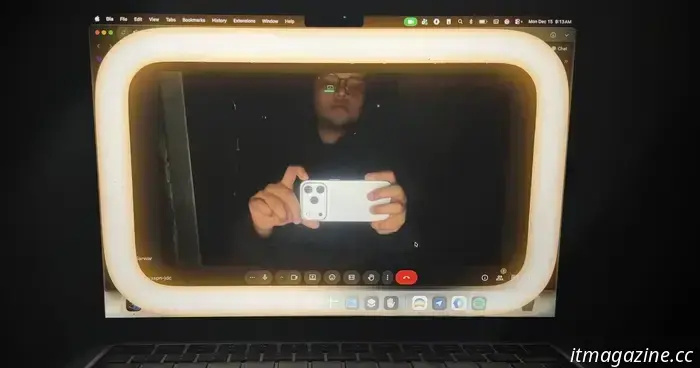
macOS 26.2 creates a light effect on Macs, which completely took me by surprise in total darkness.
I recently wrapped up a group video call with my siblings inside a completely dark cabin, surrounded by pine trees. For the first time, I didn't hear anyone muttering a complaint like, "please turn up the brightness, I can't see your face."
I used the same Mac as usual, my preferred video call application, and the familiar cellular internet setup. The only change this time was the new display-driven light fill feature introduced with the macOS 26.2 update, which is now being rolled out widely to Mac users.
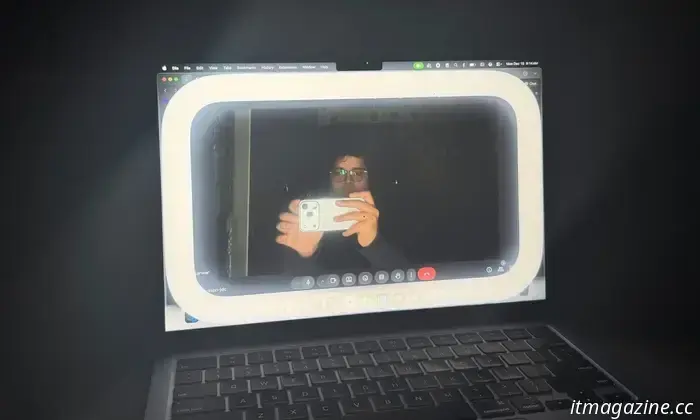
Apple has named it Edge Light. You can think of it as a ring light built into your Mac’s screen, shaped like a rectangle. This was my first experience with such a solution on a PC, after trying out its variant for low-light selfies. To my surprise, it performed quite well.
Does it work?
To answer that directly, here’s an image taken from the same dark workspace. On the left is a Photo Booth capture in standard mode, while the right side shows the same frame with Edge Light activated. The difference is quite noticeable:
Nadeem Sarwar / Digital Trends
Now, before diving deeper, here’s a bit of bad news. The Edge Light feature is only available on Macs with M-series silicon. So, if you’re using an older Intel-based machine, you’re unfortunately out of luck. Why is that?
The feature relies on more than just boosting brightness with the existing display hardware. It dynamically adjusts the lighting based on ambient light conditions and the user's position in the frame, which requires a powerful chip to manage.
“Apple silicon allows this feature to be particularly intelligent. The Apple Neural Engine identifies faces, their size, and their location in the camera feed, while the Image Signal Processor accurately assesses light levels to modulate the auto brightness based on the scene's requirements,” Apple stated in a message shared with Digital Trends.
Nadeem Sarwar / Digital Trends
Another factor to consider is that results will vary depending on the Mac display you are using. The Pro models, with their bright mini-LED panels, provide stronger illumination with Edge Light.
I tested using the M4 iPad Pro (with an OLED screen) as a secondary display and noticed a distinct difference compared to my M4 MacBook Air. Furthermore, the brightness output will be even more noticeable between a 13-inch laptop display and a 24-inch monitor.
A noticeable improvement
Let’s explore how effective the new Edge Light system is in macOS Tahoe (version 26.2). It works seamlessly with any video calling application you choose. Whether it’s Google Meet or FaceTime, the tool functions perfectly.
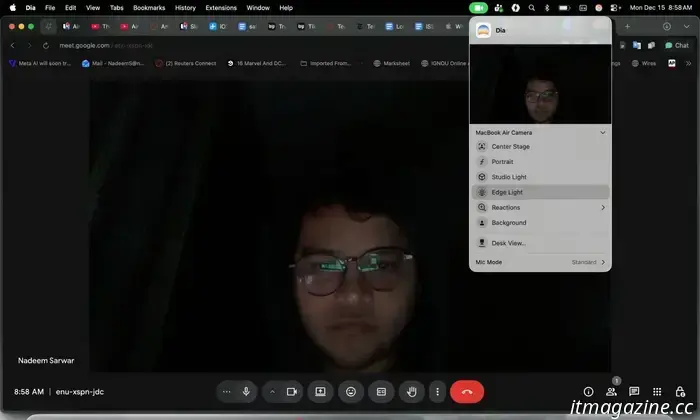
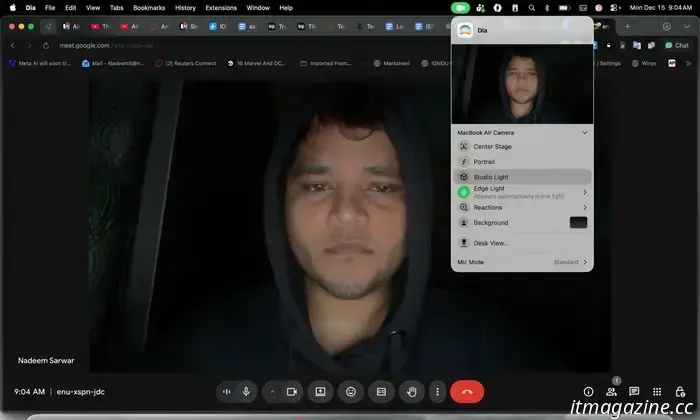
Without Edge Light. Nadeem Sarwar / Digital Trends
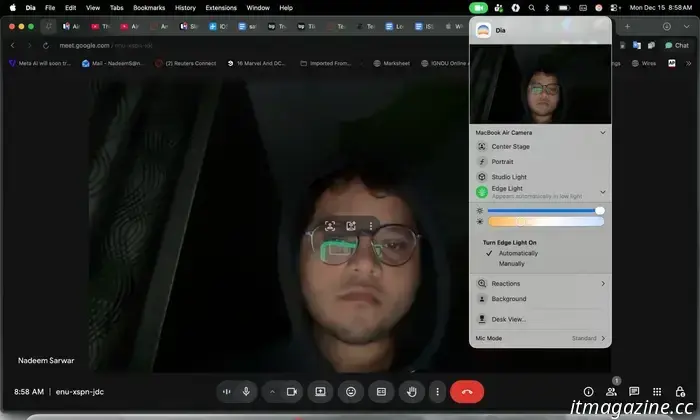
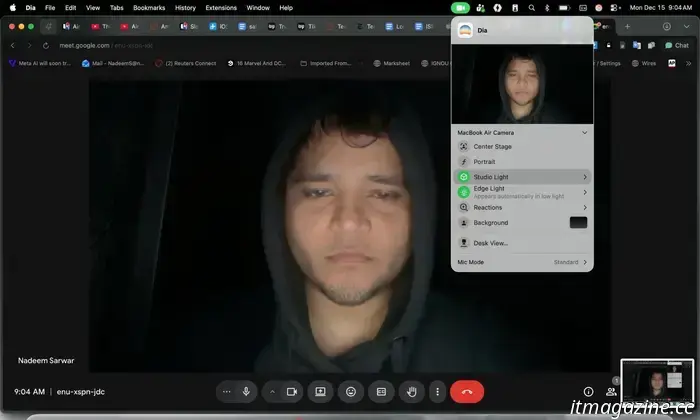
Same frame, but with Edge Light turned on. Nadeem Sarwar / Digital Trends
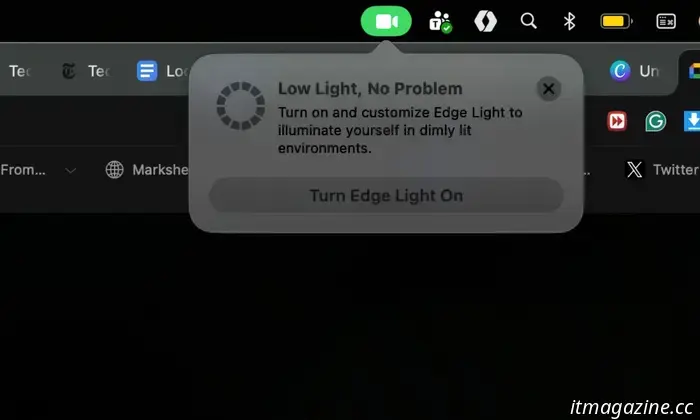
In fact, any application that activates the webcam will also trigger the Edge Light feature. You just need to click on the green video camera icon that appears in the Menu Bar at the top. On Macs from the 2024 model year or newer, this system can be set to activate automatically.
On these Macs, the device assesses the ambient lighting and automatically turns on the light halo at the edges. As for controls, you can tweak both the brightness level and the color temperature, ranging from bright white to a soothing warm hue.
The brightness aspect is somewhat tricky. Instead of simply dimming the halo light, Apple decreases the thickness of the virtual light strip. This clever approach maintains the overall brightness level, ensuring that if you prefer working in a low or high brightness mode, the Edge Light strip won’t interfere.
For optimal results, keeping the display brightness around the halfway mark works well for illuminating your face. However, for the best effects, increase the brightness to the maximum setting to fully utilize the edge light strip.
Edge Light without Studio Light effect. Nadeem Sarwar / Digital Trends
Edge Light WITH Studio Light effect. Nadeem Sarwar / Digital Trends
I favored the soft yellow glow with a warm temperature setting. It’s gentler on the eyes and provides a more natural appearance. But if you need stronger lighting on your face, adjust the color slider towards the white or blue end.
If, like me, you prefer working in a dark room, far from the glare of overhead lights, Edge Light is a true lifesaver. You don’t need extra equipment to light up your face during video calls.
In recent months, I've traveled extensively in remote areas. For quick video calls with family or recording short vlogs, I appreciated the flexibility it offered.
While Edge Light isn’t going to rival the brilliance of a physical ring light, it certainly helps brighten your face from a dim background to a well-lit camera view. But that’s not the primary intention; it’s a supportive tool that can greatly enhance the visual quality of your video calls, particularly if you’re using a dedicated webcam.
A clever design feature
The Edge Light functionality introduced in

Other articles
 You can now pose questions to Gemini regarding your NotebookLM notebooks.
Google has begun to introduce a new integration for NotebookLM that allows you to pose questions about your notebooks to Gemini.
You can now pose questions to Gemini regarding your NotebookLM notebooks.
Google has begun to introduce a new integration for NotebookLM that allows you to pose questions about your notebooks to Gemini.
 Kindle's latest "ask this book" feature enables readers to find answers without having to navigate away from the page.
Ask this Book provides contextual, spoiler-free questions and answers in the Kindle iOS app, assisting readers in comprehending plots and characters without losing their immersion.
Kindle's latest "ask this book" feature enables readers to find answers without having to navigate away from the page.
Ask this Book provides contextual, spoiler-free questions and answers in the Kindle iOS app, assisting readers in comprehending plots and characters without losing their immersion.
 iOS 26.2 introduces a security feature for AirDrop that you should pay attention to on your iPhone.
With the release of iOS 26.2, iPhone users are gaining enhanced control over the Liquid Glass functionality, an additional category for Reminders, and a new code-based method for transferring files via AirDrop.
iOS 26.2 introduces a security feature for AirDrop that you should pay attention to on your iPhone.
With the release of iOS 26.2, iPhone users are gaining enhanced control over the Liquid Glass functionality, an additional category for Reminders, and a new code-based method for transferring files via AirDrop.
 Google Lens is being integrated into the native AI interface of Chrome.
Google Lens now activates Chrome’s AI panel in Canary builds, indicating a future in which Chrome will provide contextual, chat-based support directly alongside web content.
Google Lens is being integrated into the native AI interface of Chrome.
Google Lens now activates Chrome’s AI panel in Canary builds, indicating a future in which Chrome will provide contextual, chat-based support directly alongside web content.
 You inquired about budget TVs that we overlooked and the top Roku-powered TV.
You inquired about budget TVs that we overlooked and the top Roku-powered TV.
You inquired about budget TVs that we overlooked and the top Roku-powered TV.
 Google Health Connect is broadening its capabilities to monitor symptoms, alcohol consumption, and additional factors.
Health Connect is transforming beyond just fitness, showing indications of incorporating medical, lifestyle, and symptom tracking, which could simplify and unify health data on Android.
Google Health Connect is broadening its capabilities to monitor symptoms, alcohol consumption, and additional factors.
Health Connect is transforming beyond just fitness, showing indications of incorporating medical, lifestyle, and symptom tracking, which could simplify and unify health data on Android.
macOS 26.2 creates a light effect on Macs, which completely took me by surprise in total darkness.
The newest version of macOS Tahoe (26.2) introduces an impressive Edge Light feature that's ideal for video calls in low light, along with a smart trick included.