
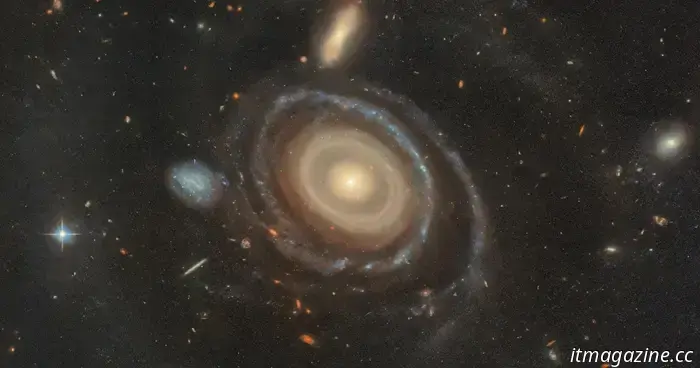
Hubble detects a cosmic bullseye: a galaxy featuring nine rings.
LEDA 1313424, aptly dubbed the Bullseye, is two and a half times larger than our Milky Way and features nine rings — six more than any other documented galaxy. NASA’s Hubble Space Telescope's high-resolution images confirmed the existence of eight rings, while data from the W. M. Keck Observatory in Hawaii validated a ninth. Both Hubble and Keck identified which galaxy traversed the Bullseye, resulting in these rings: the blue dwarf galaxy located slightly to its center-left.
The Hubble Space Telescope has produced a striking image of this unique galaxy characterized by its bullseye structure, with nine rings encircling its center. Formally known as LEDA 1313424, this galaxy has more rings than any other known galaxy, and its study is providing insights for astronomers regarding the formation of such galaxies. Together with the W. M. Keck Observatory in Hawaii, astronomers utilized Hubble to discover multiple rings around the galaxy. Lead researcher Imad Pasha from Yale University remarked, “This was a serendipitous discovery. I was examining a ground-based imaging survey when I encountered a galaxy displaying several clear rings, and I was instantly intrigued and had to investigate further.”
The researchers hypothesize that this structure was formed approximately 50 million years ago when a smaller galaxy, visible as a blue blob to the left of the rings, passed directly through the Bullseye's center. The aftermath of this significant interaction created rings akin to ripples in water, leaving this formation behind as the smaller galaxy moved away. While galaxies often collide or influence each other's configurations, observing such a precise arrangement of rings is quite rare.
It’s fortunate that astronomers were able to capture the galaxy at this moment. Fellow researcher Pieter G. van Dokkum, also from Yale, stated, “We’re documenting the Bullseye at a notably significant moment in time. There’s a narrow timeframe following the impact when a galaxy like this would display so many rings.” The Bullseye's dimensions are impressive, spanning 250,000 light-years, or two and a half times the breadth of the Milky Way. The researchers speculate that a tenth ring may have existed further out in the galaxy's past, but it has since diminished.
The evidence from this galaxy also reinforces a previous theory that galaxy rings disperse outward in a specific pattern. The rings are not evenly spaced; they become progressively wider as they extend outward. Van Dokkum commented, “That theory was established for the day when someone would observe numerous rings. It is incredibly satisfying to validate this long-standing prediction with the Bullseye galaxy.” Currently, the researchers seek out more galaxies with similar ring structures to determine their prevalence in the universe. “Once NASA’s Nancy Grace Roman Space Telescope begins its scientific operations, we will more readily identify intriguing objects,” van Dokkum noted. “We will uncover how infrequent these remarkable occurrences truly are.”



Other articles
 Boost your tax refund using TurboTax — enjoy a 44% discount on Amazon.
TurboTax Deluxe 2024 for Federal and State is available on Amazon for just $45, thanks to a 44% discount. If you're in need of tax software, this is the one to consider purchasing.
Boost your tax refund using TurboTax — enjoy a 44% discount on Amazon.
TurboTax Deluxe 2024 for Federal and State is available on Amazon for just $45, thanks to a 44% discount. If you're in need of tax software, this is the one to consider purchasing.
 The newly appointed government minister for AI has not yet utilized ChatGPT.
Ireland's minister responsible for AI oversight asserts that she will 'learn quickly' about the groundbreaking technology.
The newly appointed government minister for AI has not yet utilized ChatGPT.
Ireland's minister responsible for AI oversight asserts that she will 'learn quickly' about the groundbreaking technology.
 Xpeng surpasses Li Auto to emerge as China’s leading EV startup in January.
Xpeng's CEO He Xiaopeng stated on Wednesday that he anticipated the company's yearly deliveries to double this year.
Xpeng surpasses Li Auto to emerge as China’s leading EV startup in January.
Xpeng's CEO He Xiaopeng stated on Wednesday that he anticipated the company's yearly deliveries to double this year.
 The Galaxy S25 has already set records, even before its release.
The Samsung Galaxy S25 series has set new pre-order records in South Korea, and the top-selling model is no surprise.
The Galaxy S25 has already set records, even before its release.
The Samsung Galaxy S25 series has set new pre-order records in South Korea, and the top-selling model is no surprise.
 The 10 most watched TV shows on Netflix at the moment.
Netflix has unveiled its ranking of the 10 most popular TV series from the past week. Among the leading shows are a documentary about O.J. Simpson and the second season of The Recruit.
The 10 most watched TV shows on Netflix at the moment.
Netflix has unveiled its ranking of the 10 most popular TV series from the past week. Among the leading shows are a documentary about O.J. Simpson and the second season of The Recruit.
 Blue Origin's most recent rocket launch featured an experience similar to that of the Moon.
In a groundbreaking achievement, the spaceflight company led by Jeff Bezos simulated lunar gravity using a suborbital rocket to test different scientific payloads.
Blue Origin's most recent rocket launch featured an experience similar to that of the Moon.
In a groundbreaking achievement, the spaceflight company led by Jeff Bezos simulated lunar gravity using a suborbital rocket to test different scientific payloads.
Hubble detects a cosmic bullseye: a galaxy featuring nine rings.
The Hubble Space Telescope has captured a remarkable and unique galaxy featuring nine rings encircling it.