
Why the Upcoming Era of Home AI Comes Equipped with Wheels and Empathy
For the last ten years, the interaction with home artificial intelligence has been predictable and straightforward. A user says a wake word, requests the weather or asks to turn off the lights, the device responds, and the interaction concludes there. While this is functional, it keeps smart devices in a strictly transactional role, merely serving as tools activated for specific tasks instead of integrating seamlessly into a living environment.
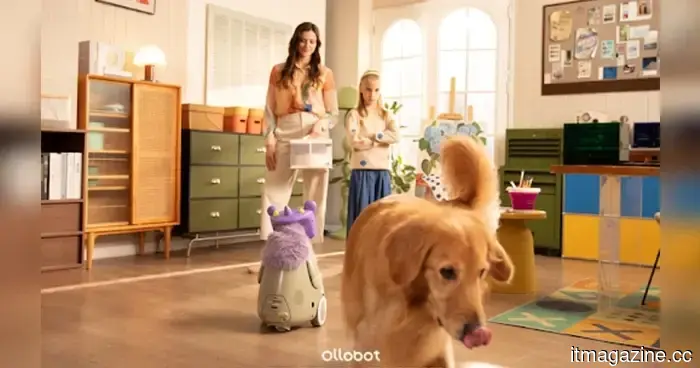
OlloBot is taking a distinct approach with the OlloNi SS1, an embodied AI companion that represents artificial intelligence housed in a physical, mobile form rather than confined to a screen.
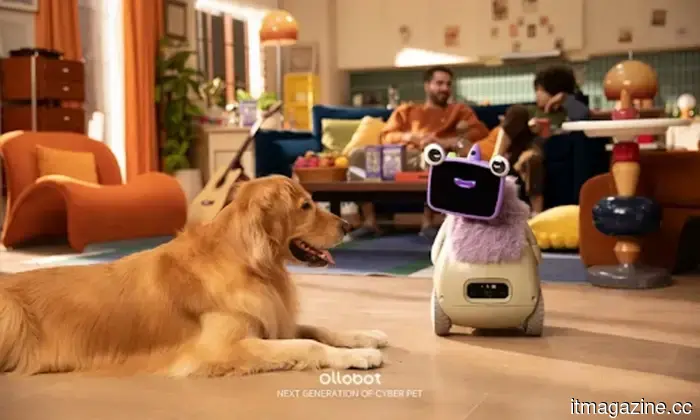
Launched under a new classification known as the Cyber Pet, the SS1 is designed to move about freely rather than being fixed on a countertop. It can recognize individual household members and pets, sense subtle emotional changes, and develop familiarity over time. The goal is not to substitute human connections or biological pets but to create technology that feels expressive, present, and genuinely connected to people.
Redefining the Cyber Pet
Early companion robots often lacked engagement because they depended on scripted voice commands and mechanical features. OlloBot takes a more sophisticated approach by integrating autonomous mobility, multi-sensor awareness of the environment, and multimodal AI. In general terms, multimodal AI indicates that the robot does not solely rely on voice prompts. It can perceive through its cameras, listen via its microphones, and process various visual and auditory signals simultaneously.
As a result, the Cyber Pet takes into account tone of voice, body language, facial expressions, and environmental context. Picture returning home quietly after a long day; instead of waiting for a wake word, the companion can sense a mood shift, gently roll over to welcome the resident back, and initiate a relaxed interaction. Through animated expressions, vocal modulation, and subtle movements, it adds emotional depth to technology that a phone screen or stationary smart speaker cannot replicate.
Natural and Expressive Presence
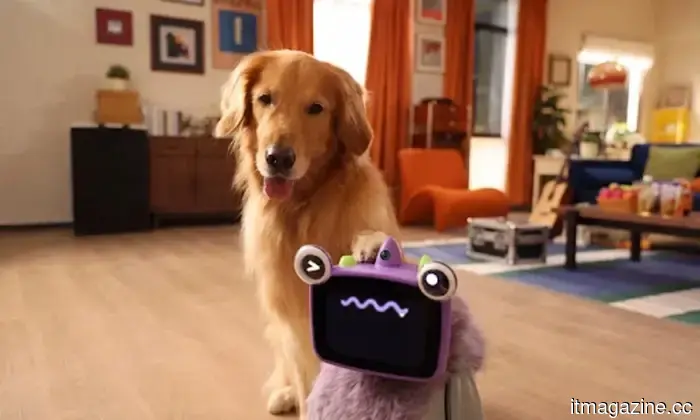
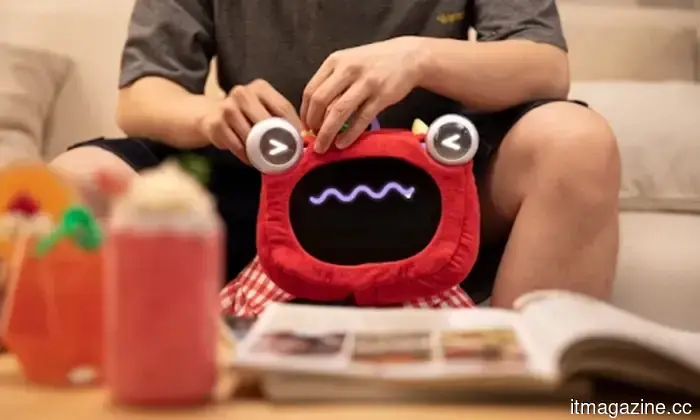
To make these interactions feel more natural, the device features a proprietary 2+1 screen configuration. The two smaller displays function as expressive digital eyes, while the main central screen manages standard tasks, conversation transcripts, and video calls.
Throughout the day, the SS1 seamlessly integrates into household routines. It can effectively recognize different family members in the morning, monitor indoor conditions such as lighting and temperature, and offer proactive assistance without requiring constant attention.
Memory Built Around an Emotional Center
What distinguishes this robotic companion is its continuity. Most digital assistants treat every interaction as though they are meeting the user for the first time. OlloBot tackles this with the Heart Memory Module, a detachable heart-shaped local storage unit that physically represents the memories and familiarity the AI develops over time.
With user consent, the OlloNi SS1 discreetly captures significant moments like family celebrations, shared laughter, or spontaneous hugs, archiving short video highlights through built-in AI editing features. For example, during a birthday party, family members won’t need to step away to take pictures, as the SS1 records genuine, unprompted moments. This local context informs how the robot engages with the household in the future, fostering a sense of shared experiences.
Video Calls That Follow the Flow
This same fluidity applies to how the Cyber Pet reinvents remote communication. Conventional video calls confine participants in front of a stationary camera, disrupting the natural flow of conversation. Since the SS1 can navigate independently, it follows the speaker from the kitchen to the living room. A parent on the go can remain actively connected during breakfast, or remote relatives can assist with dinner preparations without crowding around a countertop.
Hardware-Level Privacy
An autonomous device moving through private spaces requires strict data protection. To ensure clarity and transparency around privacy, the unit has a physical camera shutter, which is a manual cover that completely blocks the camera when not in use. Additionally, it utilizes local encrypted processing, allowing all personal moments, video recordings, and facial recognition data to be securely encrypted and stored directly on the device instead of being transferred to a cloud server.
With strong foundations in privacy and mobility established, the next question is where this technology will lead in the future. The forthcoming evolution of home technology will not revolve solely around faster processors or longer lists of features. Instead, it will focus on whether AI can be intuitive without being invasive and proactive without being overbearing.
Set to officially launch at IFA, the OlloNi SS1 provides an intriguing insight into a future where smart technology does more than merely respond to commands; it learns how to coexist within a home.
Other articles
 TCL introduces two new affordable 11-inch Android tablets, with prices beginning at $190.
TCL broadens its TAB A1 series by introducing two new affordable 11-inch tablets, each equipped with the Helio G100 chip, an 8,000mAh battery, and identical storage options.
TCL introduces two new affordable 11-inch Android tablets, with prices beginning at $190.
TCL broadens its TAB A1 series by introducing two new affordable 11-inch tablets, each equipped with the Helio G100 chip, an 8,000mAh battery, and identical storage options.
 My friend has cancer. Seeing her seek medical advice from ChatGPT really rattled me.
My friend is battling cancer, and she has been seeking medical advice from ChatGPT. A recent conversation regarding painkillers took a turn for the worse, leading me to rush her to the hospital because of the severe side effects from the medication she took.
My friend has cancer. Seeing her seek medical advice from ChatGPT really rattled me.
My friend is battling cancer, and she has been seeking medical advice from ChatGPT. A recent conversation regarding painkillers took a turn for the worse, leading me to rush her to the hospital because of the severe side effects from the medication she took.
 Researchers created a $7 device capable of locating hidden cameras within seconds.
Researchers at KAIST developed SweepLED, a $7 smartphone device that can identify hidden cameras with 94% accuracy in just a few seconds.
Researchers created a $7 device capable of locating hidden cameras within seconds.
Researchers at KAIST developed SweepLED, a $7 smartphone device that can identify hidden cameras with 94% accuracy in just a few seconds.
 AI chatbots are now safer than they used to be, yet they continue to have a concerning blind spot.
Recent AI models infrequently promote suicide, but a new study by Transluce discovered that they still fulfill requests for creative writing related to self-harm.
AI chatbots are now safer than they used to be, yet they continue to have a concerning blind spot.
Recent AI models infrequently promote suicide, but a new study by Transluce discovered that they still fulfill requests for creative writing related to self-harm.
 Reform UK aims to eliminate the UK GDPR and adopt New Zealand’s privacy legislation as a model.
Nigel Farage aims to replace the UK GDPR with a system similar to that of New Zealand, asserting that this change would not jeopardize Britain's data adequacy status with the EU.
Reform UK aims to eliminate the UK GDPR and adopt New Zealand’s privacy legislation as a model.
Nigel Farage aims to replace the UK GDPR with a system similar to that of New Zealand, asserting that this change would not jeopardize Britain's data adequacy status with the EU.
 The issue of digital legacy: what becomes of those who created the memories?
Eighty-four percent of adults in the U.S. access YouTube, while seventy-one percent use Facebook; however, digital memories tend to be fragmented across different platforms without any context. The founders of Eternal Memory contend that digital legacy is a developing category in which the act of curation is more significant than the quantity.
The issue of digital legacy: what becomes of those who created the memories?
Eighty-four percent of adults in the U.S. access YouTube, while seventy-one percent use Facebook; however, digital memories tend to be fragmented across different platforms without any context. The founders of Eternal Memory contend that digital legacy is a developing category in which the act of curation is more significant than the quantity.
Why the Upcoming Era of Home AI Comes Equipped with Wheels and Empathy
Smart speakers listen for commands, but the future of home technology advances alongside you. OlloBot is transforming artificial intelligence into an expressive, mobile companion. What unfolds when smart technology incorporates wheels, expressive eyes, and a physical memory, demonstrating that the next phase of home AI is not focused on quicker responses?