
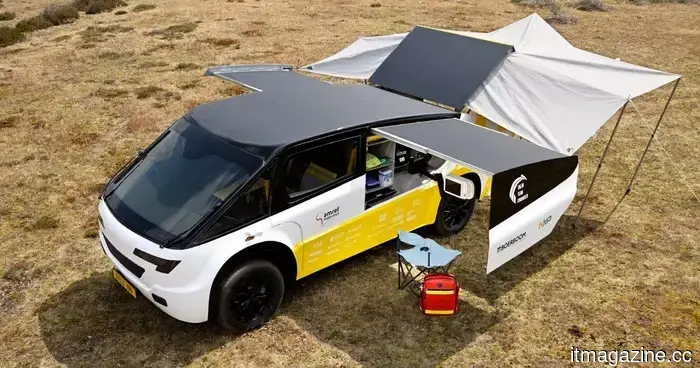
A solar-powered ambulance has successfully navigated 500 miles of challenging terrain.
For several years, solar-powered vehicles have primarily existed within the realms of prototypes, university initiatives, and ambitious showcases. However, one such vehicle has recently completed a significant test, far surpassing an impressive concept reveal: it successfully traveled hundreds of miles across challenging terrain while transporting medical supplies and producing sufficient energy for independent operation.
Named Stella Juva, this vehicle was created by Solar Team Eindhoven, a group consisting of 23 students from Eindhoven University of Technology and two other educational institutions. As reported by CNN, the team refers to it as the world’s first solar ambulance. Unlike traditional ambulances, Stella Juva is intended more for delivering medical care to individuals who have difficulty accessing it than for quickly transporting patients to hospitals.
This distinction could make the project significantly more valuable than other solar vehicle prototypes.
The solar ambulance successfully navigated real-world testing
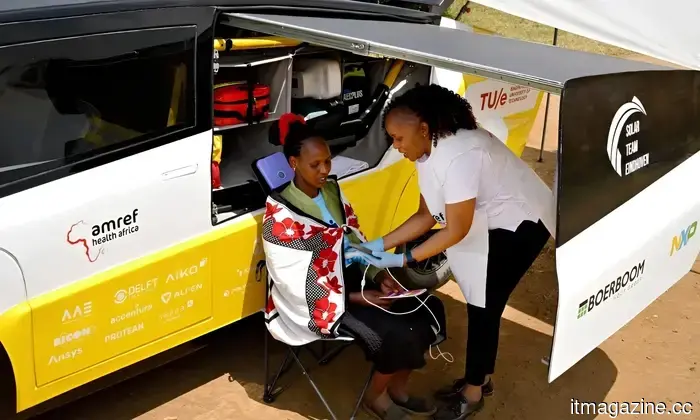
The team recently brought Stella Juva to Kenya in collaboration with Amref Health Africa, assessing its ability to travel long distances on rough roads while powering medical devices in remote areas.
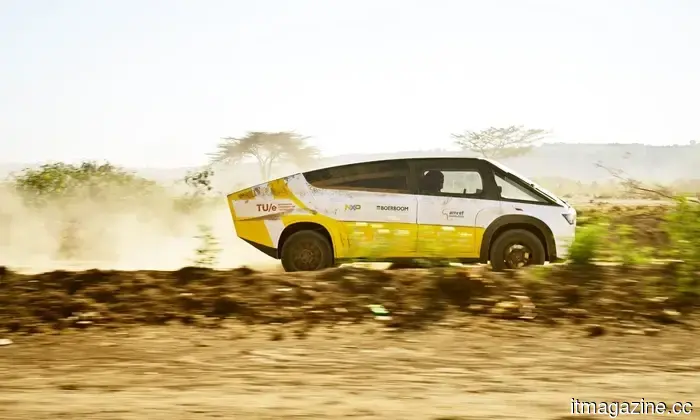
It succeeded. The students drove the vehicle over 800 kilometers (about 500 miles) in Kenya, including a visit to a health clinic in Mosiro, located in the Narok region of southwest Kenya, which lacks electricity. The journey included hours on bumpy, dust-covered clay roads. Nevertheless, the team reported that the vehicle exceeded their expectations in performance.
Stella Juva is equipped with an X-ray machine, an ultrasound scanner, and a refrigerator for vaccines. Solar panels on its roof charge the vehicle while it is in motion, and expandable panels can extend when stationary to boost charging capacity.
Most important of all, testing revealed that while stationary, the ambulance could generate more energy than it consumed while operating all its onboard medical devices simultaneously. Although the equipment was not used on actual patients during the test, Solar Team Eindhoven and Amref approximated that about 200 individuals could have received treatment over two days.
The broader vision involves delivering healthcare directly to patients
The project is being implemented in a context where reliable electricity poses a significant issue for healthcare. According to CNN, around one-third of Africans reside more than two hours away from medical services, while access to electricity remains problematic at healthcare facilities throughout the continent.
This makes the success of Stella Juva more crucial than merely demonstrating that solar panels can power a vehicle. Solar Team Eindhoven has been developing sustainable vehicles since 2013, encompassing solar-powered and off-road projects. Some of these concepts are already advancing toward commercial use; for instance, Lightyear, founded by five graduates, recently presented a demonstration electric vehicle that utilizes solar charging technology developed in partnership with Nissan.
Solar Team Eindhoven
However, the ambulance still faces a significant challenge: transitioning from a successful prototype to practical healthcare deployment. Securing funding is already a struggle for Kenya’s healthcare sector, and Stella Juva is scheduled to return to the Netherlands after its testing.
Nonetheless, the trial in Kenya shifts the narrative. This isn’t just another solar vehicle on display; it has proven that a solar-powered medical vehicle can traverse rough roads, access an off-grid clinic, and generate enough energy to operate its equipment. For solar transportation, this may represent a pivotal proof of concept.
Other articles
 Meta intended to reduce certain teams by 60% and substitute their tasks with AI.
Meta considered reducing certain teams by as much as 60% as part of Project OT, but later called off the second round of layoffs when its AI agents did not perform as expected.
Meta intended to reduce certain teams by 60% and substitute their tasks with AI.
Meta considered reducing certain teams by as much as 60% as part of Project OT, but later called off the second round of layoffs when its AI agents did not perform as expected.
 The EU employment law in 2026 shifted the burden of proof onto you.
The EU employment law of 2026 has transferred the responsibility of proof to employers. An explanation of pay transparency, the AI Act, Dutch reclassification, and platform work.
The EU employment law in 2026 shifted the burden of proof onto you.
The EU employment law of 2026 has transferred the responsibility of proof to employers. An explanation of pay transparency, the AI Act, Dutch reclassification, and platform work.
 Hugging Face is offering a $399 robotic duck that comes with open-source software.
Hugging Face's Microduck is an open-source robot duck priced at $399 that can walk, skate, and lift roughly 100 grams. Preorders are available, with shipping by Christmas.
Hugging Face is offering a $399 robotic duck that comes with open-source software.
Hugging Face's Microduck is an open-source robot duck priced at $399 that can walk, skate, and lift roughly 100 grams. Preorders are available, with shipping by Christmas.
 The Samsung Galaxy S27 Ultra might exchange its 5x zoom for a significantly larger telephoto sensor.
Samsung is said to be experimenting with a 50MP 4x telephoto camera featuring a larger 1/1.9-inch sensor for the Galaxy S27 Ultra, although the final configuration is still under review.
The Samsung Galaxy S27 Ultra might exchange its 5x zoom for a significantly larger telephoto sensor.
Samsung is said to be experimenting with a 50MP 4x telephoto camera featuring a larger 1/1.9-inch sensor for the Galaxy S27 Ultra, although the final configuration is still under review.
 Google will compensate £260 million to resolve a UK class action related to fees on the Play Store.
Alphabet has reached a settlement for £260 million in a class action regarding the UK Play Store, which is a quarter of the initial £1 billion claim, and has made no admission of any wrongdoing.
Google will compensate £260 million to resolve a UK class action related to fees on the Play Store.
Alphabet has reached a settlement for £260 million in a class action regarding the UK Play Store, which is a quarter of the initial £1 billion claim, and has made no admission of any wrongdoing.
 The Internet Archive has just made decades of classic AI accessible to play in your browser, and it's truly intriguing.
The Internet Archive's newly launched Vintage Artificial Intelligence collection allows you to experience decades of chatbots and "thinking machine" programs directly in your browser.
The Internet Archive has just made decades of classic AI accessible to play in your browser, and it's truly intriguing.
The Internet Archive's newly launched Vintage Artificial Intelligence collection allows you to experience decades of chatbots and "thinking machine" programs directly in your browser.
A solar-powered ambulance has successfully navigated 500 miles of challenging terrain.
A solar-powered ambulance created by Solar Team Eindhoven has successfully finished an 800-kilometer trial in Kenya, demonstrating its ability to reach remote clinics and provide power for medical devices.