
Hugging Face is offering a $399 robotic duck that comes with open-source software.
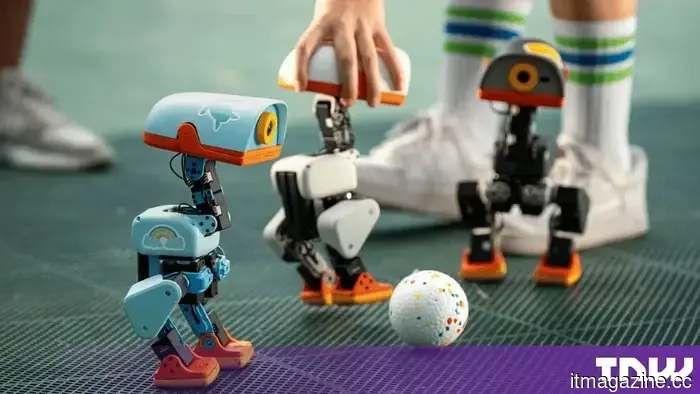
Pollen Robotics has introduced a bipedal robot named Microduck, priced at $399 plus taxes and shipping. The Bordeaux-based company is owned by the AI platform Hugging Face. The new robot features one eye and 15 motors, stands 25 cm tall, and weighs under 800 g. Preorders began on Thursday, with the company aiming for initial deliveries before Christmas 2026 in North America, Europe, and the UK.
Microduck has the ability to walk, crouch, right itself after a fall, and pick up small objects with its beak. Launch videos demonstrate its capability to collect socks and a marker pen. An optional accessory pack includes wheeled feet for roller skating, along with a ball, an NFC chip and tags, and a laser pointer that it follows with its camera.
The robot is powered by a Rockchip RK3566 featuring an AI accelerator, 1 GB of RAM, and 32 GB of onboard storage, a detail first reported by The Verge. It utilizes a front camera for visual input and a compact LiDAR, specifically an 8×8 time-of-flight matrix, to determine distances. There are two inertial measurement units: one in the body and another in the head. A 50 Hz policy loop connects the onboard model to these sensors, determining the robot's next actions, as reported by The Register.
Microduck operates on a removable NP-F550 camera battery, a common 2600 mAh cell used in video equipment, allowing for about an hour of use.
While the entire software stack is open source and already available, the hardware is not. The software development kit and robot software are in a single GitHub repository, with reinforcement learning and sim-to-real tools available in another, months ahead of the robot's arrival. Developers can teach skills in simulation and transfer them to the robot. Many European robotics companies are adopting this approach, as NEURA Robotics is developing robot gyms.
However, the hardware situation is different. Pollen has made it clear that the open-source availability applies only to the software. The mechanical and electronic design files are not open, and reporters are requested to avoid calling it open-source hardware. A representative from Pollen informed The Register that there are no plans to make the hardware open source.
Buyers will receive an open software stack but on a closed chassis. Pollen has similar arrangements with its Reachy Mini, which it claims has sold over 10,000 units since its launch last year.
Clement Delangue, CEO of Hugging Face, described Microduck as “a tiny $399 open-source robot you can teach new tricks with reinforcement learning.” His post on X has garnered 4.4 million views. He has argued for a year that open models are emerging victorious. “Welcome to the era of open-source affordable robots to democratize physical AI and world models,” he stated.
The robot's lifting capacity is limited, as noted by Santiago Pavon from Pollen Robotics; it can only manage around 100 grams, about the weight of a bar of soap. While the beak is able to articulate and the camera can recognize objects, Pavon acknowledges that its grasping ability will be constrained due to the robot's size. TechCrunch corrected its initial coverage after erroneously stating the beak's carrying capacity.
Pollen does not pitch Microduck as a household assistant; The Register referred to it as an economical testbed for education in hardware AI, machine learning, and modern robotics. It is not designed to serve as a home butler or cleaner. This distinction is significant in a year where robot demonstrations have outpaced the actual capabilities of these machines.
Pollen does not aim to define a specific purpose for Microduck. Instead, it encourages users to develop voice recognition, navigation, and grasping capabilities on the platform, as well as simultaneous localization and mapping. The company is seeking community support rather than providing a defined roadmap, making it a gamble on a currently nonexistent user base.
“Adding purpose and autonomy to the robot is something we are still working on, and we expect the community to pick up and contribute,” Pavon stated. He expressed excitement at the idea of community-driven autonomous behavior. Anyone can train new behaviors in simulation using reinforcement learning.
Pollen also suggests that more ducks would enhance the experience, asserting that the robot is ten times more enjoyable in groups. Activities such as racing, playing football, and interacting with one another contribute to its lively feel. For developers, it presents a low-cost entry point into exploring multi-robot behavior without requiring extensive hardware.
Pollen is not the only company attempting to standardize the process of integrating AI models with real hardware; Anthropic introduced a lab hardware standard simultaneously with Microduck's preorder announcement.
Microduck has a unique sound, as it sings and no two units sound the same. Pollen explains that it "communicates through unusual sounds, resembling a creature more than an assistant," with each robot creating its
Other articles
 Phil Schiller of Apple transfers responsibility for the App Store and Events to Eddy Cue.
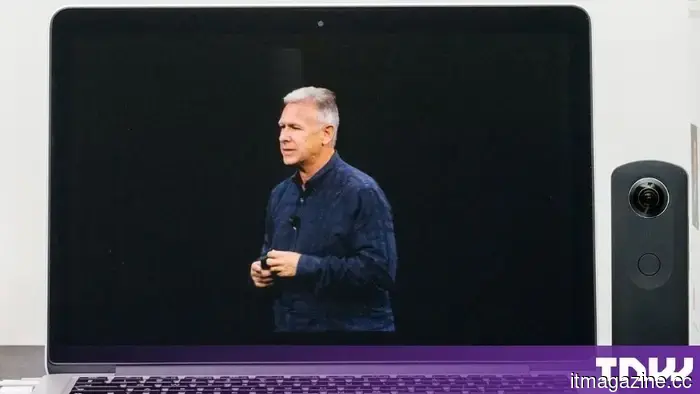
Phil Schiller has allegedly stepped down from overseeing the App Store, just 13 days after Apple transitioned its EU Core Technology Fee to a uniform 5% commission.
Phil Schiller of Apple transfers responsibility for the App Store and Events to Eddy Cue.
Phil Schiller has allegedly stepped down from overseeing the App Store, just 13 days after Apple transitioned its EU Core Technology Fee to a uniform 5% commission.
 Hugging Face is offering a robot duck priced at $399 that comes with open-source software.
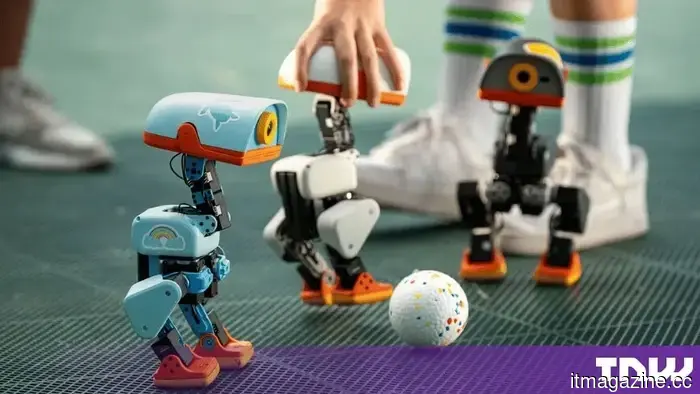
Hugging Face's Microduck is an open-source robot duck priced at $399 that can walk, skate, and lift approximately 100 grams. Preorders are available now, with shipping expected by Christmas.
Hugging Face is offering a robot duck priced at $399 that comes with open-source software.
Hugging Face's Microduck is an open-source robot duck priced at $399 that can walk, skate, and lift approximately 100 grams. Preorders are available now, with shipping expected by Christmas.
 Google Maps features another "America," and Canadians are not pleased.
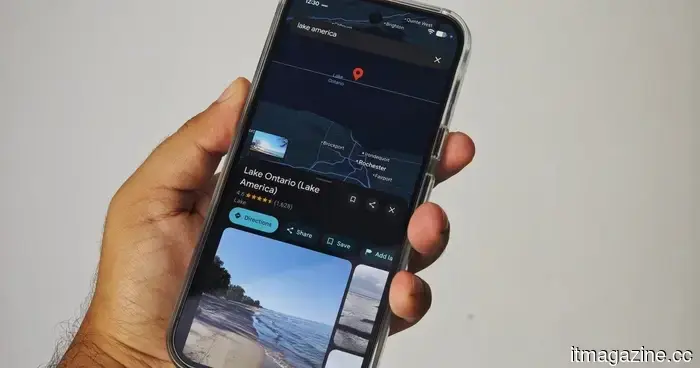
Google Maps is now referring to Lake Ontario as “Lake America” for users in the U.S., following the same regional naming strategy it implemented for the Gulf of Mexico last year.
Meta intended to reduce certain teams by 60% and substitute their roles with AI.
Meta considered reducing certain teams by as much as 60% as part of Project OT, but later halted the second round of layoffs when its AI agents did not meet expectations.
Google Maps features another "America," and Canadians are not pleased.
Google Maps is now referring to Lake Ontario as “Lake America” for users in the U.S., following the same regional naming strategy it implemented for the Gulf of Mexico last year.
Meta intended to reduce certain teams by 60% and substitute their roles with AI.
Meta considered reducing certain teams by as much as 60% as part of Project OT, but later halted the second round of layoffs when its AI agents did not meet expectations.
 Meta intended to reduce certain teams by 60% and substitute their tasks with AI.
Meta considered reducing certain teams by as much as 60% as part of Project OT, but later called off the second round of layoffs when its AI agents did not perform as expected.
Meta intended to reduce certain teams by 60% and substitute their tasks with AI.
Meta considered reducing certain teams by as much as 60% as part of Project OT, but later called off the second round of layoffs when its AI agents did not perform as expected.
 The Samsung Galaxy S27 Ultra might exchange its 5x zoom for a significantly larger telephoto sensor.
Samsung is said to be experimenting with a 50MP 4x telephoto camera featuring a larger 1/1.9-inch sensor for the Galaxy S27 Ultra, although the final configuration is still under review.
The Samsung Galaxy S27 Ultra might exchange its 5x zoom for a significantly larger telephoto sensor.
Samsung is said to be experimenting with a 50MP 4x telephoto camera featuring a larger 1/1.9-inch sensor for the Galaxy S27 Ultra, although the final configuration is still under review.
Hugging Face is offering a $399 robotic duck that comes with open-source software.
Hugging Face's Microduck is an open-source robot duck priced at $399 that can walk, skate, and lift roughly 100 grams. Preorders are available, with shipping by Christmas.