
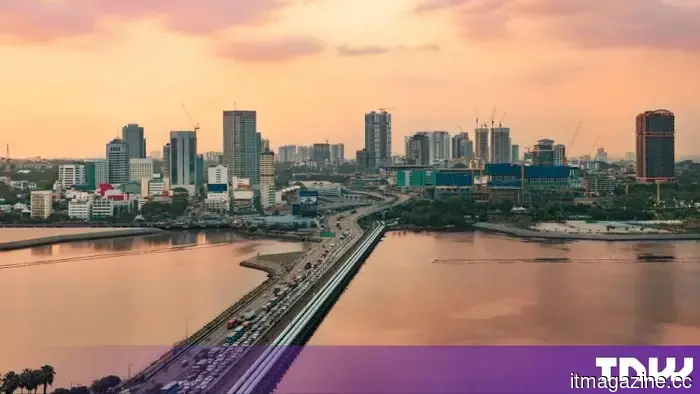
Southeast Asia intends to develop four times the data center capacity that it currently operates.
Southeast Asia currently has 306 operational data centers, with an additional 173 in development, based on data released on Tuesday. The planned capacity is nearly four times that of existing operations.
According to Arizton, investments in the Southeast Asia data center market are expected to grow from $15.72 billion in 2025 to $35.08 billion by 2031, representing a compound annual growth rate of 14.32%.
Forecasts for regional capacity project it will reach 1,435 MW by 2031, covering 5.83 million square feet of usable space.
Construction costs are significant, costing between $7 million and $11 million per megawatt, depending on the country. Factors such as limited land, labor costs, and power access contribute to these expenses.
Malaysia is currently leading the region in announced capacity, with over 6 GW of IT load planned, primarily located in Johor, adjacent to Singapore. As of November last year, this state had about 4.0 GW of upcoming capacity, with roughly 700 MW under construction. The remaining 3.3 GW is at the planned or announced stage, indicating that land and power have been secured, but construction has yet to begin. The national market is projected to expand from $6.15 billion to $11.40 billion by 2031, reaching 679 MW.
The cost differential that has attracted the industry to Malaysia shows that industrial electricity rates were between $0.06 and $0.09 per kWh in 2025, while Singapore's rates ranged from $0.21 to $0.24. Construction costs in Malaysia are between $8 million to $10 million per megawatt, whereas the Philippines offers a lower rate of $6 million to $7 million, the cheapest in the region, with land costs around $120 to $200 per square meter last year.
Moreover, Malaysia provides a 100% investment tax allowance for qualifying capital expenditure for five to ten years. Developers can opt for a corporate tax rate between zero and 10% through a program from the national investment development authority.
However, Malaysia increased power tariffs for data centers starting in July last year, potentially raising energy costs by 10% to 14%, according to Arizton. Facilities exceeding 100 MW now fall into an ultra-high voltage category and incur the highest fees, resulting in additional annual costs of $15 million to $20 million. This has prompted operators to reevaluate their energy options.
The regulations target sustainability rather than stifling growth. Malaysia aims for 70% of its power to come from renewable sources by 2050, incorporating solar, hydropower, and green hydrogen. Its Corporate Green Power Programme has allocated 800 MW of solar capacity, which companies, including data center operators, can purchase through virtual power purchase agreements. Large projects necessitate environmental impact assessments, and the government has issued green data center guidelines, focusing on greening the sector rather than exclusion, as asserted by Nicholas Spiro of Lauressa Advisory in the South China Morning Post.
Meanwhile, Singapore imposed a moratorium on new data centers from 2019 to 2022. It currently operates 45 facilities, with only six upcoming. The projected expansions are the smallest in the region, estimating 356,000 square feet and 89 MW by 2031. Future developments will prioritize efficiency and density over the construction of new facilities. Nevertheless, the country is investing, having approved a 700 MW low-carbon data center park on Jurong Island in October last year, which will utilize hydrogen-ready plants, battery storage, ammonia power, and solar energy.
Thailand is experiencing the fastest growth, with its market expected to increase from $1.44 billion to $6.28 billion by 2031, a growth rate of 27.78%, the highest in Southeast Asia. Its development pipeline exceeded 2.87 GW in September, calculated by Arizton to be 3.7 times that of Indonesia. Thailand is anticipated to surpass Indonesia in planned capacity between 2026 and 2031. The investment board approved four projects last November, totaling around 376 MW. The cost of construction there ranges from $7 million to $8 million per megawatt, with foreign investment bids skyrocketing by 80% last year.
Indonesia is projected to grow from $2.82 billion to $6.09 billion by 2031, possessing 88 active facilities and 25 more in the pipeline, with 38 of the current ones located in Jakarta. Batam, situated only 20 km from Singapore, stands as a low-latency extension of Singapore's infrastructure. Oracle inaugurated its first cloud region in Indonesia there last July, opting to lease from an operator rather than construct its own facility. Microsoft launched its first Indonesian data center in May of last year, projecting an economic contribution of about $2.5 billion and the
Otros artículos
 Las acciones de Alibaba cayeron un 8.4%. Luego, Joe Tsai y Eddie Wu fueron de compras.
El presidente y CEO de Alibaba compró $15.3 millones en acciones después de que la colocación de acciones de Alibaba enviara la acción a su caída más pronunciada en más de un año.
Las acciones de Alibaba cayeron un 8.4%. Luego, Joe Tsai y Eddie Wu fueron de compras.
El presidente y CEO de Alibaba compró $15.3 millones en acciones después de que la colocación de acciones de Alibaba enviara la acción a su caída más pronunciada en más de un año.
 Lambda está recaudando hasta $3 mil millones antes de una OPI, meses después de haber tomado prestados $917 millones para chips.
Lambda, respaldada por Nvidia, está en conversaciones para obtener hasta $3 mil millones en financiamiento previo a la salida a bolsa a una valoración de $12 mil millones o más, antes de una cotización el próximo año.
Lambda está recaudando hasta $3 mil millones antes de una OPI, meses después de haber tomado prestados $917 millones para chips.
Lambda, respaldada por Nvidia, está en conversaciones para obtener hasta $3 mil millones en financiamiento previo a la salida a bolsa a una valoración de $12 mil millones o más, antes de una cotización el próximo año.
 Lambda está recaudando hasta $3 mil millones antes de una OPI, meses después de haber tomado prestados $917 millones para chips.
Lambda, respaldada por Nvidia, está en conversaciones para obtener hasta $3 mil millones en financiamiento previo a la salida a bolsa a una valoración de $12 mil millones o más, antes de una cotización el próximo año.
Lambda está recaudando hasta $3 mil millones antes de una OPI, meses después de haber tomado prestados $917 millones para chips.
Lambda, respaldada por Nvidia, está en conversaciones para obtener hasta $3 mil millones en financiamiento previo a la salida a bolsa a una valoración de $12 mil millones o más, antes de una cotización el próximo año.
 Scalable Capital conecta €60 mil millones de activos de clientes con asistentes de IA externos.
Scalable Capital ha abierto su plataforma a ChatGPT y Claude, permitiendo a los clientes analizar y negociar carteras a través de asistentes de IA.
Scalable Capital conecta €60 mil millones de activos de clientes con asistentes de IA externos.
Scalable Capital ha abierto su plataforma a ChatGPT y Claude, permitiendo a los clientes analizar y negociar carteras a través de asistentes de IA.
 Un robot que toma sangre podría ser la mejor historia de salud de IA de 2026.
La FDA ha autorizado el primer dispositivo robótico autónomo para la extracción de sangre. Es la historia de IA menos glamorosa del año y la más convincente.
Un robot que toma sangre podría ser la mejor historia de salud de IA de 2026.
La FDA ha autorizado el primer dispositivo robótico autónomo para la extracción de sangre. Es la historia de IA menos glamorosa del año y la más convincente.
 Liner recauda $36.1 millones para llevar su búsqueda de IA centrada en evidencia a clientes empresariales
La startup surcoreana de búsqueda con IA Liner cierra una ronda de financiación Serie C de $36.1 millones liderada por LB Investment. Con 14 millones de usuarios en 220 países y un despliegue empresarial HUMAIN ONE, está apostando a que la búsqueda respaldada por citas puede ganar clientes corporativos y gubernamentales.
Liner recauda $36.1 millones para llevar su búsqueda de IA centrada en evidencia a clientes empresariales
La startup surcoreana de búsqueda con IA Liner cierra una ronda de financiación Serie C de $36.1 millones liderada por LB Investment. Con 14 millones de usuarios en 220 países y un despliegue empresarial HUMAIN ONE, está apostando a que la búsqueda respaldada por citas puede ganar clientes corporativos y gubernamentales.
Southeast Asia intends to develop four times the data center capacity that it currently operates.
According to Arizton, investment in data centres in Southeast Asia is projected to exceed $35.08 billion by 2031, more than doubling from previous figures, with Malaysia at the forefront of a 6GW pipeline.