
Thomson Reuters developed its own model using an open Chinese base.
Thomson Reuters unveiled its first proprietary large language model on Monday, naming it Thomson. The company stated that it invested $40 million in talent and computational resources to train the model, which is based on what the announcement describes as “a strong open-source foundation.” However, it does not specify which foundation was used, although its chief technology officer mentioned it in an interview.
**Expenditure Details**
Thomson Reuters is traded in Toronto and on the Nasdaq under the ticker TRI. The company offers legal, tax, accounting, and compliance products and owns Reuters. According to the announcement, the $40 million spent on training includes costs for talent and compute resources. This investment is compared to frontier labs, which have reportedly "typically spent billions of dollars on compute and years of infrastructure investment to reach the frontier." The company claims that the result is a model fully controlled by it, “without the heavy inference costs of typical frontier models.” So far, Thomson has been trained on less than 10% of its own content, with sources including Westlaw, Practical Law, Checkpoint, and Reuters.
**Base Model Information**
Chief Technology Officer Joel Hron revealed to Business Insider that Thomson is built on a model known as Snowdon, developed from “realigning” an open-source Qwen model produced by Alibaba. Business Insider identified the base model as Qwen3.5 and reported the new model as Thomson-1. The company’s press release only refers to the starting point as “a strong open-source foundation” without naming it.
**Snowdon's Development**
Hron explained that a joint team from Thomson Reuters and Imperial College in the UK adapted Qwen over several months, ensuring that the result was “ethically and politically de-biased and safe to use.” He noted, “There’s nothing that necessarily ties us to Qwen,” especially since Alibaba expressed a desire to monetize its primary users.
**Initial Model Deployment**
Thomson's initial implementation occurs within Tabular Analysis in CoCounsel Legal, the company’s AI assistant for lawyers, described as “high-volume, structured document review.” The next release will target law firms and corporate legal departments. Thomson Reuters stated that CoCounsel Legal “remains multi-model by design” and plans to incorporate Thomson across its legal and tax offerings.
**Recent Partnership with iManage**
On August 20, Thomson Reuters and document-management firm iManage announced an expanded partnership, integrating CoCounsel Legal further into the iManage platform along with HighQ, Noetica, and Legal Tracker. They also plan to implement support for Model Context Protocol, ensuring that approved Thomson Reuters tools can interact with iManage content while maintaining access controls and ethical boundaries. Rawia Ashraf, co-head of CoCounsel Legal, mentioned that legal work “lives in too many places.”
**Claude's Role**
Hron indicated that CoCounsel still primarily relies on Claude. In May, Thomson Reuters extended its partnership with Anthropic for that product. Hron mentioned, “Our main objective is to make Thomson the model that powers more and more of CoCounsel’s capabilities over time,” asserting that the new model does not replace the collaborations with Anthropic and other labs.
**Rationale Behind the Decision**
Hron cited cost as a primary factor for developing their model, stating that owning a model allows the company to leverage its own intellectual property instead of paying external AI companies. He likened it to the difference between renting and buying a house. “Renting a house provides shelter, but you aren't building equity that compounds into something valuable long-term,” he explained. River AI recently raised $1.1 billion to enable companies to train and hold their own models.
**Anthropic's Stance on Alibaba**
Anthropic has accused Chinese labs of illegally using the outputs of its models to train their versions, naming Alibaba in what it described as the largest distillation campaign against Claude. They have called for the US to impose restrictions. Senator Tom Cotton has raised concerns about US companies employing Chinese open-source models, citing potential security risks like backdoors. Neither Anthropic nor Alibaba responded to Business Insider’s inquiries.
**Academic Evaluations**
Thomson Reuters mentioned that it invited legal and AI academics to evaluate the model prior to its launch, quoting two of them. Jonathan H. Choi from Washington University School of Law tested Thomson against ChatGPT and Claude, finding that while all three models answered questions accurately, he preferred Thomson’s responses due to the links to treatises. Professor Samuel Dahan, who leads the Queen’s Conflict Analytics Lab and the Cornell Legal AI Lab, found Thomson’s “citation quality generally competitive with leading frontier models,” particularly on Canadian employment law topics.
**Open-Weight Release**
Thomson Reuters is releasing a "small" version of Thomson as an open-weight model on Hugging Face for academic and non-commercial use, and a technical report outlining the development of the foundation
Other articles
 Employer of record or entity: make your choice before someone else makes it for you.
Contractor, record contractor, employer of record, or your own organization? A cost and risk assessment framework for recruitment in Europe, including actual pricing for 2026.
Employer of record or entity: make your choice before someone else makes it for you.
Contractor, record contractor, employer of record, or your own organization? A cost and risk assessment framework for recruitment in Europe, including actual pricing for 2026.
 As the music industry struggles with a wave of challenges, Dr. Dre encourages artists to embrace AI technology.
While AI-generated music is saturating the internet, Dr. Dre is not shying away from it. He believes that artists ought to embrace and learn to utilize AI.
As the music industry struggles with a wave of challenges, Dr. Dre encourages artists to embrace AI technology.
While AI-generated music is saturating the internet, Dr. Dre is not shying away from it. He believes that artists ought to embrace and learn to utilize AI.
 Nokia has just released a simple phone that I would gladly use as my backup device.
The Nokia 300 Charge offers over 40 days of standby time, featuring a removable 3,700mAh battery, reverse charging capabilities, USB-C connectivity, and a robust built-in flashlight.
Nokia has just released a simple phone that I would gladly use as my backup device.
The Nokia 300 Charge offers over 40 days of standby time, featuring a removable 3,700mAh battery, reverse charging capabilities, USB-C connectivity, and a robust built-in flashlight.
 The competition for flagship phone chips has just introduced another heavyweight contender.
A recently unveiled 3nm smartphone processor boasts unprecedented CPU and GPU performance, supports LPDDR6, offers 200 TOPS of AI computing power, and achieves an AnTuTu V11 score exceeding 5.2 million.
The competition for flagship phone chips has just introduced another heavyweight contender.
A recently unveiled 3nm smartphone processor boasts unprecedented CPU and GPU performance, supports LPDDR6, offers 200 TOPS of AI computing power, and achieves an AnTuTu V11 score exceeding 5.2 million.
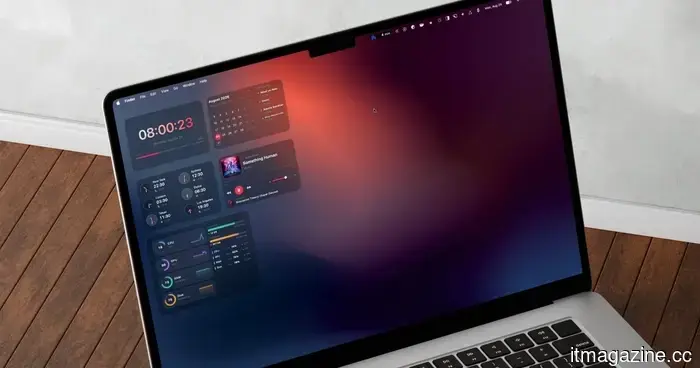 I never had any interest in Mac desktop widgets until I discovered this app.
I never appreciated macOS widgets until I discovered an application that offers more visually appealing and customizable options than those provided by Apple. Here’s the complete overview.
I never had any interest in Mac desktop widgets until I discovered this app.
I never appreciated macOS widgets until I discovered an application that offers more visually appealing and customizable options than those provided by Apple. Here’s the complete overview.
 Xiaomi's latest Xring O3 is produced at TSMC and targets a market of several hundred thousand smartphones.
Xiaomi's Xring O3 will be produced by TSMC using a 3nm process for a high-end folding smartphone, aiming for a target of 200,000 to 300,000 units.
Xiaomi's latest Xring O3 is produced at TSMC and targets a market of several hundred thousand smartphones.
Xiaomi's Xring O3 will be produced by TSMC using a 3nm process for a high-end folding smartphone, aiming for a target of 200,000 to 300,000 units.
Thomson Reuters developed its own model using an open Chinese base.
Thomson Reuters invested $40 million in Thomson, its initial in-house model. The announcement highlights an open-source foundation. According to its CTO, Alibaba's Qwen is also mentioned.