
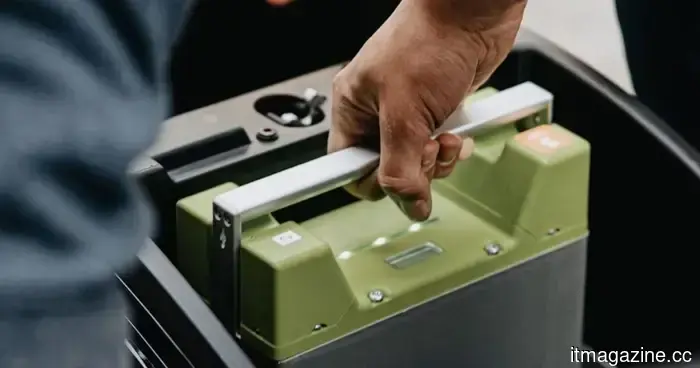
Innovative battery technology has the potential to enhance the safety of home solar batteries and extend their lifespan for many years.
60,000 cycles could transform the operation of home batteries.
Sixty thousand charge cycles for industrial or grid-scale batteries may initially seem like a typo, but researchers in Australia report that their new battery technology truly achieves this milestone.
A team at Flinders University has addressed a long-standing stability issue in water-based zinc-iodine batteries, paving the way for energy storage systems that show minimal degradation even after decades of daily use.
What did the researchers discover?
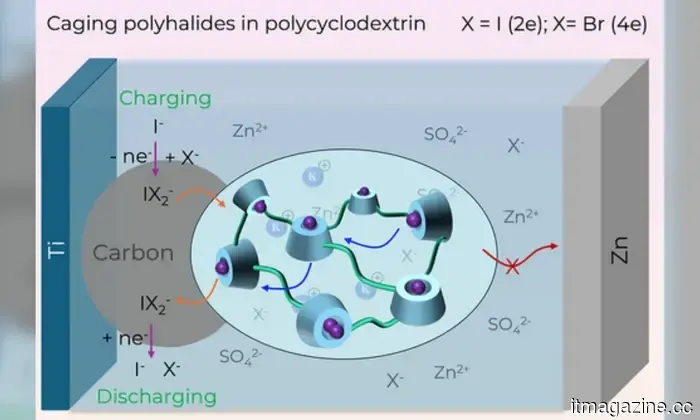
Zinc-iodine batteries have historically faced a specific challenge. The iodine compounds are prone to migrating away from the cathode (the positive electrode), where they can react with the zinc electrode, leading to gradual battery damage. Previous attempts to contain the compounds involved using charged additives or trapping them in porous materials.
However, these methods have not proven effective enough. The Flinders team developed a solution using a cage formed from cyclodextrin, a ring-shaped molecule derived from starch that they created into a polymer network. This cage captures the iodine compounds while allowing them to participate in the battery's reactions.
One version of this material achieved a better balance compared to another that held the compounds too tightly. This innovative battery maintained nearly all its capacity after exceeding 60,000 charge cycles and demonstrated the ability to recharge in approximately three minutes during high-current tests.
Where is this technology likely to be applied?
It is unlikely that we will see this battery technology in your next smartphone or laptop in the near future, as zinc-iodine chemistry does not provide the volumetric energy density necessary for slim consumer devices. Nevertheless, this breakthrough holds significant promise for stationary energy storage.
Given that the battery utilizes a non-flammable, water-based electrolyte and inexpensive plant sugars instead of mined lithium or cobalt, it could present a safer, more affordable, and notably more sustainable option for storing energy generated from wind and solar sources.
For consumers, the most significant potential lies in home energy storage. If implemented, this battery technology could allow for home solar batteries that have a lifespan of decades, require fewer replacements, and can store excess energy for use during nighttime or outages.
The exceptionally long cycle life could lower the overall costs of home energy solutions. However, despite this advancement, scaling up the technology remains challenging, and home zinc-iodine batteries will likely take several years to be accessible to individual consumers, possibly in a year or more.
For over five years, Shikhar has been simplifying developments in consumer tech and sharing insights on them…
Your next trip to the cinema might face a ban on Meta smart glasses
Smart glasses aim to facilitate capturing moments without the need to pull out a phone. However, when that moment occurs during the latest movie screening, complications arise. Cinemas throughout the UK are contemplating restrictions on camera-equipped smart glasses, like Meta's Ray-Ban, due to concerns that patrons might use them to secretly record and pirate films.
The UK Cinema Association (UKCA), which represents cinema operators nationwide, states that some venues are considering policies that would either limit or outright ban camera-enabled glasses. While there don’t currently seem to be any widespread bans among its members, this could change as smart glasses become increasingly prevalent.
One-third of the internet shows signs of AI authorship, thanks to ChatGPT
According to the Pew Research Center, there is evidence of AI authorship across a significant portion of web pages published since late 2022. The internet has seen a surge in AI-generated content since the arrival of ChatGPT, and a new analysis from Pew Research highlights just how extensive this phenomenon has become. The study reveals that approximately one-third of web pages published since ChatGPT's launch display indications of AI authorship.
The internet didn’t become AI overnight.
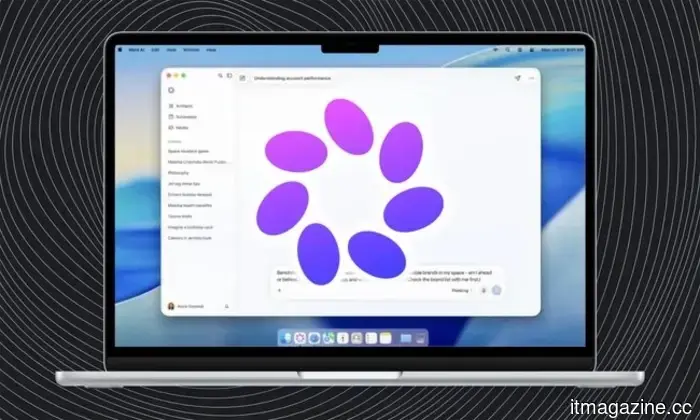
Meta’s AI assistant has finally arrived on Mac, but it still has ground to cover
Meta has introduced its AI assistant to the Mac platform through a dedicated desktop app, offering users another AI chatbot to keep alongside their other tabs. The app is capable of analyzing what is displayed on the screen, responding to questions about the content, generating text, and accepting voice commands throughout macOS.
Meta AI can actually see what is on the screen.


Other articles
 Apple is reducing its Vision Pro workforce as the focus shifts towards smart glasses.
Apple is eliminating over 200 positions within its Vision Pro, Siri, and AI teams, with approximately 100 jobs impacted specifically in the Vision Pro division.
Apple is reducing its Vision Pro workforce as the focus shifts towards smart glasses.
Apple is eliminating over 200 positions within its Vision Pro, Siri, and AI teams, with approximately 100 jobs impacted specifically in the Vision Pro division.
 Apollo discovers that AI is affecting individual paychecks instead of overall payrolls.
Apollo reports that wages in jobs with high exposure to AI increased at a rate of 6.7% more slowly after 2023, with no noticeable impact on employment levels, while the lowest earners bore the brunt of this change.
Apollo discovers that AI is affecting individual paychecks instead of overall payrolls.
Apollo reports that wages in jobs with high exposure to AI increased at a rate of 6.7% more slowly after 2023, with no noticeable impact on employment levels, while the lowest earners bore the brunt of this change.
 This startup is developing an AI model using living skin that remains viable for a month.
Outer Biosciences has emerged from stealth mode with $23 million raised, successfully maintaining donated human skin for several weeks and utilizing the outcomes to train an AI model.
This startup is developing an AI model using living skin that remains viable for a month.
Outer Biosciences has emerged from stealth mode with $23 million raised, successfully maintaining donated human skin for several weeks and utilizing the outcomes to train an AI model.
 Volkswagen introduces the ID. Era 5S priced at $13,400, featuring an electric range of 160 km.
Volkswagen’s new ID. Era 5S begins at approximately $13,400 in China and features a plug-in hybrid system with an electric-only range of up to 160km.
Volkswagen introduces the ID. Era 5S priced at $13,400, featuring an electric range of 160 km.
Volkswagen’s new ID. Era 5S begins at approximately $13,400 in China and features a plug-in hybrid system with an electric-only range of up to 160km.
 Betting companies are no longer featured on Premier League jerseys. They've been replaced by enterprise software brands.
Premier League teams have removed betting companies from the front of their shirts, and ClickHouse has filled Fulham's position. At the same time, eight clubs required new sponsorships.
Betting companies are no longer featured on Premier League jerseys. They've been replaced by enterprise software brands.
Premier League teams have removed betting companies from the front of their shirts, and ClickHouse has filled Fulham's position. At the same time, eight clubs required new sponsorships.
.jpg) 3 overlooked films on Netflix to check out this weekend (August 21-23)
From Florence Pugh's haunting Irish thriller to Elijah Wood's gruesome dark comedy, these three hidden treasures on Netflix are ideal for your next binge-watching session.
3 overlooked films on Netflix to check out this weekend (August 21-23)
From Florence Pugh's haunting Irish thriller to Elijah Wood's gruesome dark comedy, these three hidden treasures on Netflix are ideal for your next binge-watching session.
Innovative battery technology has the potential to enhance the safety of home solar batteries and extend their lifespan for many years.
A revolutionary zinc-iodine battery has the potential to extend home solar storage lifespan to decades.