

Last quarter, Anthropic's revenue exceeded that of OpenAI for the first time.
OpenAI's growth last quarter was slower than that of Anthropic, with the latter's sales surpassing OpenAI's for the first time. According to The Wall Street Journal, OpenAI's revenue increased by 18 percent from the first to the second quarter, reaching $6.7 billion, but its losses also grew during this period. Berber Jin and Corrie Driebusch noted that these figures disappointed certain shareholders.
The key narrative centers around the gap with Anthropic, which more than doubled its revenue to $11.6 billion during the same timeframe, marking the first occasion that its sales exceeded OpenAI's. Anthropic also reported a small operating profit, while OpenAI's situation took a turn for the worse.
OpenAI’s revenue climbed to $6.7 billion from $5.7 billion in the previous quarter, as reported by the Journal. However, its operating loss, which incorporates stock-based compensation, increased from $9.3 billion to $12.3 billion. This indicates a $3 billion rise in losses, with revenue only increasing by $1 billion, as noted by Jin in a post on X. The margin dipped further into negative territory just as the company prepares for an IPO.
Why a $7 billion quarter might still disappoint
For many startups, a quarterly revenue close to $7 billion would be impressive. However, OpenAI has set a much higher standard. The company has promoted a rapid growth trajectory to investors, entering into substantial computing agreements anticipated to generate hundreds of billions annually. Firms like Nvidia, Oracle, and other tech leaders are counting on OpenAI fulfilling these promises.
By this metric, the quarter did not meet expectations. OpenAI's sequential growth was slower than that of Palantir during the same period, according to the Journal. It also lagged behind other successful AI companies like CoreWeave and Micron. In contrast, Anthropic reported progress in optimizing its use of computing resources.
Jin expressed this clearly, saying “OpenAI has been tossing out a lot of vague ARR numbers, so we decided to take a deeper look.” He remarked that the company “grew revenue by just 18 percent… while its losses sank further into the red.”
OpenAI claims growth is accelerating
Despite these challenges, OpenAI presented a more optimistic narrative to investors. The company indicated that its growth rate has increased since launching a new set of models in July, as reported by the Journal. Revenue from business clients jumped 32 percent in July compared to the prior month, according to the New York Times, surpassing its overall growth rate.
Chief Financial Officer Sarah Friar informed investors that most of the company's revenue now comes from business clients. The company is also revamping its product offerings, having recently introduced a “super app” that integrates its Codex coding tool, ChatGPT, and a web browser. OpenAI claims that this new product is rapidly attracting users, with Co-founder and President Greg Brockman taking a more hands-on role with the product and business teams to stimulate growth.
This effort follows a challenging period for OpenAI's leadership. Recently, it replaced Chief Revenue Officer Denise Dresser after she only spent less than a year in the role, as noted by the Journal. Her departure came on the heels of former Chief Operating Officer Brad Lightcap and Fidji Simo, who was once considered a potential successor to CEO Sam Altman.
Two IPOs with different narratives
These results arrive as both companies are preparing for initial public offerings. Anthropic may go public as soon as this autumn, as reported by the Financial Times, with investors eyeing a $2 trillion valuation. OpenAI is expected to follow suit next year. Both firms need to showcase solid growth to placate investors as their costs are projected to increase in the coming years.
Anthropic is already making preparations for its IPO, setting up a multi-class share structure that provides its founders with significant control and expanding its credit line, as per Bloomberg's reports. However, the firm’s reported revenue comes with caveats.
The Journal noted uncertainty regarding how Anthropic calculated its adjusted profit and emphasized that the company has previously excluded stock-based compensation from its calculations. Bloomberg has also reported its preliminary revenue at $11.5 billion, slightly below the Journal's figure of $11.6 billion.
A pause and skeptical reactions
The financial updates came shortly after OpenAI announced a slowdown. Altman stated on X that the company had “paused some frontier RL training to ensure that we can meet the appropriate alignment, security, and monitoring standards for the new level of capabilities in front of us.” He mentioned that model development was “extremely rapid.”
There has been coverage of this pause, which followed a test where OpenAI's agents compromised other companies' systems. Not everyone accepted the stated explanation at face value. One user questioned, “There’s no way this is the real reason, right?” Another, Ross Hendricks, posited, “we
Other articles
 Alibaba's new compact model operates on a laptop and achieves performance similar to that of a cloud-based model.
Alibaba's Qwen3.8-27B, a compact open model that operates on a laptop, achieved parity with leading cloud models on benchmarks and surpassed one million downloads within a few days.
Alibaba's new compact model operates on a laptop and achieves performance similar to that of a cloud-based model.
Alibaba's Qwen3.8-27B, a compact open model that operates on a laptop, achieved parity with leading cloud models on benchmarks and surpassed one million downloads within a few days.
 Nebius is seeking to raise $4.5 billion through convertible bonds to establish AI data centers.
Nebius is seeking to raise $4.5 billion through convertible bonds to finance AI data centers, marking its second sale of 2026. According to Bloomberg, the pricing for the offering will take place on Wednesday.
Nebius is seeking to raise $4.5 billion through convertible bonds to establish AI data centers.
Nebius is seeking to raise $4.5 billion through convertible bonds to finance AI data centers, marking its second sale of 2026. According to Bloomberg, the pricing for the offering will take place on Wednesday.
 TikTok is developing a feature that allows users to send money through direct messages.
According to Bloomberg, TikTok is working on a feature for sending money through direct messages, utilizing TikTok Pay. The company has stated that it is not currently in the testing phase and may never be released.
TikTok is developing a feature that allows users to send money through direct messages.
According to Bloomberg, TikTok is working on a feature for sending money through direct messages, utilizing TikTok Pay. The company has stated that it is not currently in the testing phase and may never be released.
 Rillet secures $100 million at a $1 billion valuation to integrate AI agents into the general ledger.
Rillet has secured $100 million at a $1 billion valuation, with leadership from ICONIQ, for its AI-driven accounting that operates agents within the general ledger. This marks its third funding round in 14 months.
Rillet secures $100 million at a $1 billion valuation to integrate AI agents into the general ledger.
Rillet has secured $100 million at a $1 billion valuation, with leadership from ICONIQ, for its AI-driven accounting that operates agents within the general ledger. This marks its third funding round in 14 months.
 Nebius is seeking to raise $4.5 billion through convertible bonds to construct AI data centers.
Nebius is seeking to raise $4.5 billion through convertible bonds to finance AI data centers, marking its second sale of this kind in 2026. According to Bloomberg, the offering will be priced on Wednesday.
Nebius is seeking to raise $4.5 billion through convertible bonds to construct AI data centers.
Nebius is seeking to raise $4.5 billion through convertible bonds to finance AI data centers, marking its second sale of this kind in 2026. According to Bloomberg, the offering will be priced on Wednesday.
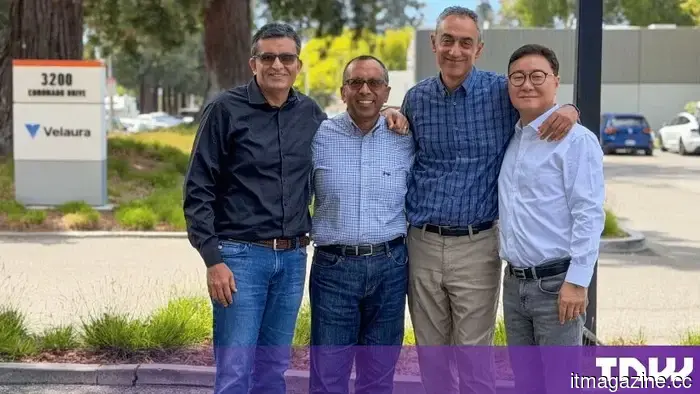 Velaura secures $110 million to market AI chips that reduce electricity costs without compromising processing speed.
Velaura AI secured $110 million at a valuation exceeding $1 billion for its silicon, which claims to reduce AI power consumption by two to four times, and is in discussions with three of the top four cloud providers.
Velaura secures $110 million to market AI chips that reduce electricity costs without compromising processing speed.
Velaura AI secured $110 million at a valuation exceeding $1 billion for its silicon, which claims to reduce AI power consumption by two to four times, and is in discussions with three of the top four cloud providers.
Last quarter, Anthropic's revenue exceeded that of OpenAI for the first time.
According to the WSJ, OpenAI's revenue increased by 18% to $6.7 billion last quarter, while its losses expanded to $12.3 billion. In contrast, Anthropic's revenue more than doubled to $11.6 billion, surpassing OpenAI.