

Cerebras has introduced the CS-4, its inaugural multi-wafer system, although the chip it contains is not novel.
Cerebras has integrated three of its large dinner-plate-sized processors into a single rack for the first time. The CS-4, revealed at the company's Supernova event on Tuesday and set to ship this quarter, is marketed as an inference machine for advanced models, with Cerebras claiming it operates up to 30 times quicker than GPU-based systems.
This announcement follows five days after OpenAI launched its Ultrafast mode, which reportedly runs GPT-5.6 Sol approximately 14 times faster on Cerebras silicon. This is also the first hardware shipment since Cerebras's $5.55 billion debut on Nasdaq in May, marking the largest tech listing in the U.S. since Snowflake.
On paper, the CS-4 system is impressive. It contains three WSE-3 Turbo wafers, delivering a total of 750 petaflops of sparse FP16 computation, a memory bandwidth of 129.6 petabytes per second, and the capability to support models with over 50 trillion parameters. The latency between wafers has been reduced from five microseconds to two, and the rack requires half the components of its predecessor. Cerebras has moved power conversion significantly closer to the processors, now housed in a detachable backpack at the rear of the chassis.
However, it remains uncertain whether the chip inside is genuinely new. The WSE-3 Turbo features the same four trillion transistors, 900,000 cores, 44GB of on-chip SRAM, and the same TSMC 5nm technology node as the WSE-3 it supersedes. The Register has reported that it is not a new silicon but rather an existing die clocked from roughly 1.4GHz to 2.8GHz. Both per-wafer compute and bandwidth have doubled, which suggests a clock speed increase rather than a complete redesign, with Cerebras planning to launch a genuinely new generation in 2027.
The 30-times performance claim is based on measuring tokens processed per second per user for a single model, gpt-oss-120b, in comparison to unspecified GPU systems. The 250 petaflops per wafer is noted as a sparse FP16 figure against 25 petaflops for dense computation.
The design appears genuinely differentiated in terms of power consumption. The Register estimates the CS-4 requires approximately 120 to 140 kilowatts per rack, about half of what similar AMD and Nvidia systems draw, which provides a realistic basis for the claimed tenfold improvement in throughput per watt.
Cerebras's CEO, Andrew Feldman, emphasized latency over raw throughput at the launch, stating that "in AI, speed is productivity," and noted in an interview with Reuters that the company anticipates achieving "four times faster" speeds by the end of 2027, along with a 20-fold increase in throughput.
Sean Lie, the chief technology officer, connected the speed discussion to agents rather than chatbots. He argued that being 30 times faster allows an agentic system significantly more capacity for reasoning, verification, or tool use, indicating a focus on enterprise clients rather than benchmark comparisons.
Cerebras identified OpenAI, G42, MBZUAI, and AWS during the launch, although it did not disclose any customer agreements or pricing for the CS-4. AMD’s Helios rack, announced in July, is included in the partner list, aligning with the company’s openness to collaborate with all AI hardware players except Nvidia.
The financial context is mixed. Second-quarter revenue reached $180.1 million, reflecting a 74% year-over-year increase with cloud revenue nearly quadrupling. However, it marked a decline from $193.4 million in the first quarter, and the margin pressures noted by Cerebras in June persist.
The quarter ended with a GAAP net loss of $450.5 million, an adjusted loss of $6.9 million, and remaining performance obligations amounting to $25.4 billion. Cerebras projects full-year revenue between $880 million and $890 million and plans to have 600 megawatts of data center capacity operational and contracted by the end of 2027.
Concentration remains a crucial structural issue. G42 and the Mohamed bin Zayed University of Artificial Intelligence accounted for about 86% of projected 2025 revenue, and the contract with OpenAI, worth over $10 billion at signing in January, is a strategic response to this issue. Additional second-quarter clients included Cognition, Lovable, CrowdStrike, Block, and Figma.
Initial shipments of the CS-4 are expected before the end of the quarter, but a more significant challenge will arise in 2027, when the next generation must be introduced using entirely new silicon rather than simply a faster clock speed.
Other articles
 The Top Ergonomic Office Chairs of 2026
Extended hours at your workstation require more than just a standard office chair. If you're enhancing your home office or substituting an old chair, these ergonomic options are crafted to ensure your comfort and support during the entire workday.
The Top Ergonomic Office Chairs of 2026
Extended hours at your workstation require more than just a standard office chair. If you're enhancing your home office or substituting an old chair, these ergonomic options are crafted to ensure your comfort and support during the entire workday.
 ChatGPT is introducing a version for teenagers, and I have many inquiries.
Teenagers are increasingly utilizing AI for their homework and beyond. OpenAI’s latest ChatGPT experience aims to ensure that they are genuinely learning from it, incorporating some significant safeguards in the process.
ChatGPT is introducing a version for teenagers, and I have many inquiries.
Teenagers are increasingly utilizing AI for their homework and beyond. OpenAI’s latest ChatGPT experience aims to ensure that they are genuinely learning from it, incorporating some significant safeguards in the process.
 Apple's camera AirPods might actually inform you when your hair is obstructing the view.
Recently revealed information from macOS Tahoe 26.7 outlines Apple's strategy for addressing bad hair days and ensuring secure pairing for the AirPods camera.
Apple's camera AirPods might actually inform you when your hair is obstructing the view.
Recently revealed information from macOS Tahoe 26.7 outlines Apple's strategy for addressing bad hair days and ensuring secure pairing for the AirPods camera.
 This 1918 electric vehicle was equipped with 42 batteries and boasted a greater range than a 2011 Leaf.
A 1918 Detroit Electric showcased at Monterey boasted a range of 80 miles, surpassing that of the initial Nissan Leaf. Its downfall was attributed to its cost, not its range.
This 1918 electric vehicle was equipped with 42 batteries and boasted a greater range than a 2011 Leaf.
A 1918 Detroit Electric showcased at Monterey boasted a range of 80 miles, surpassing that of the initial Nissan Leaf. Its downfall was attributed to its cost, not its range.
 A recent report indicates that Meta compensates influencers to advocate against social media restrictions for teenage accounts globally.
As nations begin to prohibit teenagers from using social media, Meta is paying actors, psychologists, and parenting influencers in over a dozen countries to advocate against a widespread ban on teen accounts.
A recent report indicates that Meta compensates influencers to advocate against social media restrictions for teenage accounts globally.
As nations begin to prohibit teenagers from using social media, Meta is paying actors, psychologists, and parenting influencers in over a dozen countries to advocate against a widespread ban on teen accounts.
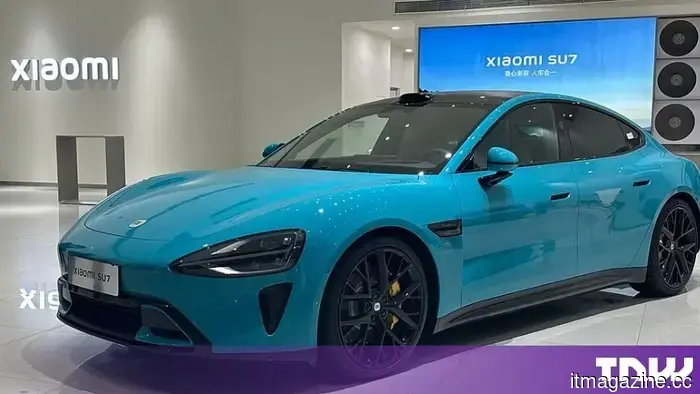 Xiaomi's inaugural electric vehicle has surpassed half a million units delivered.
Xiaomi's SU7 has achieved 500,000 deliveries in 28.5 months. However, it has seen a decline of 43.6% this year, whereas the company overall has experienced an increase of nearly 15%.
Xiaomi's inaugural electric vehicle has surpassed half a million units delivered.
Xiaomi's SU7 has achieved 500,000 deliveries in 28.5 months. However, it has seen a decline of 43.6% this year, whereas the company overall has experienced an increase of nearly 15%.
Cerebras has introduced the CS-4, its inaugural multi-wafer system, although the chip it contains is not novel.
Cerebras' CS-4 combines three wafers into a single rack and boasts a performance that is 30 times faster than a GPU. However, the processor it contains is the WSE-3, which operates at a higher clock speed.