

The financial implications of a voice agent: the actual expense of a minute's dialogue.
Most voice agent pricing starts with one key figure: cost per minute for voice agents. However, this number does not adequately represent the true expenses involved in operating a production system. I learned this firsthand while creating and managing a voice agent for enterprise use. When you consider components like speech recognition, text-to-speech, model usage, telephony, and infrastructure, the cost of a production minute encompasses several different expenses. Thus, it's more useful to examine the cost per successful outcome instead.
What constitutes a voice minute
A production voice agent generally involves five primary cost layers, which include:
Speech-to-text (STT), which converts incoming audio to text and is usually charged per audio minute.
LLM inference, which is billed by tokens rather than time. Longer calls can lead to increased costs as the model processes instructions, conversation history, and outputs from tools.
Text-to-speech (TTS), which translates responses back into audio and is typically priced by characters, tokens, or the amount of speech produced. If the agent speaks frequently, TTS can contribute significantly to variable costs.
Telephony and transport introduce costs based on connected time, influenced by the provider, call type, and location.
Real-time voice infrastructure covers media servers, orchestration, computing, session rates, logging, and monitoring. While managed platforms often include these in their per-minute rates, building your own system incurs additional engineering expenses.
Therefore, when you see a pricing structure for conversational AI such as “$0.05 per minute,” it lacks meaning without knowing what it entails.
A 35-minute call has two sizes
Imagine a 35-minute interview-style conversation. One person might speak for 20 minutes, while the agent speaks for 12. The remaining time would consist of pauses, interruptions, and transitions. Each cost layer perceives the call differently. STT is mainly concerned with the participant's speech, while TTS focuses on the agent's speech. Telephony and infrastructure can account for the entire 35 minutes.
The LLM considers another aspect: accumulated context. At the beginning of a call, the model may only need to process system instructions and a few exchanges. After 20 turns, it might have to incorporate earlier responses, recent dialogue, tool outputs, and system instructions again before generating the next response. This indicates that a later turn can incur more costs than an earlier one, even if both take the same amount of time to articulate.
Teams can mitigate the growth of context by summarizing previous dialogue, discarding outdated information, only utilizing relevant data, or employing caching if permitted by the model. Each approach has advantages and drawbacks; removing too much could lead to missing essential information, while retaining everything results in increased token usage. I observed this variance in lengthy conversations, where one participant provided five clear answers while another interrupted, requested clarification, and then returned to the original question. Both calls might take a similar duration, but the latter involves more turns and processing for the model. Although the length of the call sets a starting point, the flow of the conversation ultimately dictates the actual cost.
Silence, interruptions, and latency impact expenses
Natural conversations include instances of silence. A person may pause to think or locate a document. While speech recognition doesn't charge for every silent moment, telephony and session infrastructure continue to bill for the duration the connection remains open.
Interruptions introduce additional costs. If someone speaks while the agent is responding, the system will halt the agent’s response even if the TTS service has already generated audio that isn't heard. Latency can exacerbate the issue. If responses are too delayed, individuals may repeat themselves or start new sentences, resulting in added turns, processing, and prolonged connection time.
To minimize latency, improvements in model speed, turn detection, infrastructure, or engineering efforts are necessary. While these options may raise direct costs, they can prevent sluggish systems from escalating expenses due to extra turns.
Failed calls are included in the calculation
If your system requires 108 attempts to achieve 100 successful outcomes, the eight failures may have already incurred costs for transcription, model tokens, generated speech, telephony, and infrastructure before ending. If users need to retry, another set of costs begins.
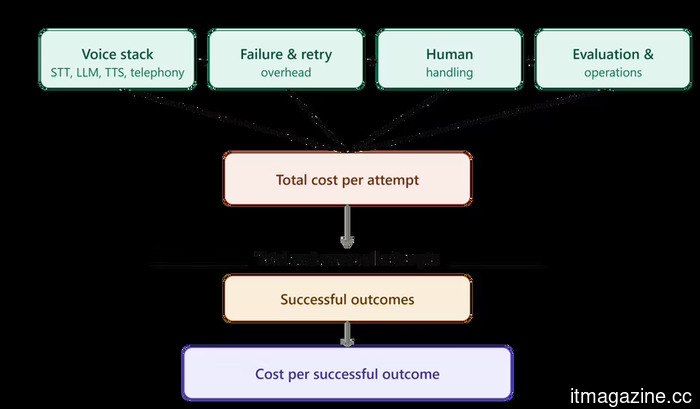
Typically, the cost per successful outcome can be calculated as follows:
Cost per successful outcome = (Voice stack + failure & retry overhead + human handling + evaluation & operations) / Successful outcomes
When a failure occurs also matters. Losing a call after 34 minutes is more expensive than losing one after just one minute. A low advertised price cannot compensate for poor completion rates.
The economics of non-English voice
Evaluating components in a non-English language shifted my perspective. The quality of recognition became more significant than the headline price since an error could lead to an additional answer, model turn, and a longer call.
Maintaining clear voice quality was essential during extended conversations. Turn detection needed to adapt to real accents, varying speaking speeds, interruptions, and colloquial phr
Other articles
 An AirTag found in a rare book pointed to an Amazon book scanning facility located in Las Vegas.
A bookseller concealed an AirTag within a rare book. 404 Media traced it to a book scanning warehouse operated by Amazon, where employees removed bindings to digitize the pages.
An AirTag found in a rare book pointed to an Amazon book scanning facility located in Las Vegas.
A bookseller concealed an AirTag within a rare book. 404 Media traced it to a book scanning warehouse operated by Amazon, where employees removed bindings to digitize the pages.
 Situational Awareness conducted two auctions simultaneously, and one group of bidders remained unaware.
The Wall Street Journal outlines a timeline of six days at Situational Awareness: a 20% reduction in its Anthropic investment, a 12-hour time constraint, and a concurrent deal with Citadel.
Situational Awareness conducted two auctions simultaneously, and one group of bidders remained unaware.
The Wall Street Journal outlines a timeline of six days at Situational Awareness: a 20% reduction in its Anthropic investment, a 12-hour time constraint, and a concurrent deal with Citadel.
 The most amusing and practical Siri commands for iOS and macOS.
Siri has become even more intelligent with iOS 27 and macOS Golden Gate. Explore the most entertaining and helpful Siri commands for the iPhone, Mac, HomePod, and Apple Watch.
The most amusing and practical Siri commands for iOS and macOS.
Siri has become even more intelligent with iOS 27 and macOS Golden Gate. Explore the most entertaining and helpful Siri commands for the iPhone, Mac, HomePod, and Apple Watch.
 A source reports that Anthropic's revenue run rate exceeds $65 billion, but it should be noted that a run rate does not equate to actual revenue.
According to an unnamed source, Anthropic has informed investors that its annualized revenue run rate exceeded $65 billion in July. While this figure is impressive, it's important to note that a run rate does not equate to booked revenue, and it comes before an IPO.
A source reports that Anthropic's revenue run rate exceeds $65 billion, but it should be noted that a run rate does not equate to actual revenue.
According to an unnamed source, Anthropic has informed investors that its annualized revenue run rate exceeded $65 billion in July. While this figure is impressive, it's important to note that a run rate does not equate to booked revenue, and it comes before an IPO.
 Browsing Tools and Ad Blockers: A Guide to a Cleaner Online Experience
A comparison of five browser-based ad blockers: Open Adblocker, uBlock Origin Lite, AdGuard, Ghostery, and Adblock Plus, each tailored to different browsing preferences.
Browsing Tools and Ad Blockers: A Guide to a Cleaner Online Experience
A comparison of five browser-based ad blockers: Open Adblocker, uBlock Origin Lite, AdGuard, Ghostery, and Adblock Plus, each tailored to different browsing preferences.
 Space has secured $2.4 million in funding to eliminate the traditional hard drive by creating an AI-native filesystem designed for both humans and agents.
Space, supported by a16z’s Speedrun, has secured $2.4M in pre-seed funding to develop a distributed filesystem that transmits only the necessary bytes for people and AI agents, without utilizing any local disk space. The proposition is ambitious, yet the market is competitive.
Space has secured $2.4 million in funding to eliminate the traditional hard drive by creating an AI-native filesystem designed for both humans and agents.
Space, supported by a16z’s Speedrun, has secured $2.4M in pre-seed funding to develop a distributed filesystem that transmits only the necessary bytes for people and AI agents, without utilizing any local disk space. The proposition is ambitious, yet the market is competitive.
The financial implications of a voice agent: the actual expense of a minute's dialogue.
The headline price per minute of a voice agent conceals five layers of costs, as well as overhead from failures and increasing context, which ultimately influence whether a use case can be scaled effectively.