

The financial aspects of a voice assistant: the true cost of one minute of dialogue.
Most voice agent pricing begins with a single metric: the cost per minute of using the voice agent. However, this figure does not accurately reflect the true expenses associated with operating a production system.
I experienced this firsthand while developing and managing a voice agent for enterprise applications. When you consider speech recognition, text-to-speech, model usage, telephony, and infrastructure, the cost of a production minute encompasses several different expenses.
This is why it’s more beneficial to examine the cost per successful outcome instead.
What comprises a voice minute
A production voice agent typically consists of five primary cost layers, including:
1. Speech-to-text (STT), which converts incoming audio into text and is generally charged per audio minute.
2. LLM inference, which costs based on tokens rather than time. Longer calls may incur higher costs as the model processes commands, conversation history, and tool outputs.
3. Text-to-speech (TTS), which converts responses back to audio, often billed by characters, tokens, or the volume of speech generated. If the agent speaks frequently, TTS can significantly increase costs.
4. Telephony and transport fees, which depend on connection time, varying by provider, call type, and location.
5. Real-time voice infrastructure that includes media servers, orchestration, computing, session rates, logging, and monitoring. Managed platforms typically incorporate these in their per-minute pricing, but building a system independently incurs greater engineering costs.
Thus, when you see a conversational AI pricing like “$0.05 per minute,” it holds little meaning unless you understand what is included.
The dynamics of a 35-minute call
Take a 35-minute interview-style conversation as an example. One participant might speak for 20 minutes, while the agent might speak for 12 minutes, leaving pauses, interruptions, and turn transitions to account for the remaining time.
Each cost layer perceives that call differently: STT focuses on the participant's speech, while TTS is concerned with the agent's speech. Telephony and infrastructure may monitor the entire 35 minutes.
The LLM considers another factor: accumulated context.
In the early stages of a call, the model may only process system instructions and a few exchanges. After multiple turns, it might need to incorporate previous answers, recent dialogue, tool outputs, and updated instructions before producing the next response. This implies that a later response could be more expensive than an earlier one, even if both take the same duration to articulate.
Teams can mitigate context accumulation by summarizing prior dialogue, discarding irrelevant information, only retaining pertinent content, or utilizing caching if supported by the model. Each strategy has its advantages and disadvantages; overly removing context may lead to the loss of crucial information, while retaining everything can lead to increased token usage.
I observed this variance during extended conversations. One participant may provide five clear responses, whereas another might interrupt, request clarification, and then revert to the original question. Both calls might last a similar duration, but the latter creates more turns and incurs extra processing for the model.
While the length of the call establishes the baseline cost, the flow of the conversation ultimately determines the actual expense.
Silences, interruptions, and latency increase costs
Real conversations often include pauses. Someone may take a moment to think or search for a document. While speech recognition might not bill for every silent moment, telephony and session infrastructure continue to charge as long as a connection remains open.
Interruptions add further costs. If a participant begins speaking while the agent is responding, the system will halt its response, even if TTS has already produced audio that remains unheard.
Latency exacerbates the issue. Slow responses can prompt individuals to repeat themselves or start new sentences, resulting in additional turns, increased processing, and extended connection times.
To minimize latency, enhancements are needed in model speed, turn detection, infrastructure, or additional engineering efforts. Although these improvements can raise direct costs, they also prevent slow systems from generating expensive extra turns.
Handling failed calls effectively
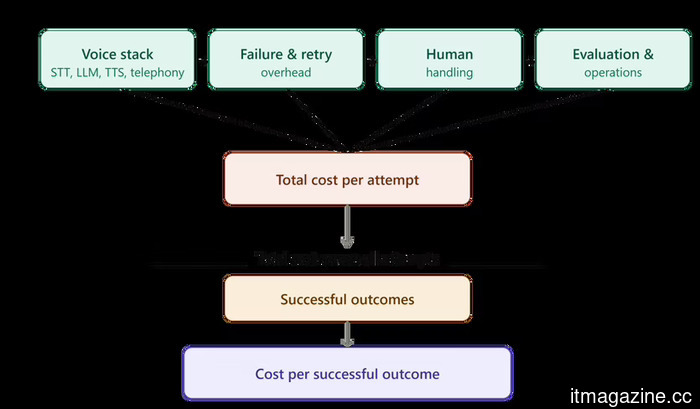
Assuming your system requires 108 attempts to achieve 100 successful outcomes, the eight failures might have already consumed resources for transcription, model tokens, generated speech, telephony, and infrastructure before the call concluded. If users retry, it initiates another round of costs.
Cost models typically appear as follows:
Cost per successful outcome = (Voice stack + failure & retry overhead + human handling + evaluation & operations) / Successful outcomes
When a failure occurs is critical too; losing a call after 34 minutes incurs greater costs than losing one after a minute. A low headline price cannot compensate for inadequate completion rates.
How using a non-English voice alters economics
Engaging with a non-English language shifted the way I evaluated components. The quality of recognition became more significant than the headline price, as an error could trigger another response, model turn, and extend the call duration.
Maintaining voice quality during lengthy calls was essential. Turn detection had to accommodate real accents, varying speaking speeds, interruptions
Other articles
 Space has secured $2.4 million in funding to eliminate the traditional hard drive by creating an AI-native filesystem designed for both humans and agents.
Space, supported by a16z’s Speedrun, has secured $2.4M in pre-seed funding to develop a distributed filesystem that transmits only the necessary bytes for people and AI agents, without utilizing any local disk space. The proposition is ambitious, yet the market is competitive.
Space has secured $2.4 million in funding to eliminate the traditional hard drive by creating an AI-native filesystem designed for both humans and agents.
Space, supported by a16z’s Speedrun, has secured $2.4M in pre-seed funding to develop a distributed filesystem that transmits only the necessary bytes for people and AI agents, without utilizing any local disk space. The proposition is ambitious, yet the market is competitive.
 What is the actual CO2 emissions from US data centres in terms of the equivalent of cars?
A recent study from Cornell estimates that AI servers in the US could produce between 24 and 44 million tonnes of CO2 annually by 2030. This emissions level is equivalent to that of 5 to 10 million cars, not 24 million, and this estimate is based on assumptions that merit further examination.
What is the actual CO2 emissions from US data centres in terms of the equivalent of cars?
A recent study from Cornell estimates that AI servers in the US could produce between 24 and 44 million tonnes of CO2 annually by 2030. This emissions level is equivalent to that of 5 to 10 million cars, not 24 million, and this estimate is based on assumptions that merit further examination.
 Samsung's more affordable Galaxy S26 FE might include a camera feature that I really enjoyed.
Leaked hands-on videos of the Galaxy S26 FE reveal the upcoming phone operating on One UI 9 and seemingly adopting the impressive Horizontal Lock video mode from the S26 series.
Samsung's more affordable Galaxy S26 FE might include a camera feature that I really enjoyed.
Leaked hands-on videos of the Galaxy S26 FE reveal the upcoming phone operating on One UI 9 and seemingly adopting the impressive Horizontal Lock video mode from the S26 series.
 OpenAI introduces ChatGPT for teenagers and will automatically enroll users under 18.
OpenAI is launching ChatGPT for Teens to all users under 18 that it can identify. The platform will not allow romantic language, avoid implied emotions, and will have a Study Mode with a timer.
OpenAI introduces ChatGPT for teenagers and will automatically enroll users under 18.
OpenAI is launching ChatGPT for Teens to all users under 18 that it can identify. The platform will not allow romantic language, avoid implied emotions, and will have a Study Mode with a timer.
 The financial implications of a voice agent: the actual expense of a minute's dialogue.
The headline price per minute of a voice agent conceals five layers of costs, as well as overhead from failures and increasing context, which ultimately influence whether a use case can be scaled effectively.
The financial implications of a voice agent: the actual expense of a minute's dialogue.
The headline price per minute of a voice agent conceals five layers of costs, as well as overhead from failures and increasing context, which ultimately influence whether a use case can be scaled effectively.
 Apple inadvertently disclosed its AirPods that come with a camera.
A concealed demo video in macOS Tahoe 26.7 exhibits AirPods with cameras in operation, and they could be released as early as September.
Apple inadvertently disclosed its AirPods that come with a camera.
A concealed demo video in macOS Tahoe 26.7 exhibits AirPods with cameras in operation, and they could be released as early as September.
The financial aspects of a voice assistant: the true cost of one minute of dialogue.
The headline price per minute for a voice agent conceals five layers of costs, including failure overhead and context expansion, which are crucial in assessing whether a use case can truly scale.