
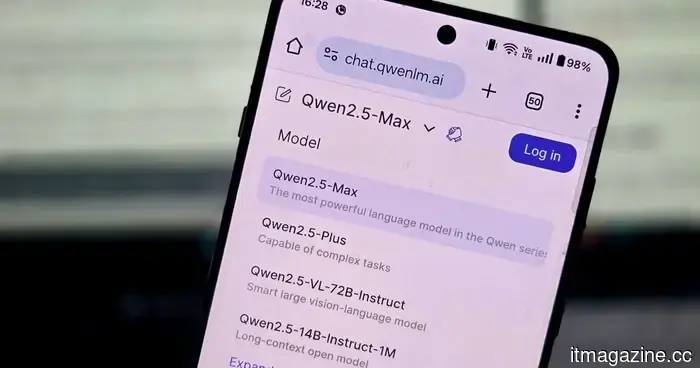
Meta and Google have just been surpassed by an AI powerhouse you might not anticipate.
Alibaba's Qwen AI Model
The competition in the AI field often focuses on well-known entities like OpenAI, Google, Meta, and Anthropic. However, when it comes to downloadable models that developers can utilize, another player has surged ahead significantly. Alibaba reports that its Qwen series of open-weight AI models has achieved over 3 billion downloads worldwide in the last six months, placing Qwen ahead of notable names in AI, including models from Meta and Google.
This disparity is particularly evident in Hugging Face data for 2026. Google’s open models have garnered approximately 418 million downloads, while Meta has around 227 million, as indicated in Hugging Face’s most recent State of Open Models report. Qwen, however, is evolving into more than just a single popular model. Alibaba has launched over 460 Qwen models, and developers have produced more than 300,000 derivative models based on them.
Developers are building with Qwen, not just downloading it.
These download figures are significant because open models operate differently from proprietary AI services. Developers can modify them for specific tasks, refine them with their own datasets, and use them as the groundwork for entirely new AI applications. Essentially, each download has the potential to transform into something unique. This seems to be happening with Qwen on a large scale. Hugging Face describes it as one of the key pillars in today’s open AI landscape, with the Qwen model family increasingly favored by developers looking to fine-tune or implement their work.
Qwen Chat / Alibaba
This can lead to a snowball effect. As more developers adopt Qwen, a greater variety of specialized versions emerge. These models can then attract even more developers, thereby further growing the ecosystem. Alibaba also benefits from its cloud services. The company is extending Qwen to enterprise clients outside China, encompassing markets throughout Southeast Asia and Africa, which may introduce its models to businesses that might typically prefer American alternatives.
China's advances in open AI are becoming hard to overlook.
Qwen’s rapid growth adds a new layer to the rivalry between the US and China in AI — Alibaba is not the only one. Other Chinese firms like DeepSeek, Moonshot AI, and MiniMax are also working on increasingly advanced models while attempting to close the performance gap with leading closed systems from companies such as OpenAI and Anthropic.
The competition for developers is becoming more intense. Recently, Meta and Nvidia have both launched new open AI models, providing developers with even more choices regarding the technology they wish to utilize. For Alibaba, the achievement of 3 billion downloads indicates that Qwen has already captured a substantial audience beyond its domestic market. The next significant battle in AI may hinge not just on who creates the smartest model, but on whose model becomes the preferred choice for development.
Shimul is a contributor at Digital Trends, with over five years of experience in the tech industry.
Your holiday photos could help scammers figure out exactly where you are
AI can extract surprisingly accurate location information from seemingly harmless posts on Instagram and Facebook, making phishing scams far more convincing.
That innocent holiday photo might be doing more than revealing how great the weather is. A new scam highlighted by The Guardian demonstrates how criminals can utilize AI to analyze images shared on social media, determine where they were taken, and leverage that information to craft phishing messages that appear alarmingly authentic.
The method is surprisingly straightforward. Consider sharing a few family pictures from Porto without mentioning the location. Days later, you receive a text stating that your bank has detected unusual card activity while you were in Porto, requesting you to verify your information via a link. Since the message includes a detail that only someone aware of the trip would know, it comes across as much more credible. Yet, the scammer may have known nothing about the trip; the photo revealed it.
Meta promised to stop creepy AI glasses videos, but they’re still all over Instagram.
Smart glasses can be genuinely beneficial for hands-free photography, listening to music, or asking an AI assistant about your surroundings. Unfortunately, the incorporation of cameras into wearables also paves the way for less pleasant uses, and that’s becoming a concern for Meta.
Instagram’s head Adam Mosseri announced in July that the platform was taking steps to eliminate videos where individuals use Meta glasses to secretly film and harass others. However, a recent investigation by Business Insider indicates that the cleanup may not be progressing as smoothly as Meta hoped. The publication uncovered numerous pickup and prank videos still available on Instagram weeks after Mosseri's statements, some from well-known or verified creators, showcasing instances of women being approached and filmed in public using Meta glasses.
An AI company paid humans to climax with a bot. It now claims big stress and focus wins.
The Masturbation Lab Report asserts that 37% of adults are open to AI-guided masturbation and that this method can yield significant benefits.
I recently spoke with some college students, and during our conversation, I discovered intriguing ways






Other articles
 I discovered a more effective method for dictating on my Mac that doesn't require the cloud.
This free, local AI dictation application transfers your words directly into any app, requiring no subscription and no cloud services, and its accuracy is impressive. Here's why I keep using it.
I discovered a more effective method for dictating on my Mac that doesn't require the cloud.
This free, local AI dictation application transfers your words directly into any app, requiring no subscription and no cloud services, and its accuracy is impressive. Here's why I keep using it.
 Samsung might be adopting a complete iOS-like Liquid Glass appearance in OneUI 9.5.
Samsung's One UI 9.5 might present a glass-like interface featuring more luminous edges, blur effects, enhanced visual depth, and a potential App Lock option.
Samsung might be adopting a complete iOS-like Liquid Glass appearance in OneUI 9.5.
Samsung's One UI 9.5 might present a glass-like interface featuring more luminous edges, blur effects, enhanced visual depth, and a potential App Lock option.
 Meta vowed to put an end to unsettling AI glasses videos, yet they continue to appear frequently on Instagram.
Instagram announced that it would take a firmer stance against harassment captured with Meta’s AI glasses. However, a month later, it seems that many of those videos are still getting through.
Meta vowed to put an end to unsettling AI glasses videos, yet they continue to appear frequently on Instagram.
Instagram announced that it would take a firmer stance against harassment captured with Meta’s AI glasses. However, a month later, it seems that many of those videos are still getting through.
 I used this music app for Mac, and I now hope that macOS would have it integrated by default.
Gramola allows me to access my music easily while still staying focused on my work. This Mac app has noticeably improved my daily listening experience.
I used this music app for Mac, and I now hope that macOS would have it integrated by default.
Gramola allows me to access my music easily while still staying focused on my work. This Mac app has noticeably improved my daily listening experience.
 OpenAI's latest ChatGPT feature records your keystrokes and saves them in unencrypted text format.
OpenAI's Computer History tracks mouse clicks, keystrokes, and application switches on macOS, saves the memory files without encryption, and is not accessible in the EEA and UK.
OpenAI's latest ChatGPT feature records your keystrokes and saves them in unencrypted text format.
OpenAI's Computer History tracks mouse clicks, keystrokes, and application switches on macOS, saves the memory files without encryption, and is not accessible in the EEA and UK.
 Google might have unintentionally revealed a new fitness tracker that includes a display.
Google's Pixel 11 commercials seem to reveal an unannounced fitness tracker that falls between the Fitbit Air and the Pixel Watch.
Google might have unintentionally revealed a new fitness tracker that includes a display.
Google's Pixel 11 commercials seem to reveal an unannounced fitness tracker that falls between the Fitbit Air and the Pixel Watch.
Meta and Google have just been surpassed by an AI powerhouse you might not anticipate.
Alibaba's Qwen has emerged as a significant player in open AI, achieving over 3 billion downloads in merely six months and surpassing some of Silicon Valley's major competitors.