
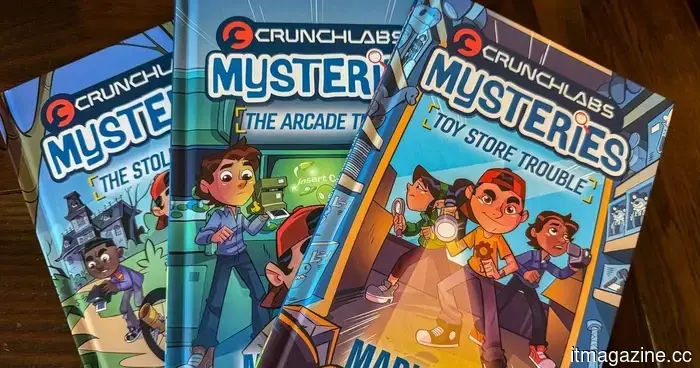
Mark Rober's latest CrunchLabs mysteries transform reading into an interactive STEM experience.
Mark Rober has dedicated years to demonstrating that science and engineering can be engaging rather than dull. His highly popular videos transform topics like physics, robotics, and mechanical engineering into exciting challenges, clever pranks, and fascinating machines that captivate kids' curiosity.
CrunchLabs has brought this approach into the physical realm with its Build Box subscriptions. Now, Rober is venturing into a new frontier: children's literature.
The first three titles in the new CrunchLabs Mysteries series are Toy Store Trouble, The Arcade Thief, and The Stolen Bike. Each book is a hardcover, richly illustrated mystery featuring a fictional 12-year-old Mark Rober. Aimed at children reading at approximately a third-grade level or higher, these stories ideally target elementary students in grades three through six.
This age group is a fitting choice. Younger readers often seek more substantial narratives but might feel daunted by lengthy passages of uninterrupted text. Mysteries provide a natural incentive to keep flipping pages, while the illustrations and familiar CrunchLabs style make the books feel more accessible compared to typical science lessons.
The concept also gives Rober a perfect childhood alter ego. Young Mark doesn’t rely on superhuman abilities or improbable luck to solve problems. He observes, experiments, constructs, and applies engineering principles to uncover what occurred. The scientific aspect is not an unrelated addition but rather integrated into the hero's thought process.
This may be the key idea behind the series. Children are often taught science as a set of facts with definite answers, whereas engineering starts with a different question: How can I utilize my knowledge to tackle this issue?
Rober’s videos and Build Boxes have consistently highlighted this methodology, including the trial, error, and occasional setbacks that accompany the process of creating something functional. The mysteries now extend this approach to reading and storytelling.
Each book features a hands-on STEM project related to the narrative that extends beyond the final chapter, along with a new video showcasing the real Rober. Rather than simply finishing the mystery and returning the book to the shelf, young readers are encouraged to experiment with one of the ideas themselves.
I have witnessed the effectiveness of this formula firsthand.
I gifted one of my granddaughters a CrunchLabs Build Box subscription for two years and collaboratively worked on several projects with her. The kits were thoughtfully curated, engaging to assemble, and based on real engineering principles. They presented a sufficient challenge to yield a sense of accomplishment without becoming so daunting that an adult needed to take charge.
Equally important, the explanations were integral to the experience. While a project might yield a catapult, launcher, or mechanical toy, the primary aim was to grasp why it functioned. Building together opened up discussions about force, motion, leverage, stored energy, and design decisions without feeling like a lecture.
The books seem to apply the same approach to reading. A child first encounters an engineering concept through characters and a mystery before getting a chance to build or conduct an experiment related to it.
That sequence could be particularly effective for reluctant readers who enjoy hands-on activities, as well as eager readers who have yet to develop an interest in engineering. A child who may shy away from a traditional science book might be drawn into these stories through the mystery, the illustrations, or simply by recognizing Rober from YouTube.
Furthermore, it is a clever expansion of the CrunchLabs universe. YouTube videos spark excitement, and Build Boxes translate that excitement into action. The mystery series adds another dimension by motivating children to read, think critically about clues, and envision themselves as problem-solvers. It links storytelling, video, and hands-on construction, rather than treating them as disconnected activities.
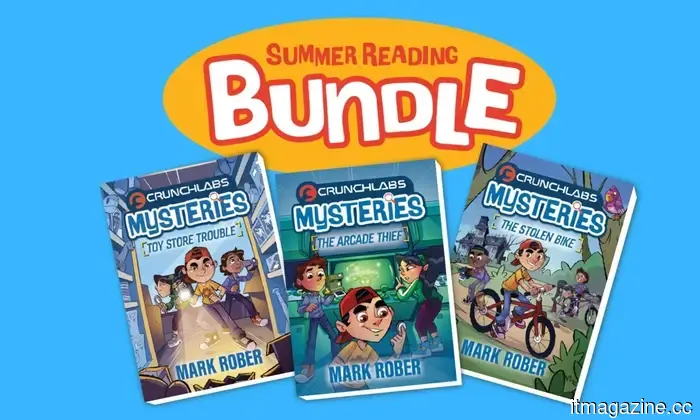
CrunchLabs indicates that the initial series will ultimately comprise 12 books. The broader series is available as a monthly add-on for current CrunchLabs subscribers, but the first three volumes can also be purchased together as a special package.
For a limited time, Toy Store Trouble, The Arcade Thief, and The Stolen Bike are available together for $39.95, including free shipping within the U.S. The bundle is currently offered only in the United States.
No book series, video platform, or subscription box will turn every child into an engineer. That’s not the primary aim. The more realistic—and arguably more significant—goal is to make science feel attainable, creative, and enjoyable before children conclude that it is challenging or “not for them.”
These three books appear crafted to achieve precisely that. They harness the curiosity sparked by Mark Rober’s YouTube videos and CrunchLabs Build Boxes and embed it within stories that children can enjoy independently.
Then, in true CrunchLabs style, they encourage readers to pause watching, set aside reading, and begin building.

Other articles
 Galaxy phones might finally receive a fundamental privacy feature that Samsung overlooked.
A leaked build of One UI 9.5 shows that Galaxy phones will feature a dedicated App Lock, which secures individual apps using biometrics and conceals their notifications, widgets, and shortcuts.
Galaxy phones might finally receive a fundamental privacy feature that Samsung overlooked.
A leaked build of One UI 9.5 shows that Galaxy phones will feature a dedicated App Lock, which secures individual apps using biometrics and conceals their notifications, widgets, and shortcuts.
 Samsung may finally introduce a fundamental privacy feature that was overlooked in Galaxy phones.
A leaked build of One UI 9.5 shows that Galaxy phones will feature a dedicated App Lock, which secures specific apps using biometrics and conceals their notifications, widgets, and shortcuts.
Samsung may finally introduce a fundamental privacy feature that was overlooked in Galaxy phones.
A leaked build of One UI 9.5 shows that Galaxy phones will feature a dedicated App Lock, which secures specific apps using biometrics and conceals their notifications, widgets, and shortcuts.
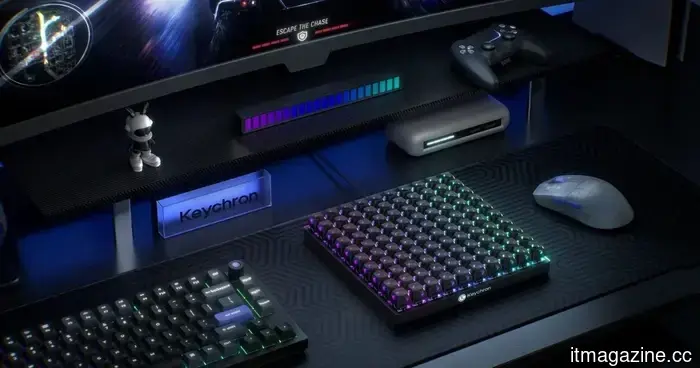 Keychron produced 96 blank keys, leaving someone else to deal with the issue.
The C100 8K from Keychron is a $65 wired macro pad featuring 96 programmable keys, hot-swappable switches, per-key RGB backlighting, and ample blank space to transform into virtually any desktop control panel you can conceive.
Keychron produced 96 blank keys, leaving someone else to deal with the issue.
The C100 8K from Keychron is a $65 wired macro pad featuring 96 programmable keys, hot-swappable switches, per-key RGB backlighting, and ample blank space to transform into virtually any desktop control panel you can conceive.
 The CFO of OpenAI informs shareholders that revenue from enterprise has surpassed that of ChatGPT.
OpenAI's enterprise revenue has surpassed that of consumer revenue ahead of expectations, according to its finance chief, with the run rate hitting $40 billion.
The CFO of OpenAI informs shareholders that revenue from enterprise has surpassed that of ChatGPT.
OpenAI's enterprise revenue has surpassed that of consumer revenue ahead of expectations, according to its finance chief, with the run rate hitting $40 billion.
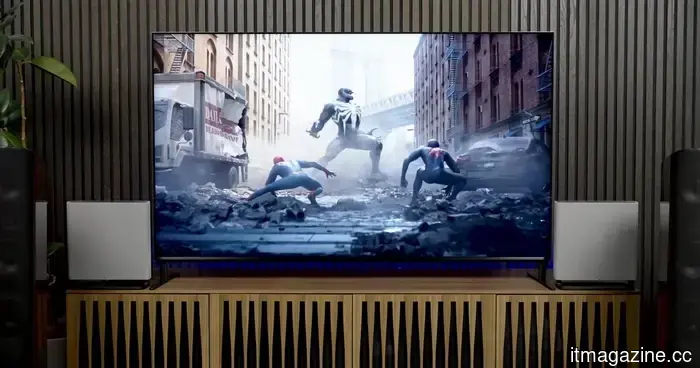 The top QLED TVs for 2026, following tests of over 20 models.
We evaluated more than 20 leading QLED TVs for 2026 to identify the finest models in terms of brightness, color accuracy, and gaming performance. Check out our expert selections for all budgets and room dimensions.
The top QLED TVs for 2026, following tests of over 20 models.
We evaluated more than 20 leading QLED TVs for 2026 to identify the finest models in terms of brightness, color accuracy, and gaming performance. Check out our expert selections for all budgets and room dimensions.
 EV prices increased for the first time in 2026, and the reasons can be attributed to the discounts.
In July, the average price of electric cars sold in the US was $56,126, marking the first increase since 2026, following a nearly 25% reduction in EV incentives by manufacturers over the course of a year.
EV prices increased for the first time in 2026, and the reasons can be attributed to the discounts.
In July, the average price of electric cars sold in the US was $56,126, marking the first increase since 2026, following a nearly 25% reduction in EV incentives by manufacturers over the course of a year.
Mark Rober's latest CrunchLabs mysteries transform reading into an interactive STEM experience.
The CrunchLabs Mysteries book series, created by scientist and inventor Mark Rober, merges illustrated detective stories designed to inspire young thinkers and enhance their problem-solving abilities.