

Google's Gemini app introduces a switch to turn off AI watermarks, though there are certain exceptions.
Your AI creations no longer require a visible watermark.
Google
If you've ever used Gemini to create an image and found the stamped-on watermark frustrating, Google has finally addressed this issue. Gemini is introducing a new feature called Media Watermarks that allows you to toggle the visibility of watermarks on or off for everything you produce, including images created with Nano Banana, videos generated with Omni, and music composed using Lyria. Previously, the visible watermark was automatically applied without an option to disable it.
Over the coming days, you will have the ability to choose whether your image, video, and music creations made with Gemini will display visible watermarks. However, invisible SynthID watermarks and C2PA metadata will always remain embedded in the background. To adjust this setting, simply navigate to your settings and toggle “Show…
How can you disable AI watermarks for Nano Banana, Omni, and Lyria in Gemini?
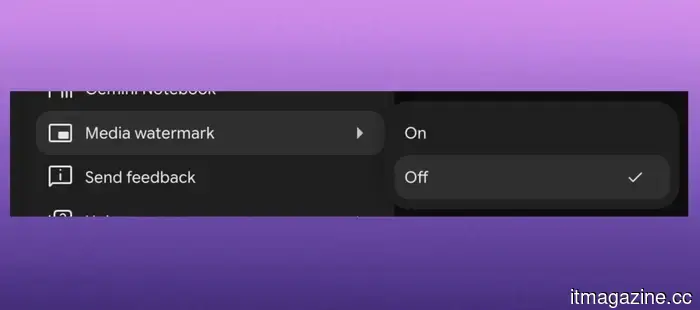
Disabling AI-generated watermarks is a simple process. Go to Gemini’s settings, select Media Watermark, and toggle it on or off. Your choice will apply to all future images, videos, and music tracks created thereafter.
Google
It’s important to note that disabling the visible AI watermark does not render your content untraceable. Google continues to embed an invisible SynthID watermark and C2PA metadata in all generated content, irrespective of the visible watermark setting, ensuring the origin of AI-generated content remains identifiable.
Additionally, be aware that this feature may not be available universally. Users in India, South Korea, or Vietnam will only have access to the watermark toggle with a paid AI Ultra subscription; otherwise, their content will retain the visible watermark automatically. Work and school accounts also do not receive this option, meaning visible watermarks will remain mandatory in those scenarios.
Why did Google implement the AI watermark toggle in Gemini?
This update was anticipated. Google VP Josh Woodward sought user feedback on their primary frustrations with Gemini, and thousands contributed. The removal of Nano Banana’s visible watermark was among the top 10 requests. Woodward mentioned that the team would take this into consideration, and now the feature has officially been launched, in response to growing community efforts to eliminate AI watermarks from generated content.
Manisha Priyadarshini is a tech and entertainment writer with over nine years of editorial experience.
I never thought that fake shopping could deceive my mind until I explored the viral dopamine websites.
On these counterfeit shopping and delivery platforms, nothing ever arrives or costs a dime, yet the dopamine rush felt genuine.
I spent some time in the internet's most fictional mall, loading a shopping cart with items I couldn't purchase, searching for discounts on non-existent products, and completing three separate checkouts for a total of $0.00. I then placed a fictitious food order and smoked a cigarette I couldn't taste, surrounded by strangers I will never meet, on a rooftop that also doesn't exist. My bank account remained unchanged, but my mind, frustratingly, did.
When I first learned about South Korea's rising "dopamine sites," I thought they were just another internet curiosity that I'd briefly explore and then forget about by lunchtime. Instead, I stumbled upon a surprisingly inventive concept hidden within the absurdity. You can browse endless imaginary products, add everything to your cart, and finalize a purchase that doesn't truly exist. These sites aren't attempting to sell you anything; they're trying to recreate the shopping experience while eliminating the aspect that drains your wallet.
LG aims to develop humanoid robots, and NVIDIA is providing the intelligence.
This isn't merely another robot tease. LG and NVIDIA have recently detailed actual hardware.
With time, more legacy hardware companies are seen racing to integrate humanoid robots into their plans. The latest player is LG, entering the field with tentative timelines. The company's bipedal humanoid, built on Nvidia's robotics platform, is scheduled for early 2027, supported by a broader initiative in AI factories and self-driving vehicle technologies.
Googlebook may utilize older Snapdragon chips to create more affordable laptops.
Snapdragon X Plus and X Elite models might be in the works.
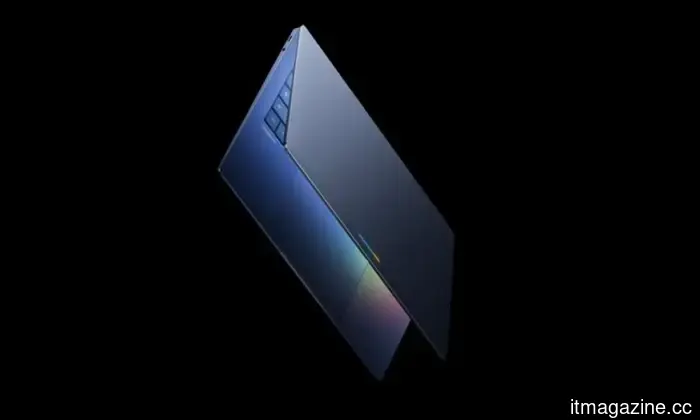
Google has confirmed that Googlebook will support multiple chip manufacturers, and a new leak may have uncovered the first Snapdragon models in development. New code references found by GbookHub reportedly link two Googlebook designs, codenamed Annite and Pic, to Qualcomm’s Snapdragon X Plus X1P-42-100 processor. Additionally, both models are said to be associated with a board platform called Mica.




Other articles
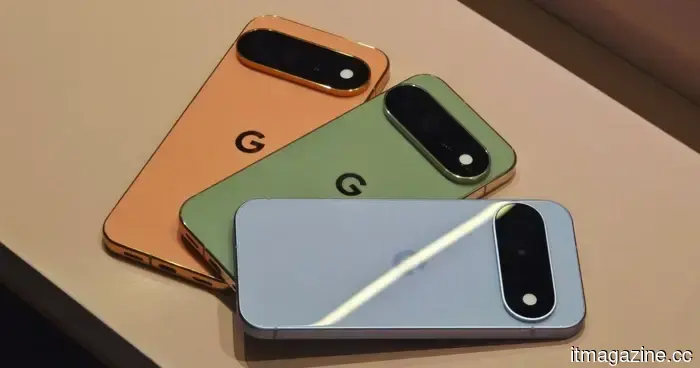 The seven-year spare parts guarantee for Pixel 11 might be ideal for weathering RAMageddon.
The Pixel 11 series will maintain seven years of spare-parts support. In a market where smartphone prices are continuously rising, this could make long-term ownership significantly more feasible.
The seven-year spare parts guarantee for Pixel 11 might be ideal for weathering RAMageddon.
The Pixel 11 series will maintain seven years of spare-parts support. In a market where smartphone prices are continuously rising, this could make long-term ownership significantly more feasible.
 Google Sheets can now transform your dull spreadsheets into mini-applications.
Google's updated Sheets canvas employs Gemini to convert data rows into interactive dashboards, trackers, and various visual tools — all without the need for coding.
Google Sheets can now transform your dull spreadsheets into mini-applications.
Google's updated Sheets canvas employs Gemini to convert data rows into interactive dashboards, trackers, and various visual tools — all without the need for coding.
 Google's Gemini app introduces a switch to turn off AI watermarks, though there are a few exceptions.
Gemini now allows you to disable visible watermarks on Nano Banana images, Omni videos, and Lyria music, although this feature is still limited in some countries.
Google's Gemini app introduces a switch to turn off AI watermarks, though there are a few exceptions.
Gemini now allows you to disable visible watermarks on Nano Banana images, Omni videos, and Lyria music, although this feature is still limited in some countries.
 Google's much-anticipated RGB HiLight feature on the Pixel 11 Pro left me feeling disappointed.
Google's HiLight has the potential to reduce the intrusiveness of notifications, but its restricted features leave me desiring greater functionality.
Google's much-anticipated RGB HiLight feature on the Pixel 11 Pro left me feeling disappointed.
Google's HiLight has the potential to reduce the intrusiveness of notifications, but its restricted features leave me desiring greater functionality.
 LG aims to create humanoid robots, with NVIDIA providing the intelligence.
LG's humanoid robot now has a definitive target date: early 2027, featuring NVIDIA's Jetson Thor chip and the Isaac GR00T model.
LG aims to create humanoid robots, with NVIDIA providing the intelligence.
LG's humanoid robot now has a definitive target date: early 2027, featuring NVIDIA's Jetson Thor chip and the Isaac GR00T model.
 LG aims to create humanoid robots, with NVIDIA providing the intelligence.
LG's humanoid robot now has a concrete launch date: early 2027, utilizing NVIDIA's Jetson Thor chip along with the Isaac GR00T model.
LG aims to create humanoid robots, with NVIDIA providing the intelligence.
LG's humanoid robot now has a concrete launch date: early 2027, utilizing NVIDIA's Jetson Thor chip along with the Isaac GR00T model.
Google's Gemini app introduces a switch to turn off AI watermarks, though there are certain exceptions.
Gemini now allows users to disable visible watermarks on Nano Banana images, Omni videos, and Lyria music, although this feature is still limited in specific countries.