
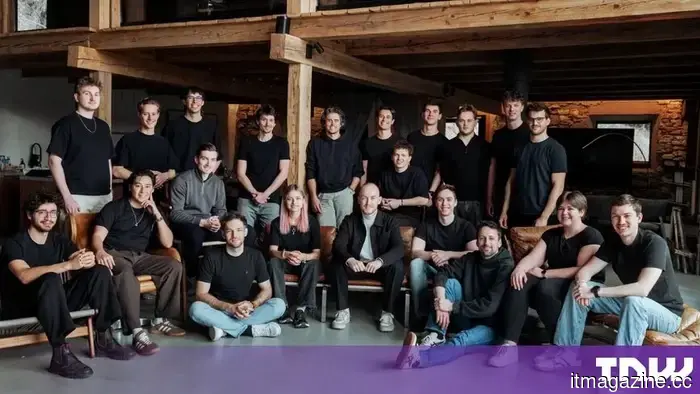
Exclusive: fonio.ai in Vienna reaches $10 million in annual recurring revenue within just a year of launching its subscription service.
A Vienna-based startup that most of the tech world may not know about has just released figures that are likely to catch attention. fonio.ai, a European platform specializing in AI-driven customer calls, claims to have exceeded $10 million in annual recurring revenue (ARR) within less than a year.
Since February, when the company transitioned from a prepaid system to a subscription model, it reports a revenue increase of over 30% each month, propelling it into the eight-figure revenue range from a standing start. fonio.ai offers automated conversations; its AI agents are capable of answering phone calls, managing WhatsApp, and will soon be able to handle email and chat as well, engaging in natural-sounding dialogues for businesses that deal with high volumes of customer interactions around the clock.
The company's scale is already noteworthy, as it serves over 7,000 customers and processes several million calls through its platform each month—enough to turn a clever demonstration into a practical operational tool. In June, fonio.ai completed a $17 million seed funding round led by Harry Stebbings’ 20VC at a valuation of $140 million, reportedly one of the largest seed investments Austria has ever seen, just months after a previous fundraising effort.
“We are creating a global market leader right from Vienna,” states co-founder and CEO Daniel Keinrath, who launched the company in late 2024 alongside Matthias Gruber.
The company's strategy focuses on controlling more of the stack than its competitors. fonio.ai develops its own hyper-realistic voice technology, which it claims ranks among the best available in multiple languages, rather than relying solely on widely accessible human-like voice tools.
Fonio.ai is also prioritizing personalization. Its agents are designed to learn from the interactions they manage, and the platform is capable of recognizing returning callers to greet them by name or recall their information—a feature they assert is compliant with GDPR and must be actively enabled.
Maintaining customer service lines is costly and notoriously difficult to sustain 24/7, making an agent that responds instantly in a caller’s preferred language at any hour a solution that addresses a significant cost area for companies.
The company is confident in its future; fonio.ai aims for an annual recurring revenue between €20 million and €30 million by the end of the year, which would more than double the current milestone it is celebrating.
Additionally, although it only made its first hire in June 2025, the company has already expanded to around 80 employees, with 17 new hires just last month, and currently has 52 positions open, aiming for a workforce of 130 to 150 by the end of the year across ten markets.
Fonio.ai has expanded through acquisitions as well, acquiring its Linz-based competitor fluently last September, signaling its intention to consolidate its home market rather than merely defend it.
However, the competition remains a significant consideration. Well-funded American rivals like HappyRobot, which recently raised $150 million, are pursuing the same enterprise customers, while model labs continuously integrate superior voice technology into their products.
Moreover, there are the usual caveats when it comes to self-reported milestones announced by the company. The ARR figures are unaudited, rapid monthly growth is easier to achieve from a smaller base, and the crucial details of gross margin, churn, and profitability remain unaddressed in the celebratory context.
Daniel Keinrath, co-founder and CEO of fonio.ai, discussed these matters with us, sharing insights.
Achieving $10 million in ARR within a year is impressive. Can you disclose the proportion of that from new customers versus growth within existing accounts, and what is your net revenue retention rate?
Daniel Keinrath: We prefer not to disclose the exact breakdown of our revenue, but we can say that our current net revenue retention is slightly below 100%. Our goal is to reach 110% by the end of the year.
Churn can be a significant hurdle for fast-growing AI companies. What are your logo and revenue churn rates, and how did the switch from prepaid to subscription affect them?
Daniel Keinrath: While we can't share specific churn rates, it helps that we don’t offer a free trial. Our system has a strict paywall, which means our customers have a strong commitment, resulting in a very solid churn rate for an AI startup.
Your agents "learn from the conversations they handle.” Can you explain what they are learning, how to prevent them from acquiring incorrect information, and how can customers monitor that?
Daniel Keinrath: Customers automatically receive a list of suggestions that could be added to the knowledge base. They can review these suggestions and either accept, decline, or improve them. In 95% of cases, our clients accept the proposed enhancements.
You mentioned building a global market leader from Vienna. Can a European voice-AI company truly succeed globally, or will the US market eventually shift your focus across the Atlantic
Other articles
 Apple might have discovered a solution to the OLED iMac’s most significant issue, but it is still several years away from being released.
LG Display's latest OLED strategy aims to address the burn-in issue that has prevented OLED from being included in the iMac for years, rather than merely enhancing brightness.
Apple might have discovered a solution to the OLED iMac’s most significant issue, but it is still several years away from being released.
LG Display's latest OLED strategy aims to address the burn-in issue that has prevented OLED from being included in the iMac for years, rather than merely enhancing brightness.
 Intel secures up to $20 billion to back its foundry investment in competition with TSMC.
Intel is offering $15 billion in stock, with the possibility of increasing this to $20 billion, to finance its foundry initiative, taking advantage of the fact that its shares have nearly tripled in value since 2026, making new equity relatively inexpensive.
Intel secures up to $20 billion to back its foundry investment in competition with TSMC.
Intel is offering $15 billion in stock, with the possibility of increasing this to $20 billion, to finance its foundry initiative, taking advantage of the fact that its shares have nearly tripled in value since 2026, making new equity relatively inexpensive.
 Six major financial institutions are supporting Nvidia's $500 billion initiative to finance the expansion of AI.
Nvidia has brought together six prominent figures from the finance sector to develop 'compute financing platforms' that have the potential to leverage more than $500 billion of external capital for AI development.
Six major financial institutions are supporting Nvidia's $500 billion initiative to finance the expansion of AI.
Nvidia has brought together six prominent figures from the finance sector to develop 'compute financing platforms' that have the potential to leverage more than $500 billion of external capital for AI development.
 Intel secures up to $20 billion to support its foundry initiative in competition with TSMC.
Intel is offering $15 billion in stock, with the possibility of increasing it to $20 billion, to finance its foundry investment. This move comes as the company's shares are expected to nearly triple by 2026, making new equity more affordable.
Intel secures up to $20 billion to support its foundry initiative in competition with TSMC.
Intel is offering $15 billion in stock, with the possibility of increasing it to $20 billion, to finance its foundry investment. This move comes as the company's shares are expected to nearly triple by 2026, making new equity more affordable.
 Intel secures up to $20 billion to support its foundry initiative in competition with TSMC.
Intel is offering $15 billion in stock, potentially increasing it to $20 billion, to support its foundry investment, taking advantage of a near-tripling of its share price by 2026, which makes new equity more affordable.
Intel secures up to $20 billion to support its foundry initiative in competition with TSMC.
Intel is offering $15 billion in stock, potentially increasing it to $20 billion, to support its foundry investment, taking advantage of a near-tripling of its share price by 2026, which makes new equity more affordable.
 Lovable's solution to the risks of enterprise AI is an insurance policy offered by Lloyd's.
Lovable is the inaugural coding agent platform to receive certification under AIUC-1, and this certification is backed by Lloyd's underwriting. Three launches, one goal: procurement.
Lovable's solution to the risks of enterprise AI is an insurance policy offered by Lloyd's.
Lovable is the inaugural coding agent platform to receive certification under AIUC-1, and this certification is backed by Lloyd's underwriting. Three launches, one goal: procurement.
Exclusive: fonio.ai in Vienna reaches $10 million in annual recurring revenue within just a year of launching its subscription service.
Fonio.ai, the Vienna-based voice-AI startup, reports that it has exceeded $10 million in annual recurring revenue within less than a year, experiencing over 30% monthly growth since transitioning to a subscription-only model.