
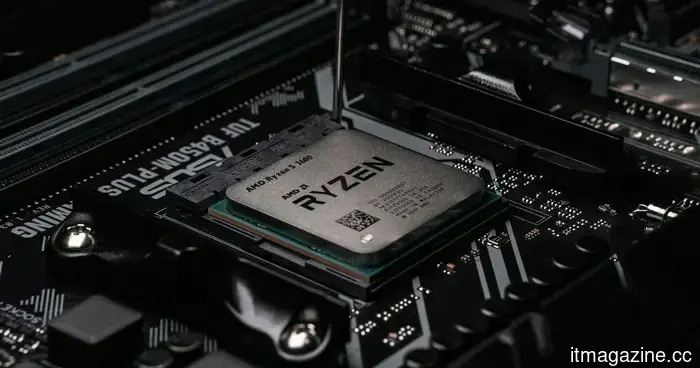
Researchers at MIT have discovered a new Spectre attack that is capable of bypassing the defenses of both Intel and AMD.
Since 2018, CPU security has been plagued by the Spectre vulnerability, and researchers from MIT have now identified a new method to exploit it. The TONTOU attack bypasses certain protections that Intel and AMD have implemented over the years by taking advantage of a small flaw in the way these defenses function. This research was conducted by Daniël Trujillo and Mengjia Yan at MIT’s Computer Science and Artificial Intelligence Laboratory (CSAIL). Their findings indicate that even after a processor has cleared or isolated information used by its branch predictor, there is a brief moment before that information is used. TONTOU, which stands for Time-of-Neutralization to Time-of-Use, specifically targets this vulnerability.
Understanding the small flaw exploited by TONTOU requires knowledge of the foundational mechanics behind Spectre attacks. Modern CPUs utilize speculative execution to anticipate the next actions of software and begin processing in advance. If a prediction is proven incorrect, the CPU discards the outcomes, but evidence of that speculative execution may remain in the CPU, potentially leaking data through side channels.
Following the emergence of Spectre, chip manufacturers implemented defenses to cleanse or isolate the branch predictor, which aids the CPU in predicting code execution paths. The objective is clear: eliminate anything an attacker may have inserted before sensitive operations occur. However, as pointed out by the MIT researchers, the cleanup and the application of the prediction mechanism cannot happen simultaneously, resulting in a small “post-neutralization window.” TONTOU capitalizes on this gap by injecting a precisely timed interrupt to re-poison the predictor.
The researchers evaluated TONTOU on Intel Cascade Lake Refresh and Arrow Lake processors, as well as AMD Zen 2 and Zen 4 models, successfully inducing the necessary branch mispredictions across both platforms. AMD’s Safe RET defense creates an exceptionally narrow window—just two instructions wide and typically lasting mere tens of nanoseconds. Nonetheless, the researchers managed to exploit it by manipulating the timing of the processor. Their method, known as interrupt injection, involves scheduling high-frequency timer interrupts to fit within that window, thereby permitting the attacker to corrupt structures like the return stack buffer (RSB) or branch history buffer (BHB).
Crucially, this isn’t merely a theoretical concern. On an AMD Zen 2 system with a stock Linux kernel, the researchers devised a complete end-to-end exploit that successfully compromised Linux’s kernel address space layout randomization (KASLR) in all ten attempts. They also accessed and leaked /etc/shadow, which houses root password hashes, in five of those instances. However, the attack is not particularly swift: MIT recorded a protected memory read rate of about five bytes per second, and The Register noted that each full exploit attempt took approximately 18 minutes under specific software conditions on Intel systems.
In summary, TONTOU is a complex attack that highlights a genuine weakness, yet it is not something that typical malware could easily deploy against an arbitrary PC.
On the bright side, this issue is not an unpatched zero-day threat poised to compromise your computer. Trujillo and Yan informed AMD and Intel in February, and Linux kernel maintainers in March. Subsequently, AMD released a kernel patch to mitigate the attack, emphasizing the importance of keeping Linux up to date. Intel, conversely, informed the researchers that they do not intend to implement further mitigations, citing the myriad factors influencing real-world exploitation, including the need for appropriate disclosure methods. Nevertheless, Intel did reward the researchers with a bug-bounty payment.
The broader implication is not that your Intel or AMD PC is at imminent risk, but rather that Spectre-like attacks continue to present a persistent challenge at the hardware level. TONTOU illustrates that even well-crafted defenses can leave small vulnerabilities for researchers to exploit. For most desktop users, this should not incite panic. However, for shared systems, cloud infrastructures, and multi-tenant environments where untrusted code operates alongside other workloads, this research serves as a stark reminder that the Spectre issue is not resolved.


Other articles
 Apple's changes to the Watch lineup mean there is no budget option this year.
Gurman reports that three models of the Apple Watch are currently in the final stages of testing, and none of them is an SE. Apple appears to be stepping away from the budget segment as Google launches a $99 tracker.
Apple's changes to the Watch lineup mean there is no budget option this year.
Gurman reports that three models of the Apple Watch are currently in the final stages of testing, and none of them is an SE. Apple appears to be stepping away from the budget segment as Google launches a $99 tracker.
 You cannot achieve AI sovereignty through regulation alone.
Europe might provide regulatory certainty for AI companies, but it still lacks the essential compute, chips, energy, and infrastructure necessary for achieving strategic autonomy.
You cannot achieve AI sovereignty through regulation alone.
Europe might provide regulatory certainty for AI companies, but it still lacks the essential compute, chips, energy, and infrastructure necessary for achieving strategic autonomy.
 Grok’s image tools receive a professional enhancement featuring templates, accurate editing, and a second-place ranking in Arena.
SpaceXAI launched Grok Imagine Image 2.0, which features magic wand editing, background removal, multi-reference inputs, and templates. It holds the second position behind OpenAI on Arena.
Grok’s image tools receive a professional enhancement featuring templates, accurate editing, and a second-place ranking in Arena.
SpaceXAI launched Grok Imagine Image 2.0, which features magic wand editing, background removal, multi-reference inputs, and templates. It holds the second position behind OpenAI on Arena.
 OpenAI has recently acquired a startup that specializes in slide decks. It is building an office suite through a series of acqui-hires.
OpenAI has purchased the presentation startup NextSlide after approximately a year of existence. The product it is replacing is PowerPoint, which is owned by its largest investor.
OpenAI has recently acquired a startup that specializes in slide decks. It is building an office suite through a series of acqui-hires.
OpenAI has purchased the presentation startup NextSlide after approximately a year of existence. The product it is replacing is PowerPoint, which is owned by its largest investor.
 Amazon's new data center in Texas has the potential to be the largest individual polluter in the United States. It will remain disconnected from the power grid.
Amazon is supporting a 7.65GW gas facility for a data center in Texas, which has been authorized to emit 33 million tons of CO2 annually. It will not be linked to the electrical grid, and that sums up the situation.
Amazon's new data center in Texas has the potential to be the largest individual polluter in the United States. It will remain disconnected from the power grid.
Amazon is supporting a 7.65GW gas facility for a data center in Texas, which has been authorized to emit 33 million tons of CO2 annually. It will not be linked to the electrical grid, and that sums up the situation.
 Apple Reminders was inadequate for project management until I discovered this feature.
I never imagined that Apple Reminders could manage real project tracking until I discovered the hidden Column view, which transforms it into a genuine Kanban board.
Apple Reminders was inadequate for project management until I discovered this feature.
I never imagined that Apple Reminders could manage real project tracking until I discovered the hidden Column view, which transforms it into a genuine Kanban board.
Researchers at MIT have discovered a new Spectre attack that is capable of bypassing the defenses of both Intel and AMD.
Researchers at MIT have unveiled TONTOU, a novel Spectre-type attack that can circumvent protections on the latest Intel and AMD processors by taking advantage of a minuscule timing gap.