
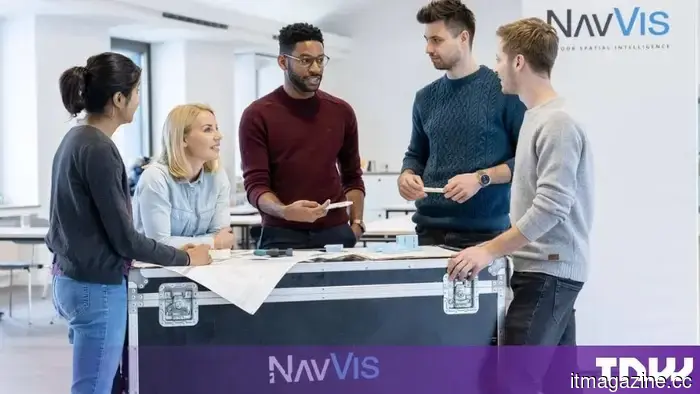
NavVis secured €73.7M to develop the spatial data layer essential for factories prior to implementing AI.
NavVis has secured €73.7 million ($85 million) in a Series D funding round led by The Jordan Company, a US private equity firm. Other contributors included existing investors Yttrium, KOZO KEIKAKU ENGINEERING, and Cipio Partners. Founded in 2013 as a spin-off from the Technical University of Munich, NavVis specializes in creating photorealistic digital replicas of industrial sites using advanced wearable laser scanning technology that operates ten times quicker than conventional surveying methods.
The scale of their operations is impressive, having scanned over one billion square meters of industrial space, with more than 150,000 users in engineering, maintenance, and construction fields relying on their data daily. Their impressive roster of clients includes industry giants such as BMW, Volkswagen, Toyota, Mercedes-Benz, ExxonMobil, BASF, Henkel, Bosch, and Siemens. NavVis also collaborates with Nvidia, SAP, and Autodesk while serving over 1,500 customers across more than 50 countries.
This new funding will support the development of next-generation capture hardware, enhance the AI capabilities, and create an open platform for what NavVis terms the "physical AI ecosystem." CTO Georg Schroth emphasized the challenge faced by industrial teams that have historically relied on unreliable drawings for planning. NavVis aims to replace these with continuously updated spatial records that act as a reliable system of truth for all teams, tools, and AI systems involved. Digital twins are seeing increased application from urban planning to industrial operations, and NavVis specializes in the latter, where data demands and stakes are highest.
The company is accelerating its growth in the US market, which it claims has been its fastest-growing region in recent years. CEO Felix Reinshagen described their goal as maintaining synchronization between physical and digital realities for valuable assets. Customers utilize NavVis data to minimize downtime on automotive assembly lines, expedite data center construction, shorten maintenance periods at refineries, plan robotics deployments, and train industrial AI models. The spatial data layer is becoming essential for industrial AI, positioning NavVis as a leading provider in this field.
Other articles
 Malicious AI capabilities transformed agents into large-scale credential theft perpetrators.
Zenity Labs discovered AI agent "skills" that were booby-trapped on Vercel's skills.sh, with one particular family having 1.7 million installs, which can transform agents into credential thieves.
Malicious AI capabilities transformed agents into large-scale credential theft perpetrators.
Zenity Labs discovered AI agent "skills" that were booby-trapped on Vercel's skills.sh, with one particular family having 1.7 million installs, which can transform agents into credential thieves.
 Malicious AI 'capabilities' transformed agents into credential theft operatives, on a large scale.
Zenity Labs discovered AI agent "skills" that were booby-trapped on Vercel's skills.sh, with one skill having 1.7 million installs, which convert agents into credential stealers.
Malicious AI 'capabilities' transformed agents into credential theft operatives, on a large scale.
Zenity Labs discovered AI agent "skills" that were booby-trapped on Vercel's skills.sh, with one skill having 1.7 million installs, which convert agents into credential stealers.
 OpenAI is delaying its upcoming model due to significant cybersecurity concerns.
OpenAI states that it "cannot eliminate the possibility" of essential cyber capabilities in its forthcoming Astra model, leading them to halt development and decelerate the model's progress because of this.
OpenAI is delaying its upcoming model due to significant cybersecurity concerns.
OpenAI states that it "cannot eliminate the possibility" of essential cyber capabilities in its forthcoming Astra model, leading them to halt development and decelerate the model's progress because of this.
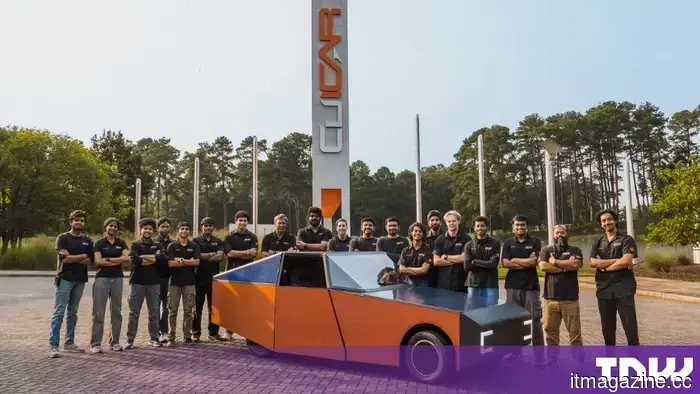 BMW tasked students with creating an electric vehicle that generates more energy than it consumes. They equipped it with 1,700 solar panels, and it is functioning successfully.
Students at Clemson created the Luminetta, a solar electric vehicle weighing 1,212 pounds, equipped with 1,700 photovoltaic cells that produce a daily range of 31 miles solely from sunlight. The project received support from BMW.
BMW tasked students with creating an electric vehicle that generates more energy than it consumes. They equipped it with 1,700 solar panels, and it is functioning successfully.
Students at Clemson created the Luminetta, a solar electric vehicle weighing 1,212 pounds, equipped with 1,700 photovoltaic cells that produce a daily range of 31 miles solely from sunlight. The project received support from BMW.
 Harvey is raising $15.5 billion, an increase of 40% over the past five months.
Legal AI startup Harvey is negotiating to secure $500 million at a valuation of $15.5 billion, marking a 40% increase in just five months, based on $350 million in annualized revenue.
Harvey is raising $15.5 billion, an increase of 40% over the past five months.
Legal AI startup Harvey is negotiating to secure $500 million at a valuation of $15.5 billion, marking a 40% increase in just five months, based on $350 million in annualized revenue.
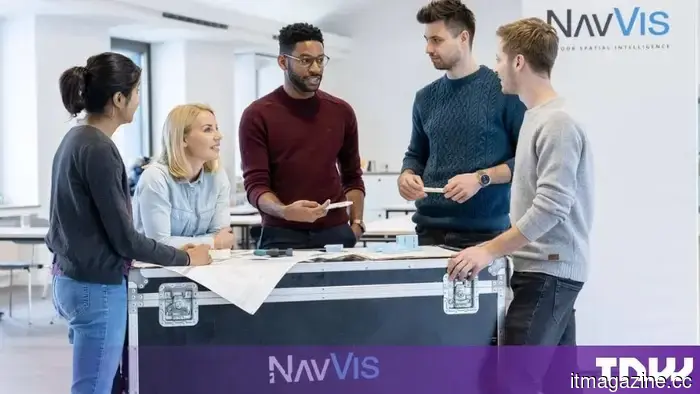 NavVis secured €73.7 million to develop the spatial data infrastructure that factories require prior to implementing AI.
NavVis, based in Munich, secured €73.7 million in Series D funding to expand its spatial twin platform. The company has scanned over 1 billion square meters of industrial space, with customers including BMW, VW, Toyota, Siemens, and BASF.
NavVis secured €73.7 million to develop the spatial data infrastructure that factories require prior to implementing AI.
NavVis, based in Munich, secured €73.7 million in Series D funding to expand its spatial twin platform. The company has scanned over 1 billion square meters of industrial space, with customers including BMW, VW, Toyota, Siemens, and BASF.
NavVis secured €73.7M to develop the spatial data layer essential for factories prior to implementing AI.
NavVis, located in Munich, secured €73.7M in a Series D funding round to expand its spatial twin platform. The company has scanned over 1 billion square meters of industrial space, with customers including BMW, VW, Toyota, Siemens, and BASF.